
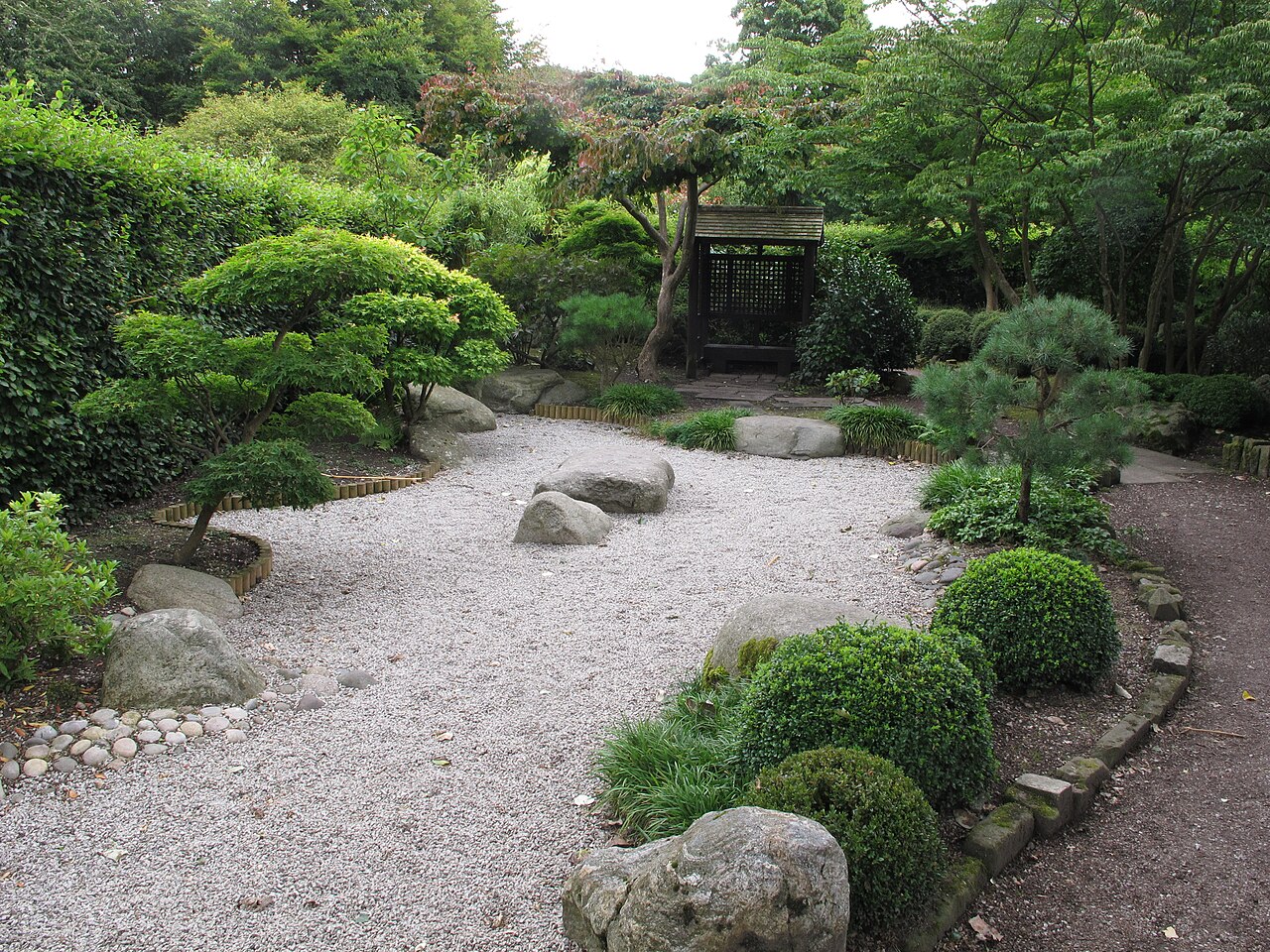
Walkden Gardens
Photo: David Hawgood / CC BY-SA 2.0, modified.
Overview
The Japanese Garden at Walkden Gardens is a walk-through landscape garden in Sale, Greater Manchester. Officially opened in 2006, it was designed and constructed by members of the North West Region of the Japanese Garden Society. The garden is organised as a sequence of three enclosed spaces: an intimate entrance garden, a woodland garden influenced by tea-garden design, and a larger karesansui composition. Its winding path and succession of changing views make it primarily a strolling garden, despite the inclusion of several other Japanese garden traditions.
History
Walkden Gardens occupies land formerly used as Moorside Nurseries, which was left to the local authority by nurseryman Harry Walkden for public benefit. The wider park was subsequently developed as a series of enclosed garden rooms separated by tall hedges, creating a suitable setting for an independent Japanese garden.
The Japanese garden project was undertaken by members of the Japanese Garden Society’s North West Region. Construction began in early 2004 and continued for more than two years, supported financially by Greening Greater Manchester. Reclaimed stone already present within Walkden Gardens was incorporated into walls and path edges.
The completed garden was formally opened on 20 October 2006 by the Japanese ambassador to the United Kingdom, Yoshiji Nogami. Further modifications were made in 2009, and Japanese Garden Society volunteers have continued to maintain and develop the garden through regular working sessions.
Design features
The garden is designed as a strolling garden, with a deliberately winding path that reveals different scenes as visitors move through it. Bamboo screens, archways and gateways divide the composition into three sections, creating the impression of passing between separate garden rooms. The reverse journey offers different framed views, a basic feature of sequential Japanese garden design.
The first section is an intimate entrance landscape centred on a group of three large rocks. These are interpreted as Buddhist deities welcoming visitors into the garden. The sharply turning path conceals the remainder of the composition and encourages gradual discovery.
Beyond a bamboo-roofed gateway, the second section forms a shaded woodland garden loosely influenced by the naturalistic character of a tea garden. Trees and restrained underplanting create a secluded glade, while a gravel hollow beneath Japanese maples may be read as either mist or temporary water. A side path leads towards clipped shrubs arranged as descending hills beneath three symbolic mountain rocks.
The third and most open section is a karesansui dry landscape. Gravel represents a lake containing rock islands, including stones suggesting the form of a turtle, a traditional symbol of longevity. A dry stream of slate passes beneath a bridge, while a second symbolic river descends from a mound representing distant mountains. Clipped shrubs evoke clouds around the peaks, and trained pines suggest a rugged mountainside.
A covered seat modelled on a tea-garden waiting shelter provides a fixed view across the gravel lake towards the symbolic mountain landscape. The combination of woodland, dry landscape and tea-garden references enriches the route, but these remain subsidiary elements within the garden’s overall strolling structure.
Garden elements
Buildings
Enclosures
Stones
Current status
The garden remains maintained within Walkden Gardens, which is owned and managed by Trafford Council. Members of the Japanese Garden Society’s regional group continue to undertake regular maintenance, including pruning, gravel raking, stonework and timber repairs. The wider public park remains freely accessible.