
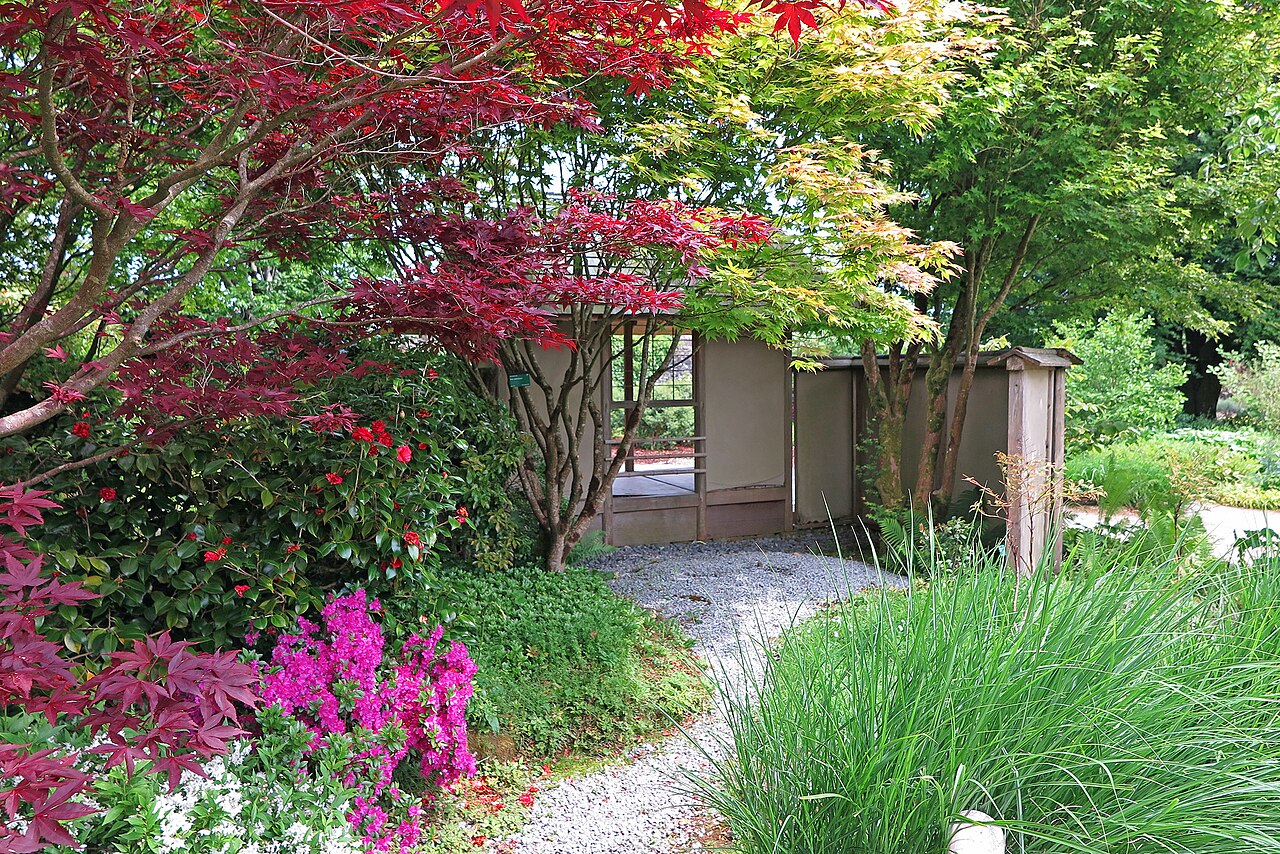
Sui Ou Tei
Photo: Dylan Moore / CC BY-SA 2.0, modified.
Overview
Sui Ou Tei is a Japanese garden at the National Botanic Garden of Wales in Llanarthne, Carmarthenshire. Originally created for the 2001 RHS Chelsea Flower Show, it combines three traditional forms: a pond-and-hill garden, a dry landscape garden and a tea garden. After winning both a Gold Medal and Best in Show, the garden was dismantled, transported to Wales and reconstructed at the newly established botanic garden.
History
The garden was designed by Professor Masao Fukuhara of Osaka University of Arts for the 2001 RHS Chelsea Flower Show. It was jointly supported as part of the Japan 2001 festival by the Japanese government and The Daily Telegraph. At Chelsea, the garden received a Gold Medal and the show’s Best in Show award.
Following the exhibition, Japanese ambassador Sadayuki Hayashi proposed that the garden should be given a permanent home at the recently opened National Botanic Garden of Wales. The composition was dismantled and transferred piece by piece to Llanarthne, where Masao Fukuhara and a team of Japanese gardeners rebuilt it during the winter of 2001–2002.
By 2017, the garden required substantial repair and horticultural renovation. A restoration programme was led by the Japanese Garden Society, with partial funding from the Japanese government. The work included structural repairs, specialist pruning and replanting, and was completed by the spring of 2019.
Design features
The garden combines a pond-and-hill composition, a karesansui dry garden and a tea-garden area within a compact, carefully scaled landscape. Water, gravel, rocks, paths and clipped planting are arranged to evoke mountains, forests, streams, lakes and islands in miniature.
The pond-and-hill section uses water and modelled terrain to suggest a natural lake landscape. The dry garden employs gravel and stones as abstract representations of water and landforms, while the tea-garden section creates a more secluded approach to a small rustic pavilion or iori. Cherry trees, conifers, shrubs and moss-like ground planting provide seasonal change and reinforce the contrast between the different garden zones.
The name Sui Ou Tei refers symbolically to the national flowers of Japan and Wales: the cherry blossom and the daffodil. The garden was conceived as a cultural link between the two countries and as a compressed representation of traditional Japanese landscape design.
Garden elements
Bridges
Buildings
Enclosures
Stones
Current status
The garden remains maintained as a permanent feature of the National Botanic Garden of Wales. Following the restoration completed in 2019, it continues to be presented as one of the institution’s principal cultural gardens and is accessible as part of a general visit.