
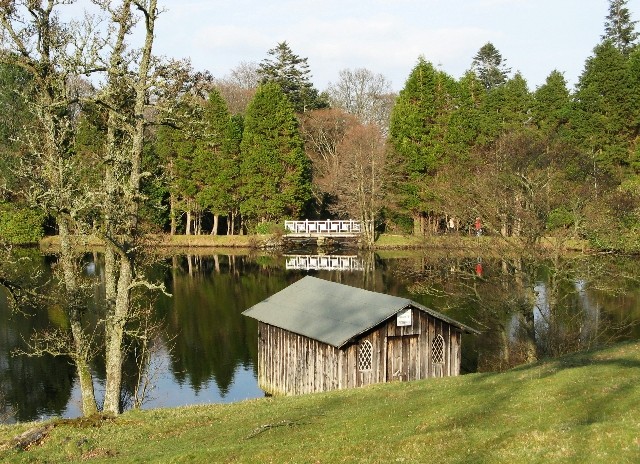
Stobo Japanese Water Garden
Photo: Eileen Henderson / CC BY-SA 2.0, modified.
Overview
Stobo Japanese Water Garden is an early twentieth-century Japanese-style water garden near Stobo Castle in the Scottish Borders. Created by Hylton Philipson, with landscape designer Edward White also credited by Historic Environment Scotland, it is one of Scotland’s notable Edwardian examples of Japanese-influenced garden design. The garden is organised around the constant presence of water, with a waterfall, cascades, ponds, stepping stones and bridges set among mature woodland planting.
History
The garden was developed in the early 1900s, with Historic Environment Scotland giving the main phase of the water garden as 1907–1913. Japanese Garden Society notes its construction around 1910, following Philipson’s earlier visit to Japan. The garden formed part of the wider designed landscape of Stobo Castle, but is now described as part of Stobo Home Farm / Stobo Farm rather than simply the castle spa grounds.
Design features
The garden follows the line of water from a dramatic waterfall through a sequence of ponds and streams, crossed by stepping stones and small bridges. Japanese-style elements include cherry trees, maples, stone lanterns, a tea-house-like structure and a humpback bridge. The planting includes azaleas, rhododendrons, katsura and other Japanese or Japanese-associated species, giving strong seasonal effects in spring and autumn.