
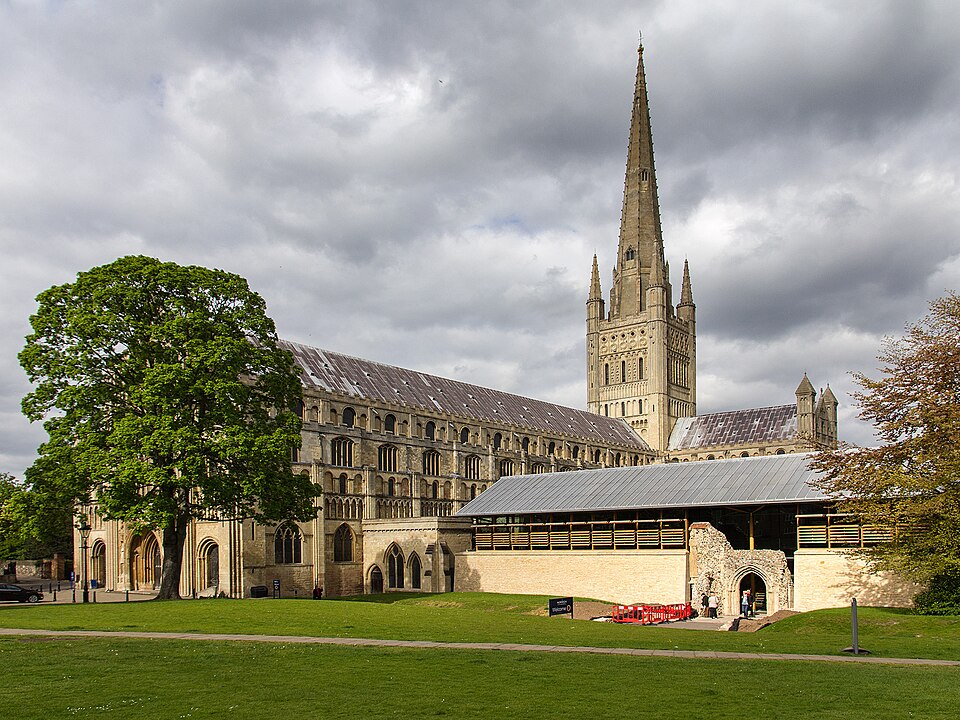
Norwich Cathedral
Photo: David P Howard / CC BY-SA 2.0. modified.
Overview
The Sainsbury Japanese Garden, also known by the proposed name Garden of Calm Virtue, is a compact karesansui garden within the Hostry visitor centre at Norwich Cathedral. Constructed in 2010, it occupies a narrow enclosed space between the modern Hostry and the medieval cathedral wall. The garden consists entirely of rocks, gravel, polished pebbles and stepping stones, without planting, and is intended to provide visitors with a moment of contemplation as they enter the cathedral.
History
The idea for the garden came from Canon Jeremy Haselock, who had visited Japan repeatedly and recognised parallels between Benedictine monastic life and Buddhist temple practice. He requested a dry Japanese garden for a previously unused space beside the entrance route through the new Hostry. The cathedral approached the Sainsbury Institute for the Study of Japanese Arts and Cultures, which then involved the Japanese Garden Society.
The garden was designed by Graham Hardman, then national chairman of the Japanese Garden Society, and Robert Ketchell, a former chairman of the Society. Two alternative schemes were prepared before a final design was selected. The project was funded through donations raised by the Sainsbury Institute, while Japanese Garden Society members contributed their design and construction work.
Construction took place in March 2010. The confined site and the presence of a large underground wastewater pipe forced the designers to modify the original rock arrangement. Access was also unusually difficult, requiring the stones and approximately 2.5 tonnes of gravel to be moved through a narrow doorway into the enclosed courtyard. The Hostry and garden were officially opened by Queen Elizabeth II and the Duke of Edinburgh on 4 May 2010.
Design features
The garden occupies a space measuring approximately 3 × 8 metres. It is viewed through glass from the Hostry exhibition area and entrance corridor and is not intended to be entered by visitors. The absence of plants was a deliberate requirement, giving the composition the austere character of a pure dry landscape garden.
Its main focal point is a triadic stone arrangement. This may be interpreted either as a Buddhist triad or, in the setting of an Anglican cathedral, as the Christian Trinity. The remaining stones appear to point or move towards this central group, drawing the viewer’s attention into the composition.
The pale gravel represents water or the sea, while the rocks may be read as mountains or islands. Dark polished pebbles and black quartzite stepping stones introduce contrasting textures. The garden is edged with grey Carboniferous sandstone, whose black mica markings relate visually to the ancient stone wall of the cathedral behind it.
The composition was conceived as a space of physical, temporal and spiritual transition between the modern Hostry and the medieval cathedral. Its combination of Buddhist and Christian symbolism reflects the project’s broader purpose of creating dialogue between different religious and cultural traditions.
Garden elements
Stones
Current status
The garden remains installed within the Hostry at Norwich Cathedral and is visible to visitors entering through the welcome and exhibition area. The composition itself remains inaccessible behind glass, which protects the stones and raked gravel from visitor traffic.