
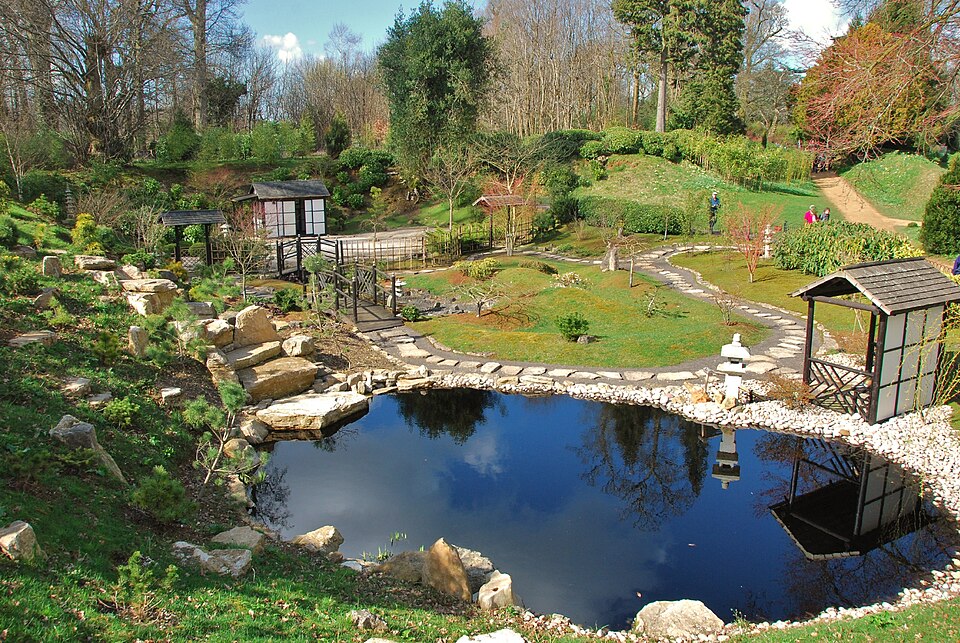
Kingston Lacy
Photo: Chris Downer / CC BY-SA 2.0. modified.
Overview
The Japanese Garden at Kingston Lacy is a seven-acre Edwardian landscape garden within the historic Kingston Lacy estate near Wimborne Minster in Dorset. Created from around 1910 by Henrietta Bankes, it developed along the existing Lady Walk as an English interpretation of Japanese garden traditions. The garden combines woodland paths, bamboo, Japanese maples, flowering cherries, granite lanterns, water features and a more formally composed tea-garden area.
History
Henrietta Bankes became interested in Japanese garden design after visiting the Japan–British Exhibition at White City, London, in 1910. She subsequently began developing an extensive Japanese garden within the woodland and shrubbery south-east of Kingston Lacy house. Plants and ornamental features were acquired for the project, including some material sourced directly from Japan.
The Japanese landscape was laid out around Lady Walk, an existing route approximately 270 metres long connecting the pleasure grounds near Cedar Walk with the area north of the kitchen garden. Published documentation does not identify a professional Japanese designer or individual landscape architect, and the garden is therefore principally attributed to Henrietta Bankes as its creator and patron.
During the later twentieth century, the garden became heavily overgrown and many of its original relationships were obscured. The National Trust began archaeological and documentary research to recover its historic layout, using surviving planting records, physical evidence and recollections from former estate gardeners. The restored and partly reinterpreted garden reopened in 2005.
Design features
The garden is structured around a long walking route through a wooded landscape, allowing visitors to encounter bamboo groves, maples, flowering cherries, stone lanterns and water features gradually. Its scale and sequential experience make it principally a strolling garden, although it also contains a distinct tea-garden composition.
The planting emphasises Japanese maples, cherries and bamboo, integrated with the established trees and woodland character of the estate. Wildflowers and shade-tolerant planting soften the ground beneath the trees, producing a garden that changes markedly between spring blossom, summer foliage and autumn colour.
A more enclosed Japanese tea garden contains granite lanterns, stepping routes, a rockery and a reflective pool. The area is intended to offer a quieter and more contemplative experience than the broader woodland walk. Although presented using Japanese forms and plants, the overall garden remains an Edwardian British interpretation rather than a historically exact Japanese composition.
In 2021, more than one hundred flowering cherry trees were planted at Kingston Lacy as part of the Sakura Cherry Tree Project, reinforcing the garden’s seasonal display and its association with relations between Japan and the United Kingdom.
Garden elements
Bridges
Buildings
Enclosures
Waters and islands
Stones
Other elements
Current status
The Japanese Garden remains maintained by the National Trust as a major part of the Kingston Lacy visitor landscape. It is accessible with normal estate admission, and guided Japanese Garden and tea-garden tours are offered on selected dates.