
Kew Gardens
Photo: Phillip Perry / CC BY-SA 2.0, modified.
Overview
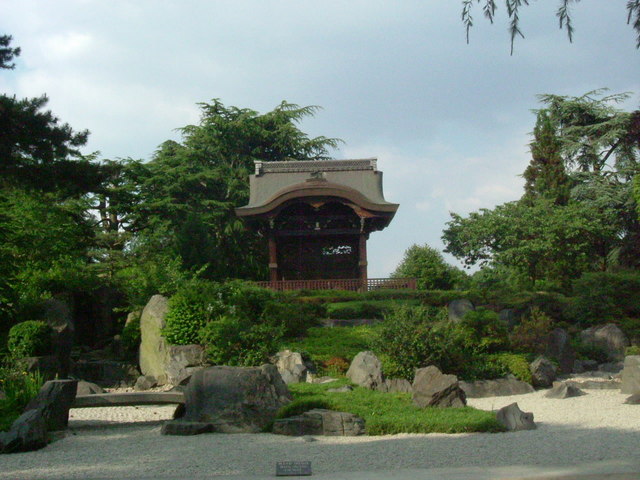
The Japanese Landscape at Kew is a Japanese garden composition surrounding the Chokushi-Mon, or Gateway of the Imperial Messenger. The gateway was created for the Japan-British Exhibition of 1910 and later moved to Kew; the present surrounding Japanese gardens opened in 1996 and were designed by Professor Masao Fukuhara of Osaka University. Kew describes the landscape as a tranquil Japanese garden designed to complement the Chokushi-Mon.
History
The oldest element of the site is the Chokushi-Mon, built for the 1910 Japan-British Exhibition at White City in London. It is a near replica, at reduced scale, of the Karamon Gate of Nishi Hongan-ji in Kyoto and was moved to Kew after the exhibition. Historic England separately lists the gateway as a replica of a famous Japanese gateway made for the 1910 exhibition and presented to Kew.
The current Japanese Landscape was laid out much later, after restoration of the gateway, and opened in 1996. Kew states that the Japanese gardens were designed by Professor Masao Fukuhara of Osaka University. Secondary garden sources explain that Fukuhara adapted garden styles from the Momoyama period, matching the architectural period evoked by the gateway.
The landscape was later incorporated into Kew’s wider interpretation of Japanese culture and plant collections. Kew identifies three distinct areas around the gateway: the Garden of Activity, the Garden of Harmony and the Garden of Peace, each representing different aspects of Japanese geography and philosophy. Nodaigarden also records Kew’s Japanese zone landscape and describes the Garden of Harmony as a calming garden area on the sloping north-east side of the gate.
Design features
The Japanese Landscape is arranged around the Chokushi-Mon and divided into three symbolic areas: Garden of Activity, Garden of Harmony and Garden of Peace. The composition uses gravel, stone, planting, shaped landform, paths and carefully framed views to complement the ornate gateway rather than to function as a single pond-strolling or tea garden. Its design is therefore best treated as a modern Japanese landscape garden built around a historic exhibition gateway.
Garden elements
Bridges
Buildings
Enclosures
Waters and islands
Stones
Other elements
Current status
Extant Japanese landscape garden within Kew Gardens, centred on the historic Chokushi-Mon / Japanese Gateway. It remains accessible with normal Kew Gardens admission.