
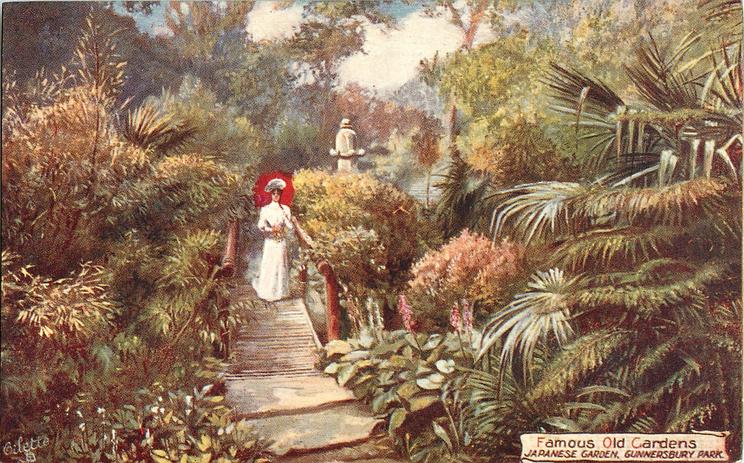
Gunnersbury Park
Historical postcard: Raphael Tuck & Sons / TuckDB Postcards, modified.
Overview
The Japanese Garden in Gunnersbury Park was an early twentieth-century Japanese-style water garden created in 1901 for Leopold de Rothschild. It formed part of the wider Rothschild landscape at Gunnersbury and was designed to complement an existing bamboo garden. The Rothschild Archive says the garden caused a sensation when planted in 1901 and included a bamboo avenue, bamboo bridge and tea house.
History
Gunnersbury Park was reunited as one estate by the Rothschild family in 1889. The Japanese Garden was laid out in 1901 by James Hudson for Leopold de Rothschild, partly to house Rothschild’s interest in waterlilies. After Leopold’s death in 1917, the estate was broken up, and in 1925 local authorities acquired the grounds to create a public park.
Design features
The garden was a Japanese-style water garden with pools, connecting channels, a teahouse, lanterns and a bamboo bridge. London Gardens Trust notes that it was probably inspired by a Japanese-style garden at Bellagio on Lake Como, so it should be treated as Japanese-style / Japonisme, not as a strictly Japanese-authentic garden. Historic England also lists the nearby Gothic Ruins on Borders of Former Japanese Gardens as Grade II, confirming the former Japanese garden area as a recognised historic feature within Gunnersbury Park.
Garden elements
Bridges
Waters and islands
Other elements
Current status
Former / partially surviving historic Japanese-style garden area within a public park