
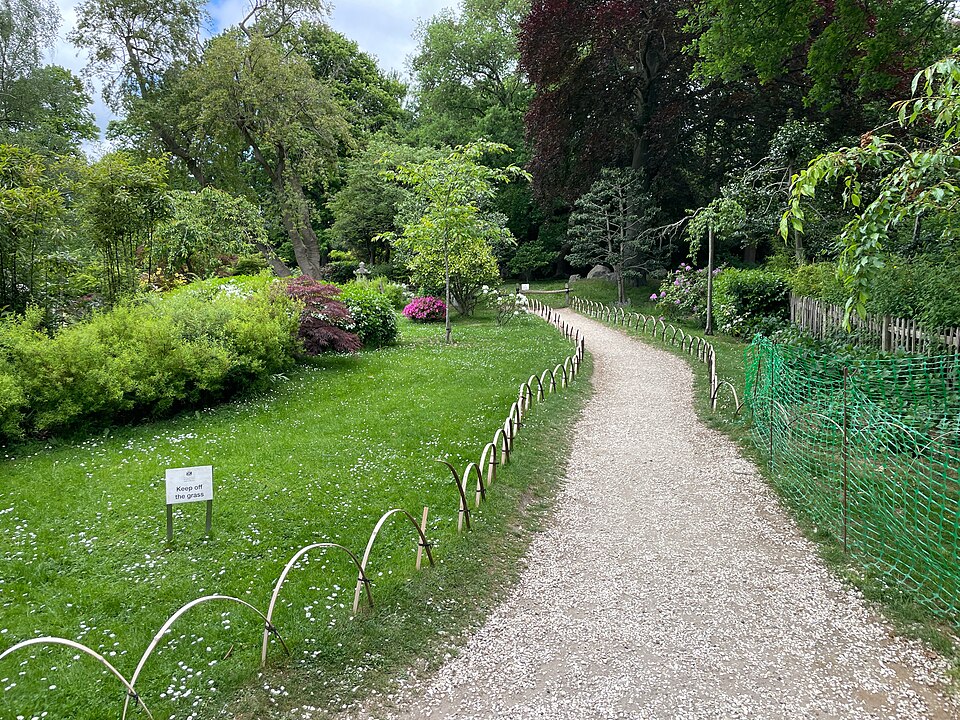
Fukushima Memorial Garden
Photo: Mr Ignavy / CC BY-SA 2.0. modified.
Overview
The Fukushima Memorial Garden is a compact Japanese commemorative garden adjoining the older Kyoto Garden in Holland Park, London. Opened in 2012, it was created as an expression of gratitude for the support given by the British people after the Great East Japan Earthquake, tsunami and Fukushima nuclear disaster of 11 March 2011. Designed by Kyoto landscape gardener Yasuo Kitayama, the garden uses a gently curving path, lawns, shrubs, bamboo edging and symbolic stone arrangements to create a quiet landscape for remembrance and reflection.
History
The garden was developed following the disasters that struck north-eastern Japan in March 2011. It was presented as a gift from Japan, with particular support from Motomiya City in Fukushima Prefecture, to acknowledge the assistance and solidarity shown by the United Kingdom during the recovery period.
The design was prepared by Yasuo Kitayama, a Kyoto-based landscape gardener who was also involved with the maintenance and development of the Japanese gardens in Holland Park. The completed garden was formally opened on 24 July 2012 at a ceremony attended by representatives of the Japanese Embassy, the Royal Borough of Kensington and Chelsea and the Japanese community in Britain.
The garden later became the focus of continuing relations between the borough and Motomiya. In 2017, a sister-garden agreement linked the Fukushima Garden with an English garden in Prince William’s Park, Motomiya, and in 2024 the two municipalities signed a broader friendship declaration.
Design features
The garden is arranged as a small walk-through landscape connected physically and visually with the neighbouring Kyoto Garden. A curving gravel path passes through lawns and low planting, allowing visitors to encounter the composition gradually rather than from a single fixed viewpoint.
The planting includes rhododendrons, hydrangeas, weeping trees and restrained evergreen shrubs. Low bamboo hoops and edging define parts of the path, while benches provide places for rest and contemplation. The design is deliberately simpler and more open than the waterfall-and-pond composition of the Kyoto Garden.
A prominent group of three upright stones has been interpreted as a reference to Jizō, the Buddhist protector associated particularly with children and travellers. The rising stones also suggest endurance, renewal and the continuation of life after disaster.
Although visitors can walk through the garden, its short route and commemorative focus distinguish it from a full-scale historical pond-strolling garden. Within the available controlled categories, however, Strolling garden is the closest fit because the composition is experienced sequentially along a path.
Garden elements
Enclosures
Stones
Other elements
Current status
The garden remains maintained as one of the two Japanese gardens within Holland Park. It is freely accessible during the park’s opening hours and continues to serve as a setting for Japanese–British commemorative and friendship events.