
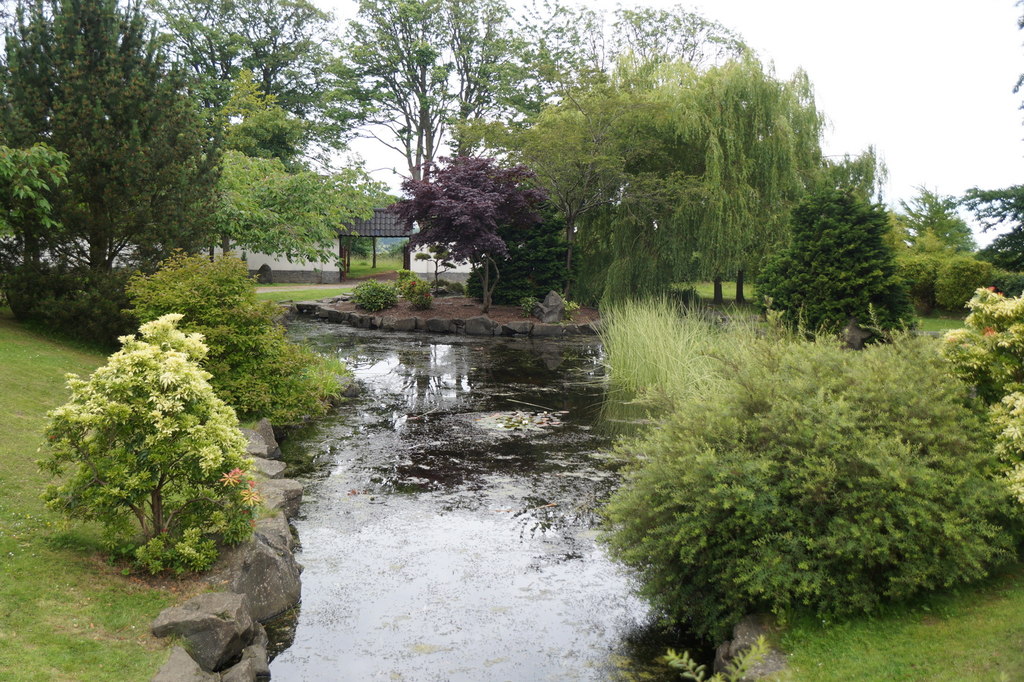
Edinburgh-Kyoto Friendship Garden
Photo: Mike Pennington / CC BY-SA 2.0, modified.
Overview
The Edinburgh–Kyoto Friendship Garden, formally titled Castle Garden to Water and Beyond, is a one-hectare Japanese garden within the grounds of Lauriston Castle in Edinburgh. Designed by Japanese landscape designer Takashi Sawano, it combines a hill-and-pond landscape, waterfalls, a dry gravel garden and a circulating path within a composition that opens towards extensive views across the Firth of Forth. The garden commemorates the friendship agreement between Edinburgh and Kyoto Prefecture.
History
Edinburgh and Kyoto Prefecture formalised their friendship agreement in 1994. The garden was subsequently developed as a millennium project intended to strengthen cultural links between the two regions and formed part of the wider programme associated with Japan 2001.
The garden was designed by Takashi Sawano, a Japanese garden and floral designer based in London. It was constructed in the north-western part of the Lauriston Castle estate and formally opened in August 2002. The project received support from both the City of Edinburgh Council and Kyoto Prefecture.
In 2003, the completed garden received recognition from the British Association of Landscape Industries. It has since become a setting for Japanese cultural events, including annual cherry-blossom celebrations organised in cooperation with Japanese cultural representatives in Scotland.
Design features
The garden occupies sloping ground descending from south to north. A summerhouse positioned above a flight of stone steps establishes the principal visual axis, directing views through the garden towards Cramond Island and Inchcolm Island in the Firth of Forth. The wider coastal landscape is therefore treated as an extension of the garden composition.
Water descends from a higher “male” waterfall, passes beneath a footbridge and continues over a lower “female” waterfall into a pond. An island within the pond can be reached by large stepping stones. The water landscape is accompanied by a karesansui gravel garden, stone groupings and a path that allows visitors to experience the garden from a succession of viewpoints.
Reused local materials connect the Japanese design with Edinburgh’s history. Stone gathered from different parts of the city was incorporated into the garden, while a path of reclaimed Edinburgh cobblestones leads from a central stone pillar, formerly associated with the Free Church headquarters, towards the main entrance.
The planting includes Japanese maples, cherry trees, bamboo, rhododendrons and clipped evergreens. Curving fences, bamboo structures, bridges, waterfalls and stone features create transitions between enclosed garden scenes and the open maritime views beyond the estate.
Garden elements
Bridges
Buildings
Enclosures
Waters and islands
Stones
Current status
The garden remains maintained as part of Lauriston Castle Gardens and continues to host Japanese cultural and cherry-blossom events. The castle grounds, including the Japanese garden, are open to visitors throughout the year without an admission charge.