
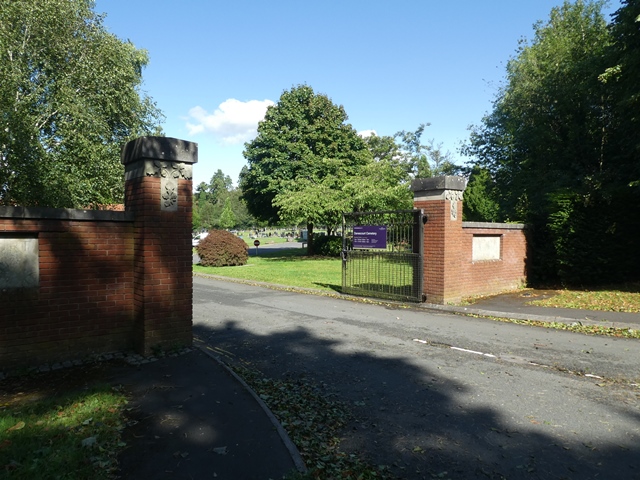
Danescourt Cemetery
Photo: ElfExplorer / CC BY-SA 2.0, modified.
Overview
The Danescourt Cemetery Japanese Garden is situated behind the cemetery’s administration building in Tettenhall, Wolverhampton. Created as part of a major cemetery extension, it was intended to provide bereaved visitors with a peaceful setting for remembrance and reflection.
The composition combines a dry landscape garden with a more densely planted section inspired by Japanese temple and tea gardens. Its arrangement of stone, gravel, clipped vegetation and symbolic watercourses was conceived by Peter Bridge as a unified work of contemplative art based on his interpretation of Zen principles.
History
During the mid-1990s, Wolverhampton City Council modernised and extended Danescourt Cemetery by approximately fifteen acres. The development included new entrance gates and an administration building. In accordance with a council policy of incorporating public art into civil-engineering projects, a garden was commissioned behind the new building as a place of quiet remembrance for bereaved families.
Local garden designer Peter Bridge was contracted to design the garden, source its materials and supervise construction. Bridge had studied Japanese gardens and Zen meditation extensively, although he had never visited Japan. He regarded his gardens as artworks and described the Danescourt design as a meditative composition structured through what he called “Zen geometry.” The garden opened in August 1996.
Following Bridge’s departure from the project, the garden was maintained by council staff. Limited resources and the absence of specialist Japanese-gardening expertise gradually allowed the planting to become overgrown and obscured much of the original stonework.
In 2009, members of the Midland Region of the Japanese Garden Society recognised the garden’s restoration potential. Working with the cemetery management and Wolverhampton City Council, volunteers cleared excessive vegetation, revealed the original rock arrangements and began reshaping the trees and shrubs. Later work reinstated symbolic streams, waterfalls, shorelines and distinctions between areas representing land and water.
The restored garden received a Heart of England in Bloom landscape award in 2011 and subsequently gained recognition through the Royal Horticultural Society’s community gardening programme.
Design features
The garden is divided into two contrasting but connected compositions viewed primarily from a raised terrace behind the administration building.
The left-hand section is essentially a karesansui, or dry landscape garden. Large stones represent islands and mountains, while granite gravel symbolises water. Smaller stone and gravel formations create symbolic streams, waterfalls and shorelines. The arrangement was intended to stimulate contemplation rather than function as a garden through which visitors circulate.
The greener right-hand section was conceived as a visual counterbalance to the austerity of the dry garden. Its composition was partly inspired by the garden of Manshu-in, a Buddhist temple in Kyoto. It incorporates carefully shaped evergreen trees and shrubs, stepping stones, lanterns and a water basin associated with tea-garden imagery.
Other notable elements include:
- approximately sixty tons of stone and forty tons of granite chippings;
- rock groups individually selected or positioned under Bridge’s supervision;
- clipped and cloud-pruned shrubs;
- Japanese cedar planted around the perimeter to screen the surrounding cemetery;
- an enclosing wall designed to evoke a traditional Japanese earthen wall;
- circular openings or “moon windows” in the boundary wall;
- a terrace incorporating a paved area and a pattern representing tatami mats;
- symbolic seas, streams, waterfalls and beaches formed without permanent open water.
Garden elements
Bridges
Enclosures
Waters and islands
Stones
Other elements
Current status
The garden remains an actively maintained contemplative space within Danescourt Cemetery. Since its restoration in 2009, its care has largely been undertaken by volunteers from the Midland Region of the Japanese Garden Society in cooperation with Wolverhampton City Council.