
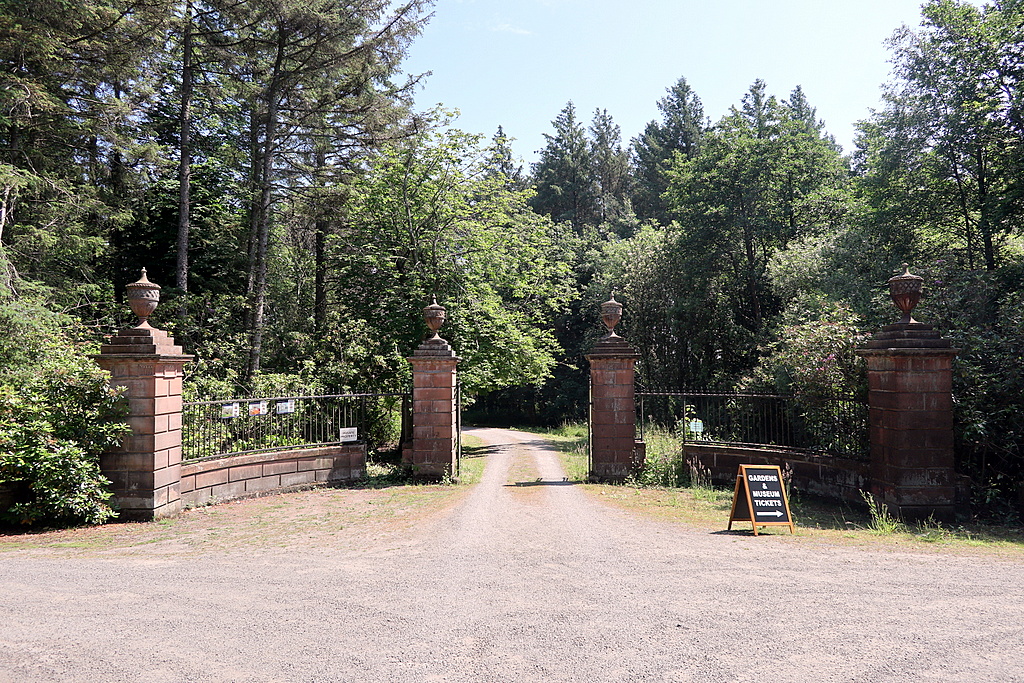
Arbigland Gardens
Photo: Andrew Curtis / CC BY-SA 2.0, modified.
Overview
Arbigland Gardens are the restored gardens of Arbigland House, an eighteenth-century estate near Kirkbean on the Solway coast. The garden is promoted today as “The Nearly Lost Gardens of Arbigland” and includes several garden rooms and landscape features, among them a Japanese garden. Scotland’s Gardens describes the woodland as containing a stream-fed lake and a Japanese garden, together with formal garden areas. Arbigland should be understood as a restored woodland estate garden with a Japanese-inspired section, rather than a historic Japanese garden of the early twentieth-century Japonisme type.
History
Arbigland House was built in the 1750s for William Craik. The wider designed landscape is listed by Historic Environment Scotland, which records ornamental garden development including a sunken rose garden laid out around 1920 and later terraces associated with the House on the Shore after 1936. The available official and inventory sources do not securely date the Japanese garden itself, so it should not be assigned an early twentieth-century date without stronger evidence.
Design features
The Japanese garden is described as one of several garden rooms within the wider Arbigland landscape. Secondary visitor descriptions place it above the lake and mention acers, azaleas and cherries. The broader garden includes woodland, a lake, beach access, terraces, formal areas, unusual trees and shrubs, and views over the Solway Firth.
Garden elements
Waters and islands
Current status
Extant and actively restored historic house garden within the grounds of Arbigland House. The garden covers about 24 acres and includes woodland walks, a stream-fed lake, formal gardens, a sunken rose garden, a sundial garden, a Well Head garden, terraces, sea views and a Japanese garden area. The current Japanese garden appears to be part of the restored / recently developed garden-room structure rather than a securely documented early Japanese garden. The gardens are open seasonally to visitors; for 2026, the official site lists opening from 1 April to 30 September, daily from 11:00, with last entry at 16:00.