
M. M. Gryshko National Botanical Garden
Photo: ViktoriaLi / CC BY-SA 4.0, modified.
Overview
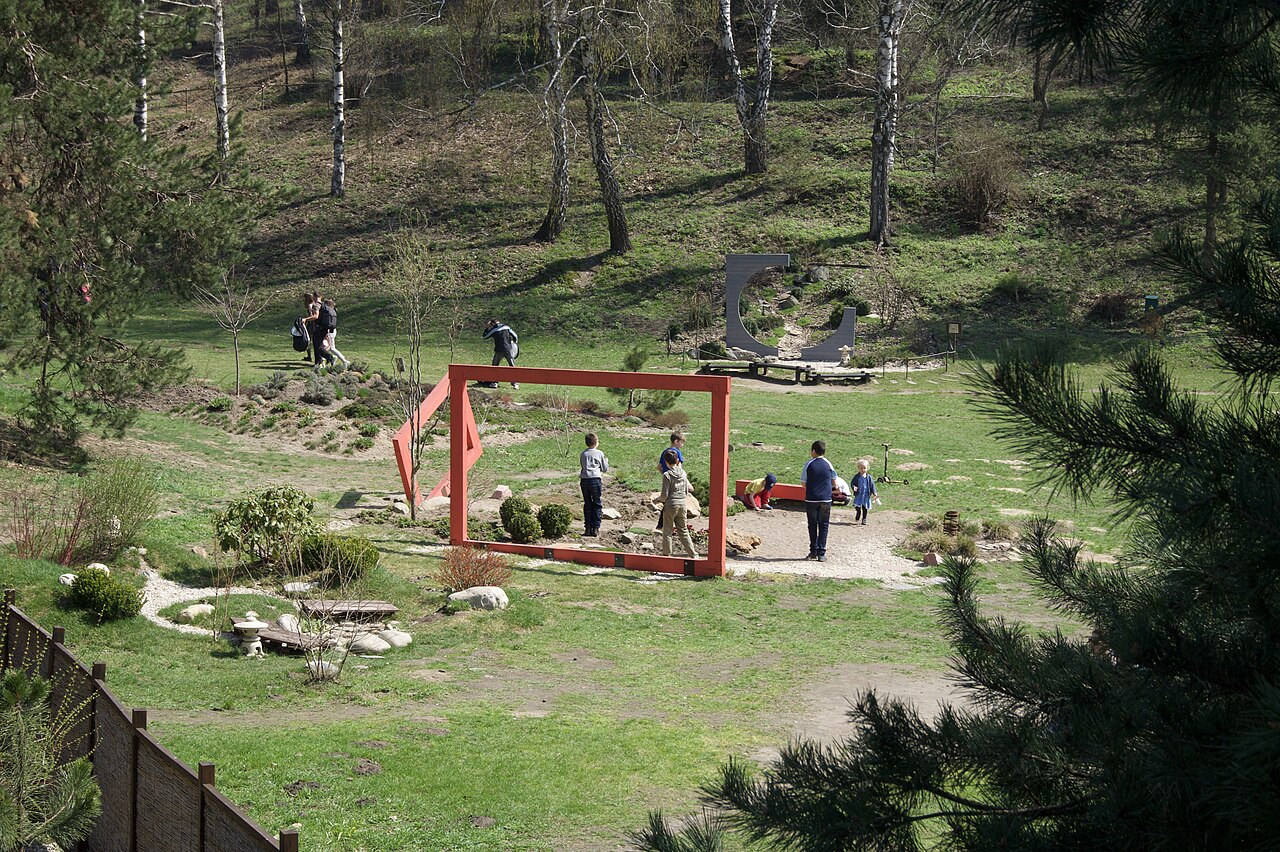
The Japanese Garden at the M. M. Gryshko National Botanical Garden in Kyiv is a collection of contemporary Japanese-inspired landscape compositions created for the Landscape Spring 2017 festival. Rather than forming a single traditionally designed Japanese garden, the area consists of a group of small installations interpreting Japanese garden imagery through the work of Ukrainian landscape architects and designers. The compositions use rocks, gravel, symbolic water, bridges, lanterns, flowering plants and sculptural elements to explore themes drawn from Japanese nature, culture and symbolism.
History
The garden area was created between 28 April and 2 May 2017 during the festival Landscape Spring 2017, which marked the officially designated Year of Japan in Ukraine. Its central event was the competition “Japanese Motifs in the Botanical Garden”, organised by the M. M. Gryshko National Botanical Garden and the magazine Landscape and Architecture, with support from the Embassy of Japan in Ukraine.
An international jury selected teams of Ukrainian landscape architects and garden designers to construct their proposals directly within the botanical garden. Contemporary accounts refer to eleven finalist teams, while the botanical garden’s subsequent scientific report records twelve completed Japanese-garden projects, apparently including an additional composition within the final exhibition. The installations were retained after the festival and marked with plaques identifying their creators and sponsors.
The individual projects included “A Japanese Garden with a Ukrainian Soul” by Tetiana Marharyd, “Magic Land” by Olena Miniailo, “Koi” by Hanna Halahan, and “Hananamichi: The Road of Flowers” by Tetiana Bondarenko, together with several other conceptual gardens. The botanical garden originally intended to use these installations as the basis for a larger unified Japanese garden, although available documentation does not confirm that this later consolidation was completed.
Design features
The compositions were deliberately conceived as contemporary interpretations, not academically reconstructed Japanese gardens. Their designers drew inspiration from books, films and general images of Japanese culture; contemporary reports noted that none of the participating designers had previously visited Japan.
The individual installations employ varied combinations of stone arrangements, gravel streams, bridges, symbolic ponds, sculptural koi, flowering trees and Japanese-style lanterns. Some use the surrounding botanical landscape as borrowed scenery, while others combine Japanese motifs with Ukrainian planting, vernacular imagery or contemporary art.
One composition, “A Japanese Garden with a Ukrainian Soul,” connects Japanese pine and cherry symbolism with Ukrainian spruce and flowering fruit trees. “Magic Land” uses a gravel-and-pebble watercourse, a rocky island, a lantern and the existing slope to create foreground, middle-ground and distant views. “Koi” centres on brightly coloured symbolic carp and a small bridge, designed to be viewed both from above and at close range.
Because the area combines numerous independent concepts and uses Japanese symbolism through contemporary Ukrainian landscape design, it is most appropriately classified as a Modern Japanese garden rather than as a traditional dry, tea or strolling garden.
Garden elements
Bridges
Buildings
Waters and islands
Stones
Other elements
Current status
The Japanese-inspired compositions remain recognised as one of the botanical garden’s modern ethnobotanical and thematic areas. The M. M. Gryshko National Botanical Garden continues to operate as a ticketed public institution, although access and opening arrangements may be affected by security conditions in Kyiv.