
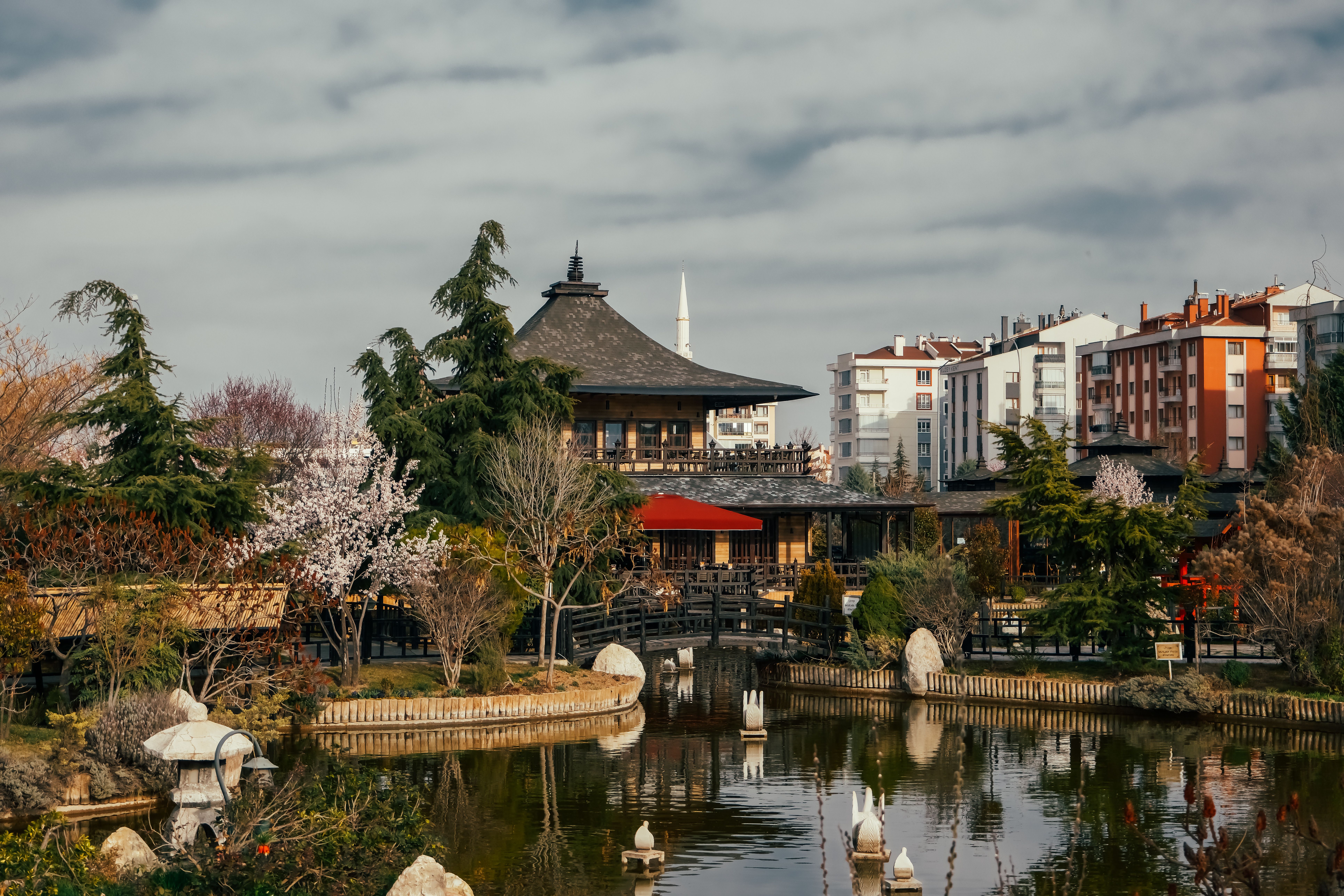
Kyoto Japanese Park
Photo: ORHAN BADUR / Pexels License, modified.
Overview
Kyoto Japanese Park is a large Japanese-inspired landscape garden in the Selçuklu district of Konya, Türkiye. Opened in 2010, the approximately 36,000-square-metre park was created to commemorate the partnership between Konya and Kyoto. Its composition centres on a large artificial lake surrounded by paths, bridges, streams, waterfalls, rock formations, planted hills and Japanese-style buildings. The route around the water and the succession of changing views give the garden the character of a large strolling garden.
History
The garden was developed by the Konya Metropolitan Municipality following the establishment of a partner-city relationship between Konya and Kyoto in December 2009. The project was intended to strengthen cultural relations between the two historic cities and to provide Konya with a permanent landscape representing Japanese garden culture.
The garden was formally opened on 27 August 2010. Contemporary descriptions identify it as one of the largest Japanese gardens in Türkiye and record a total area of approximately 36,000 square metres. The available documentation does not name an individual Japanese or Turkish landscape architect responsible for the design.
A scholarly assessment published in 2010 examined the garden against established principles of Japanese landscape design. The study concluded that the composition successfully applied many characteristic elements, including asymmetry, symbolism, miniature landscape representation and the integration of water, rocks, planting and architecture, while also adapting plant selection to Konya’s continental climate.
Design features
The garden is structured around a large artificial lake, accompanied by smaller streams, cascades and waterfalls. Paths circulate around the water and cross it by means of several wooden bridges, allowing visitors to encounter the landscape from a sequence of changing viewpoints. Artificial hills, stone settings and planted banks create a miniature representation of mountainous Japanese scenery.
Water is the dominant organising element and appears in the form of the lake, streams, waterfall and bamboo water features. Islands and shoreline rocks divide the water surface into smaller scenes, while bridges and pavilions act as visual focal points. The overall arrangement is designed at a human scale despite the unusually large size of the park.
The planting includes Japanese maples, flowering cherries, pines, bamboo and flowering shrubs, supplemented by species selected for their ability to withstand Konya’s dry summers and cold winters. The original planting scheme reportedly included approximately 170 maples, around 150 flowering trees and a comparatively small number of pines.
Japanese-style architectural features include a monumental entrance gate, timber bridges, open pavilions and a large restaurant building inspired by traditional Japanese architecture. These structures reinforce the cultural identity of the garden, although the park also functions as a heavily used municipal recreation and hospitality complex.
Current status
The garden remains maintained by the Konya Metropolitan Municipality as a freely accessible public park. It continues to operate as a recreational landscape, cultural symbol and popular venue for dining, photography and public events.