
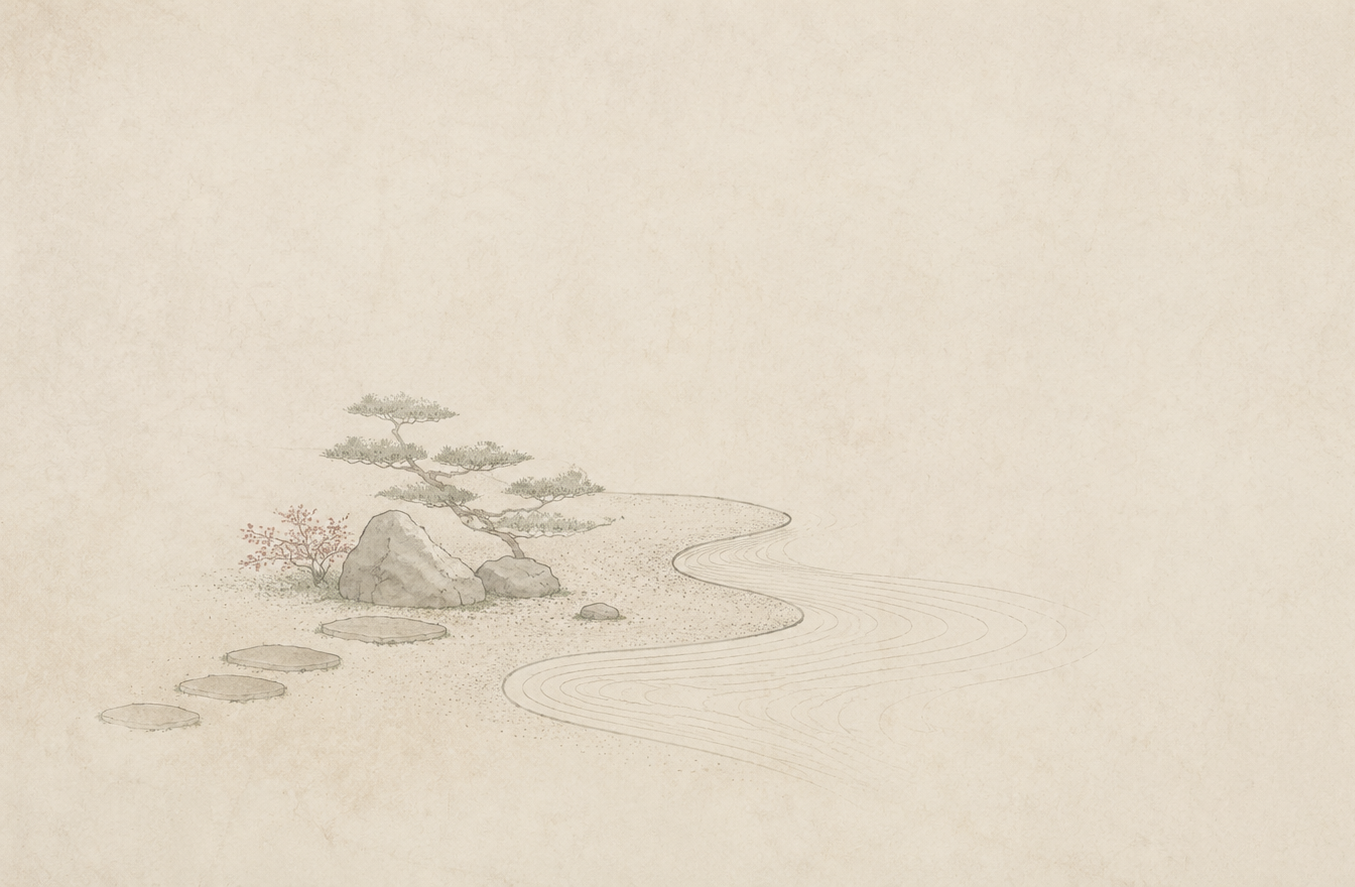
Yasuragi Spa Garden
Overview
The Yasuragi Spa Garden, formally described as the Garden of Wandering and Tranquility, is a Japanese-inspired landscape garden at the Yasuragi spa hotel in Hasseludden, east of Stockholm. The garden combines Japanese principles of contemplation and sequential movement with the existing Swedish archipelago landscape, using natural woodland, exposed rock, winding paths and carefully placed interventions rather than attempting to reproduce a historical Japanese garden literally.
History
The garden originated in a design competition organised during Sweden’s Design Year 2005. Yasuragi invited eight designers and creative practitioners to propose a new outdoor environment for the resort. The winning proposal, titled Garden of Wandering and Tranquility, was selected because it was considered the best match for Yasuragi’s activities and its emphasis on rest, reflection and wellbeing.
The garden was designed by NOD, Nature-oriented Design, in collaboration with artist and professor Gunilla Bandolin. The proposal was conceived as a larger, evolving project, and the official description notes that not every originally planned section has yet been realised. Its development therefore appears to have taken place gradually rather than through a single fully documented opening campaign.
The wider Yasuragi complex had opened as a Japanese-inspired spa hotel in 1997, within a building originally designed by Japanese architect Yoji Kasajima in the early 1970s. Kasajima adapted the building to the terrain and preserved many existing trees, creating the landscape framework later used by the garden designers.
Design features
The garden is based on the existing pine woodland, rock formations and sloping terrain between the hotel and the waterfront. Its designers treated untouched nature as the primary model, seeking not to imitate natural scenery directly but to condense and abstract it, leaving space for personal interpretation.
Visitors follow a winding descending path from the hotel towards the water. The route deliberately slows movement and leads through a sequence of marked places, including a concrete plateau, a serpentine path, resting areas and framed transitions. This sequential experience gives the garden the character of a contemporary strolling garden.
A woven-willow moon gate marks a symbolic transition between different states or spaces. Nearby stepping stones represent movement through life, while larger stones encourage visitors to stop and observe the surroundings. These features are interpreted philosophically rather than as strict copies of historical Japanese prototypes.
One of the principal installations is Rundillen, designed by Gunilla Bandolin. The circular, inward-focused space directs attention vertically towards both the sky and the earth and is presented as a meeting place between the two. The garden as a whole balances movement and stillness, physical walking and inward contemplation.
The planting relies heavily on existing Swedish vegetation, supplemented by selected trees and shrubs, including magnolia. Rather than separating the Japanese composition from its surroundings, the design merges Japanese garden ideas with the Nordic forest and coastal landscape.
Garden elements
Stones
Shinto elements
Current status
The garden remains part of the Yasuragi hotel and spa complex and is promoted as a place for quiet walking, contemplation, tea and guided nature-based activities. It is primarily accessible to hotel, conference and day-spa guests rather than as an independent public garden.