
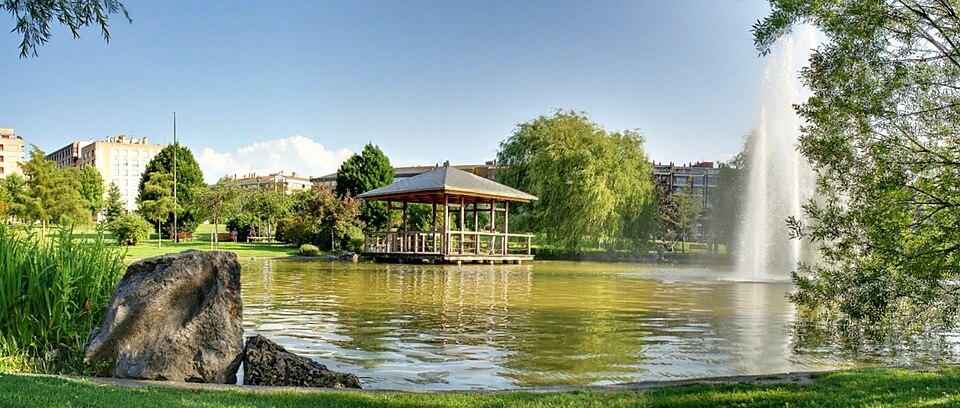
Yamaguchi Park
Photo: Xabier Marín López / CC BY-SA 3.0, modified.
Overview
Yamaguchi Park is a large Japanese-style public park in Pamplona, created in 1997 to symbolise the sister-city relationship between Pamplona and Yamaguchi, established in 1980. Pamplona’s official tourism page describes it as a Japanese garden designed by two Japanese landscapers, with around 400 trees and more than 600 plants, including Japanese cherry trees, ginkgos, maples, oaks, giant redwoods and hollies.
History
The park emerged from the cultural link between Pamplona and Yamaguchi, connected through Saint Francis Xavier, the Navarrese missionary who worked in Japan in the sixteenth century. The city partnership was formalised in 1980, and the park was completed in 1997 as a physical expression of that relationship. Several sources give its area as about 85,000 m², located between the neighbourhoods of Iturrama, San Juan and the hospital complex.
The designer attribution is slightly messy, because naturally one garden cannot simply have one tidy record like civilised database fields demand. Pamplona’s official site says it was designed by two Japanese landscapers but does not name them in the snippet available. A Spanish visitor source names them as Kyoshi Yasui and Toyo Tanaka, while a 2025 Noticias de Navarra article highlights Kenji Tatara and Shuchi Okamoto as two Japanese participants involved in the park’s creation, together with many colleagues.
The park continues to function as a Japanese cultural reference point in Pamplona. Recent reporting describes activities such as hanami and Kodomo no Hi celebrations, organised around the park’s cherry trees and Japanese symbolism. The nearby Pamplona Planetarium and Galaxy Garden add a later scientific-cultural layer, but they should be treated separately from the Japanese garden entry
Design features
Yamaguchi Park is a large public landscape garden with Japanese ornamental references rather than a small enclosed temple-style garden. Sources describe cherry trees, ginkgos, maples, water, a pond, waterfall, bridges, a palafitte / pavilion-like structure, a geyser and Japanese garden elements such as suhama, azumaya, yatsubashi, ishibashi and taki. The design is explicitly framed as a tribute to the four seasons, making it best classified as a public strolling / landscape garden.
Garden elements
Bridges
Buildings
Waters and islands
Stones
Other elements
Current status
Extant public Japanese-style park in Pamplona. It remains a major public green space and cultural symbol of the Pamplona–Yamaguchi relationship.