
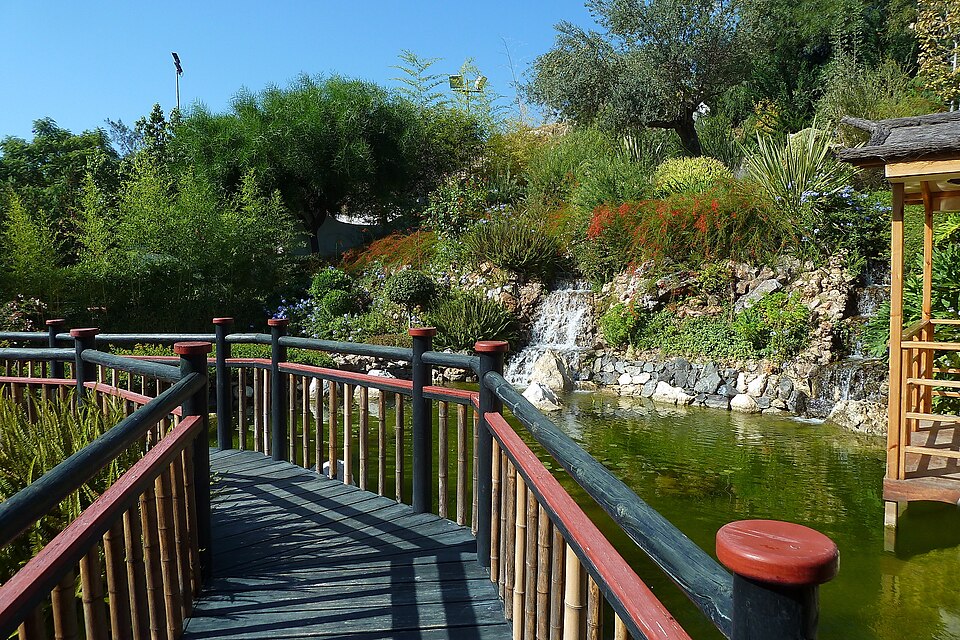
Inja no Teien
Photo: Schnobby / CC BY-SA 4.0. modified.
Overview
Inja no Teien, or the Garden of the Hermit, is a compact Japanese hill-and-pond garden within the Molino de Inca Botanical Garden in Torremolinos, southern Spain. Opened in 2012, the approximately 500-square-metre garden occupies a steep rocky slope and represents a miniature natural landscape through artificial hills, streams, waterfalls, a pond, stone paths and layered vegetation. Its design is explicitly based on the tsukiyama tradition of Japanese landscape gardening.
History
The wider Molino de Inca Botanical Garden was redeveloped and opened in its present form in 2003 around the historic springs and reconstructed watermill of Torremolinos. The Japanese Garden was added later as a separate thematic section adjoining the Los Manantiales–Molino de Inca complex.
The garden was based on a preliminary design prepared by José Vergara and Juan Vallejo, both members of the Hi no Hikari Cultural Association. Municipal technicians and gardeners from the Torremolinos Department of Parks and Gardens adapted the proposal and carried out the construction. The completed garden was formally inaugurated by mayor Pedro Fernández Montes on 24 May 2012.
The Japanese name Inja no Teien identifies the composition as the Garden of the Hermit, emphasising its intended atmosphere of seclusion, contemplation and withdrawal from the surrounding urban environment.
Design features
The garden occupies a rocky hillside with a height difference of approximately 12–15 metres. An artificial spring rises in the upper part and divides into two narrow streams, which descend through a sequence of small waterfalls before reaching a clear-water pond, described as a chitai. This water system forms the principal structural element of the garden.
The upper section is conceived as a relatively dense woodland landscape, planted with conifers, deciduous trees and shrubs. A stone path leads towards the artificial spring and culminates in an elevated viewpoint overlooking the whole composition.
The lower section has a more contemplative character and contains most of the garden’s principal ornamental features. Visitors enter through a bamboo gateway and encounter a mosaic representing the rising sun. The path then divides, deliberately concealing the complete garden and allowing its different elements to be discovered gradually.
Artificial hills, stone settings, streams and the pond create a miniature representation of mountain and lake scenery characteristic of tsukiyama gardens. The garden also contains bonsai and Japanese-associated ornamental planting adapted to the Mediterranean climate of the Costa del Sol.
Garden elements
Bridges
Buildings
Enclosures
Waters and islands
Stones
Current status
The garden remains maintained as a thematic section of the Molino de Inca Botanical Garden and is accessible during the botanical garden’s regular opening hours. Its watercourses, pond, hillside paths and planted landscape continue to form one of the principal visitor attractions within the complex.