
Mlyňany Arboretum
Photo: Japonský-bonsaj / CC BY-SA 4.0, modified.
Overview
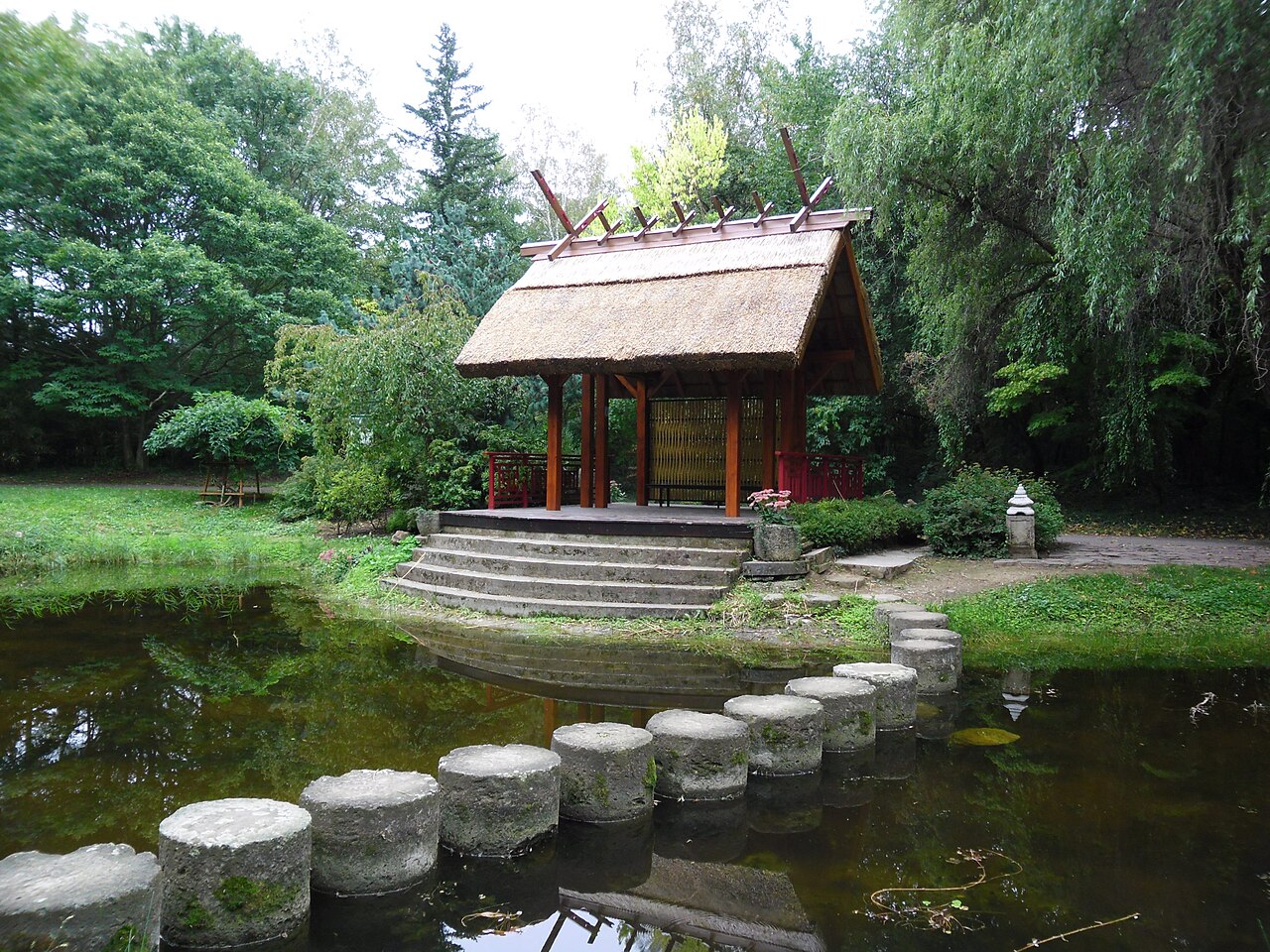
The Japanese Section of Mlyňany Arboretum is a dendrological display area within the East Asian dendroflora section of Arborétum Mlyňany SAV in Slovakia. It is not a classical Japanese garden in the formal sense, but a botanical / arboretum collection area focused on Japanese and East Asian woody plants, with a Japanese-style pavilion as a garden feature. The arboretum itself was founded in 1892 by Dr. Štefan Ambrózy-Migazzi and today contains around 2,000 taxa across a 67-hectare park.
History
The original arboretum was created from 1892 as Ambrózy-Migazzi’s evergreen park, Semper Vireo. After the site became part of the Slovak Academy of Sciences in 1953, a new development phase began, expanding the collection and introducing many non-native woody species. The East Asian dendroflora area began to be developed after the 1960 Chinese expedition, with the broader goal of displaying Asian woody plants according to geographic origin. The Japanese pavilion in the Japanese section was built in the mid-1970s and later reconstructed, with a full structural and roof renewal recorded in 2012.
Design features
The Japanese section belongs to a phytogeographical arboretum layout rather than a traditional Japanese garden composition. Its main character comes from Japanese and East Asian woody plant collections, shaded walking routes and the Japanese-style pavilion. The wider East Asian dendroflora area is explicitly organised to present taxa from Japan, Korea, China, the Himalayas, the Caucasus, Central Asia and the Far East.
Garden elements
Buildings
Enclosures
Waters and islands
Stones
Other elements
Current status
Extant Japanese section within the East Asian dendroflora area of Mlyňany Arboretum. The arboretum is a 67-hectare scientific and public dendrological collection managed by the Slovak Academy of Sciences, with one of the richest collections of non-native trees and shrubs in Central Europe. The Japanese section is part of the wider East Asian dendroflora display, which presents woody plants according to phytogeographical origin, including Japan, Korea, China, the Himalayas, the Caucasus and the Far East. A Japanese-style pavilion / japonská besiedka was built in the mid-1970s and fully reconstructed as part of collection and infrastructure renewal in 2012. The site remains publicly accessible as part of the arboretum visitor routes.