
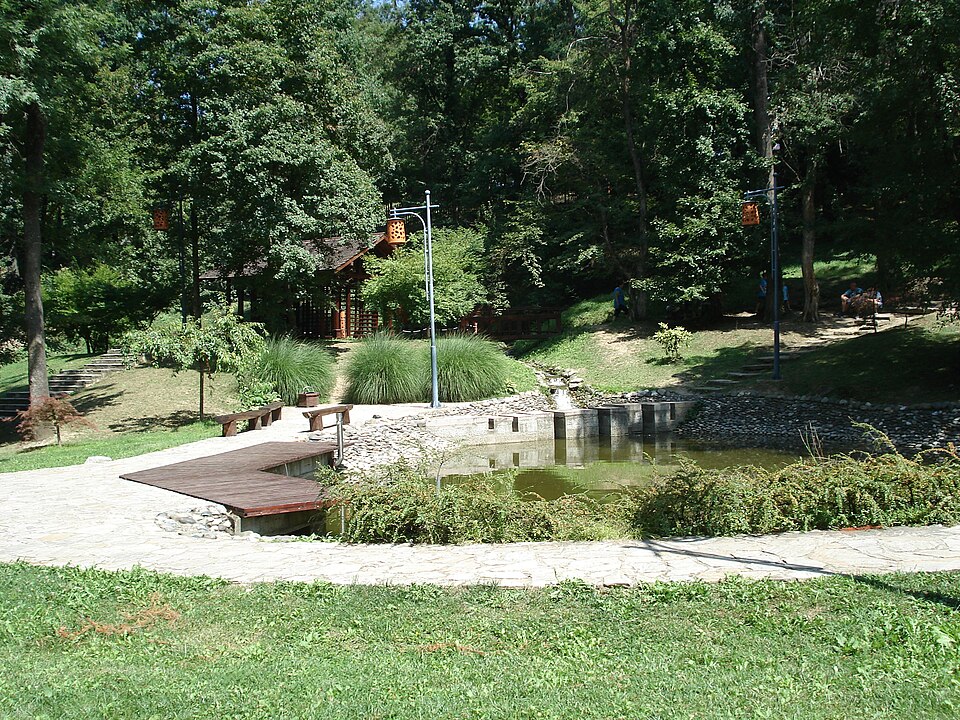
Vrnjačka Banja Park
Photo: Katarina Z / CC BY 3.0. modified.
Overview
The Japanese Garden is a 3,000-square-metre landscape garden within the central spa park of Vrnjačka Banja, Serbia. Opened in 2011, it combines an artificial pond, cascading waterfall, stream, wooden bridge, stone paths, lanterns and a small tea pavilion within a walk-through composition. Its water-centred layout and sequence of changing viewpoints give it the character of a compact strolling garden.
History
The garden was created through cooperation between the Municipality of Vrnjačka Banja and the Embassy of Japan in Serbia. The project was intended to strengthen cultural relations between Japan and Serbia while adding a new themed landscape to the town’s extensive historic spa park.
The total cost of construction was approximately 12 million Serbian dinars, financed in equal shares by the Japanese Embassy and the municipality. The completed garden was formally opened on 11 June 2011 by Serbian foreign minister Vuk Jeremić and Japanese ambassador Toshio Tsunozaki.
Published official and tourism sources do not identify an individual landscape architect or Japanese garden designer. The garden therefore appears to have been implemented as a municipal landscape project with Japanese financial and cultural support rather than as a documented work by a named specialist.
Design features
The garden is organised around an artificial pond and cascading waterfall, with water continuing through a small stream-like landscape. A wooden bridge, stone-edged banks and paths allow visitors to move around and across the composition, encountering the pond and waterfall from several angles.
A small Japanese-style tea pavilion provides a sheltered focal point beside the water. Stone paths, ornamental lanterns and carefully arranged rocks connect the architectural features with the surrounding planting. The garden is described as combining living and non-living nature, particularly plants, water and stone, in accordance with widely recognised Japanese garden principles.
The planting includes flowering trees and ornamental species associated with Japan, including Japanese cherries, together with shrubs and waterside vegetation adapted to the Serbian climate. The garden is integrated into the larger spa park rather than enclosed as an independent courtyard or temple garden.
Although relatively compact, the circulation paths, bridge and succession of pond, waterfall and pavilion views make the garden primarily a strolling landscape, rather than a fixed viewing garden or dry garden.
Garden elements
Bridges
Buildings
Enclosures
Waters and islands
Stones
Other elements
Current status
The garden remains maintained as a freely accessible attraction within the central park of Vrnjačka Banja. Its pond, waterfall, bridge and pavilion continue to be promoted as prominent features of the spa town’s public park system.