
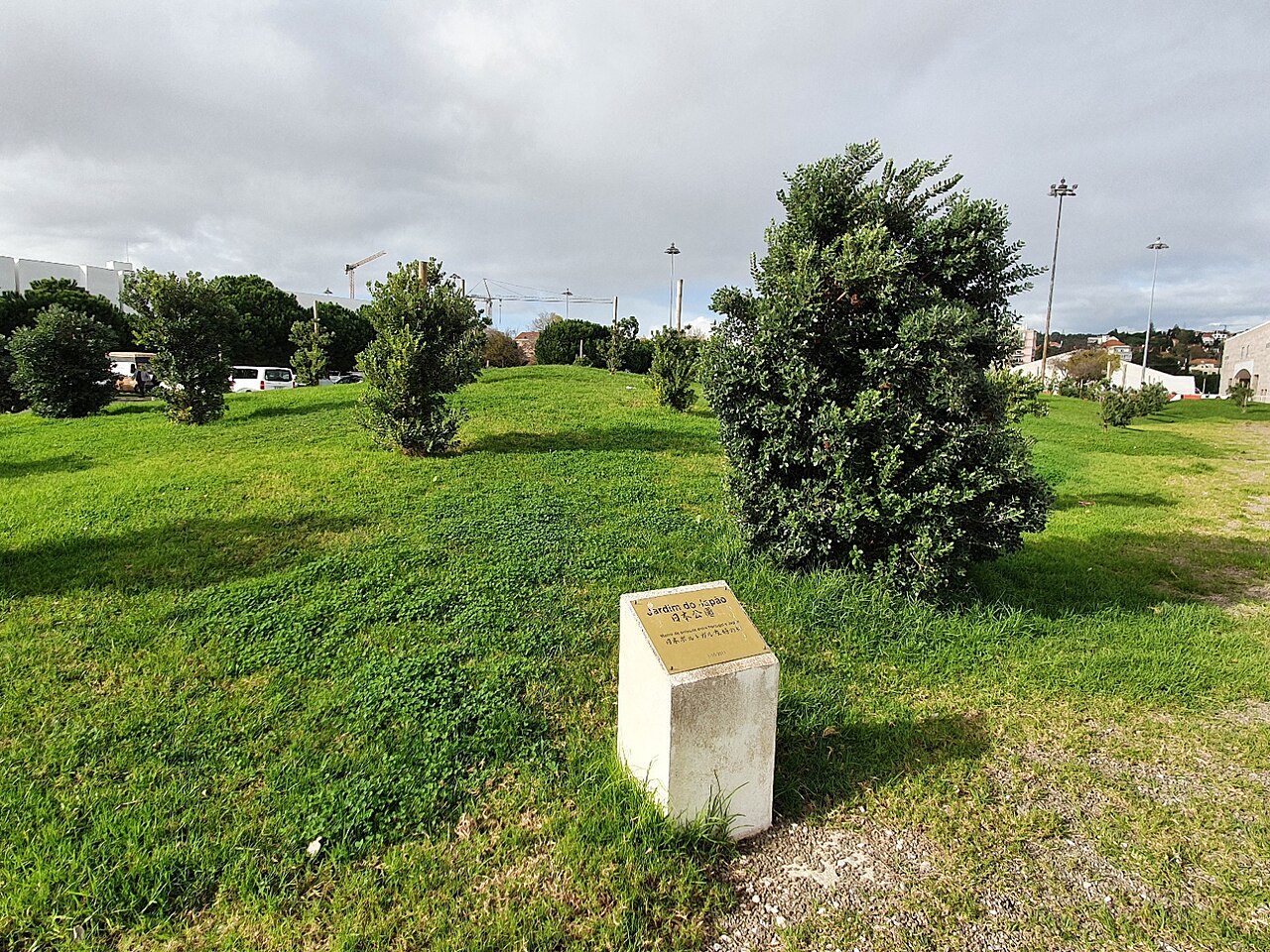
Japan Garden
Photo: GualdimG / CC BY-SA 4.0, modified.
Overview
The Jardim do Japão is a Japanese-inspired public garden on the Tagus waterfront in Belém, Lisbon, between the Museu de Arte Popular and the marina area. Covering approximately 5,200 square metres, it consists of gently modelled grass mounds, curving gravel paths and an extensive planting of flowering cherry trees. The garden commemorates the long-standing diplomatic and cultural relationship between Portugal and Japan, but it does not reproduce a traditional historical Japanese garden type.
History
The project was initiated through cooperation between the Lisbon City Council, the Port of Lisbon Authority and the Portugal–Japan Friendship Association. It was conceived to mark 461 years of relations between Portugal and Japan, calculated from the arrival of the first Portuguese visitors in Japan in 1543.
Construction was symbolically begun on 27 September 2004, when the first flowering cherry tree was planted in the presence of representatives of the three participating organisations. Contemporary reports stated that the completed garden would contain 461 cherry trees, one for each year of Portuguese–Japanese relations being commemorated.
Although the first phase was completed after 2004, the project appears to have developed more slowly than initially planned. A permanent commemorative marker bearing the inscription “Marco de amizade entre Portugal e Japão” was unveiled on 1 October 2011, when the site became the setting for a public Japanese cultural festival.
Design features
The garden is organised as an open contemporary riverside landscape rather than an enclosed traditional Japanese composition. Low artificial hills create a gently undulating terrain, while broad gravel paths curve between grassed areas and provide views towards the Tagus River.
Its principal Japanese reference is the planting of 461 flowering cherry trees. The trees function collectively as a commemorative grove, linking the seasonal symbolism of cherry blossom with the history of Portuguese–Japanese relations. Because the original trees were planted relatively young and across an exposed waterfront site, the garden has a more open and park-like character than the densely layered planting of many traditional Japanese gardens.
The entrance marker bears the garden’s name in Portuguese and Japanese together with a bilingual dedication to friendship between the two countries. Later additions to the wider public space included simple outdoor exercise equipment, reinforcing its function as an urban recreational park rather than a specialised contemplative garden.
Current status
The Jardim do Japão remains an open municipal green space along the Belém waterfront. It is freely accessible and continues to be used for recreation and occasional events celebrating Japanese culture and Portuguese–Japanese relations.