
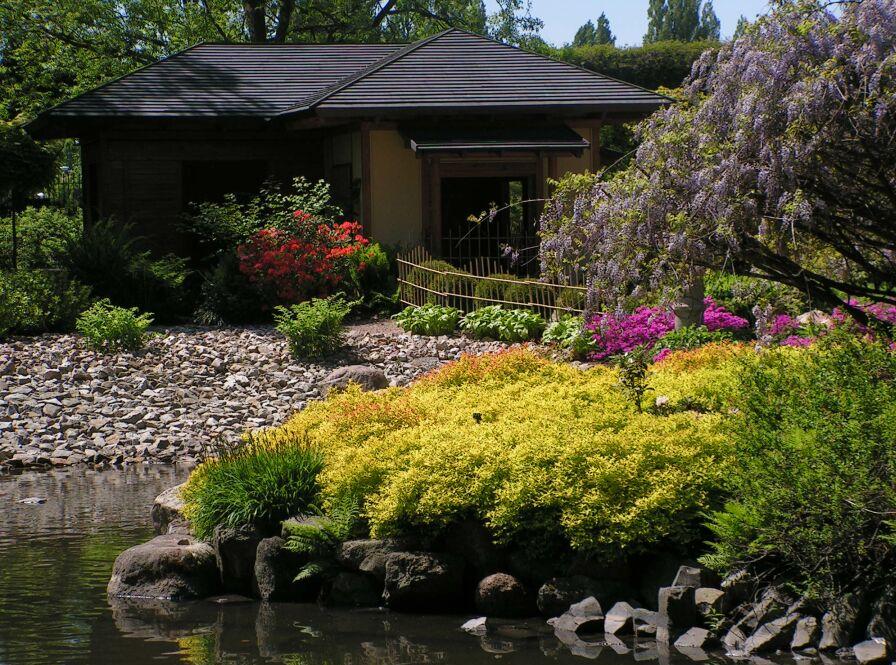
Wroclaw Japanese Garden
Photo: Puchatech K. / CC BY-SA 3.0, modified.
Overview
The Wrocław Japanese Garden is one of the most important historic Japanese gardens in Central Europe. It was created for the 1913 Centennial Exhibition beside today’s Centennial Hall, on the initiative of Count Fritz von Hochberg, with the participation of Japanese gardener Mankichi Arai. The official Centennial Hall visitor information describes it as a garden combining features of several types: public garden, water garden, tea-ceremony garden and pebble-beach garden.
History
The garden was developed between about 1909 and 1913 for the 1913 exhibition. Wrocław’s own historical material states that the idea came from Friedrich / Fritz von Hochberg, while the works were directed by Joseph Anlauf, who managed Hochberg-family gardens and had travelled in Asia with von Hochberg; Mankichi Arai acted as the Japanese expert. Other visitor-facing sources simplify this to von Hochberg and Arai as the main figures behind the garden.
After the exhibition, the most temporary exhibition elements were dismantled, but the core landscape structure remained. In the 1990s the garden underwent a major restoration with Japanese assistance. It reopened in 1997, was almost immediately damaged by the catastrophic flood of July 1997, and reopened to the public again in 1999 after further restoration.
Design features
The garden is organised around water, paths, stones, bridges, pavilions and planting. Its composition includes pond scenery, stone arrangements, paths, bamboo structures / pergola elements, water management features and Japanese-style planting. The garden is best treated as a mixed Japanese garden composition, because official descriptions identify several overlapping types: water garden, tea-ceremony garden and pebble-beach / dry-scenery elements.
Garden elements
Bridges
Buildings
Enclosures
Waters and islands
Stones
Other elements
Current status
Extant and restored historic Japanese garden within Szczytnicki Park, near Centennial Hall. The garden was created for the 1913 Centennial Exhibition in what was then Breslau. After the exhibition, many temporary structures and furnishings were removed, but the pond layout, paths, planting framework and part of the original spatial arrangement survived. In the 1990s the garden was comprehensively restored with help from Japanese specialists; it reopened in 1997, was badly damaged by the July 1997 flood, and reopened again after further restoration in 1999. Today it functions as a seasonal public garden managed as part of Wrocław’s park system, open from 1 April to 31 October, normally 9:00–19:00.