
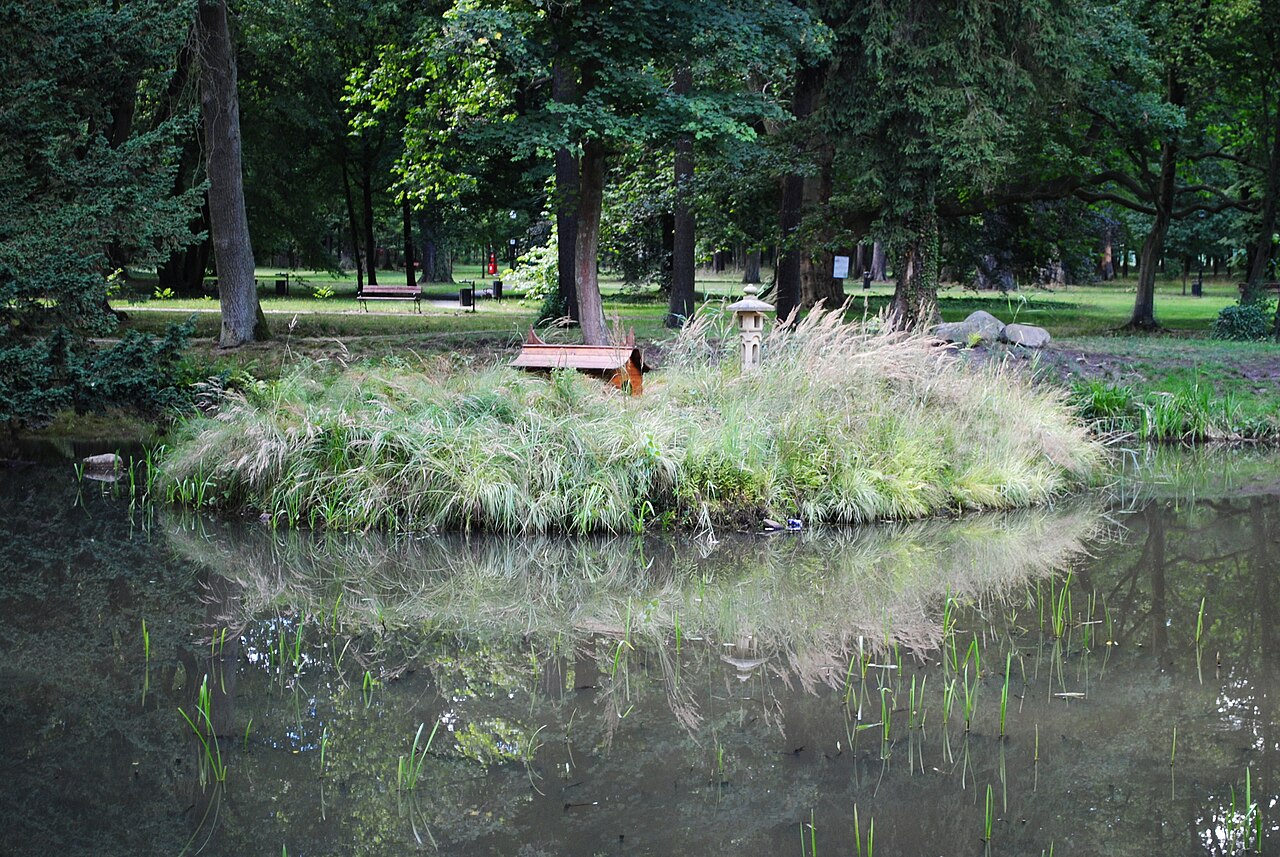
Manor Park
Photo: Marek Mróz / MacQtosh / CC BY-SA 4.0, modified.
Overview
The Japanese Garden in Manor Park at Iłowa is a historic Japanese-style garden created in the early twentieth century on the initiative of Count Friedrich / Fritz von Hochberg zu Fürstenstein, owner of the Iłowa palace and park. Local tourism material describes it as a particularly valuable part of the manor park, with a tea house, stone lanterns and small bridges. It is often presented as the first Japanese garden in Europe.
History
At the beginning of the twentieth century, Friedrich von Hochberg owned the Iłowa palace and park and remodelled the estate according to contemporary Art Nouveau landscape ideas. He owned the palace between 1902 and 1921, and sources describe extensive works around 1903–1905, including the creation of the Japanese garden. A recent scholarly source describes Count Hochberg’s Japanese garden at Iłowa / Halbau as restored and closely resembling its original 1904 appearance.
Design features
The garden includes a tea house, stone lanterns, small bridges, a system of paths and canals, an artificial lake and islands. It forms part of a larger historic park with English, French, Chinese and Japanese garden areas. The preserved water structure and island layout are especially important for its historical character.
Garden elements
Bridges
Buildings
Waters and islands
Stones
Shinto elements
Other elements
Current status
Extant and restored historic Japanese garden within the palace-and-manor park of Iłowa. The garden is part of a larger historic park complex that also includes English, French and Chinese garden areas. Its original early twentieth-century path and canal system, artificial lake and islands have largely survived, and the Japanese garden has been restored in recent years. It is publicly accessible as part of the municipal manor park and is usually presented as one of the earliest Japanese gardens in Europe.