
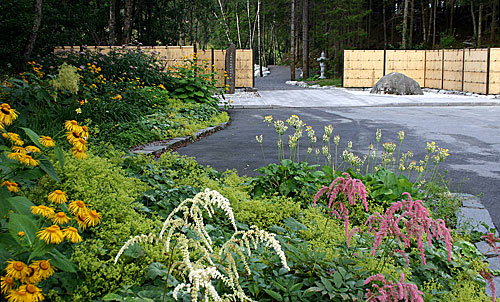
Bergen Botanical Garden
Photo: Arboretet og Botanisk hage / CC BY 3.0.
Overview
Japanhagen is a Norwegian–Japanese friendship garden within the Bergen Botanical Garden at Milde, part of the University of Bergen’s University Gardens. Designed by Japanese landscape architect Haruto Kobayashi, it integrates Japanese garden principles into the existing western Norwegian landscape rather than copying a historical garden in Japan. The composition includes a gravel garden, moss garden, bridges, stone lanterns, a stream gorge and an open tea pavilion, together with plants of Japanese origin.
History
Development of the garden began in 2005, when the first container of materials arrived from Japan, including stone lanterns and components for the bamboo entrance fence. The project was conceived as a garden promoting friendship and mutual understanding between Japan and Norway, while also creating a setting in which students, researchers and the public could experience Japanese culture.
The garden was designed and laid out by Haruto Kobayashi, who deliberately combined Japanese design elements with the natural terrain and vegetation of Milde. Rather than imposing a self-contained historical model, Kobayashi used the Norwegian site as part of the composition, adapting the garden to Bergen’s mild, wet coastal climate.
Japanhagen was completed in May 2008. It has since served as a venue for Japanese cultural activities, including tea presentations, guided tours and Japanese cultural days. Its continuing diplomatic role was reaffirmed in August 2024, when the Japanese ambassador to Norway visited the garden and received a presentation on its history and purpose.
Design features
The entrance is marked by a traditional-style bamboo fence, originally constructed with genuine bamboo imported from Japan. Beyond it, paths lead through a sequence of planted and mineral landscapes, allowing visitors to encounter the garden gradually rather than from a single viewpoint.
The garden contains three bridges. The largest is an angled wooden bridge crossing the wetland beside the Vågelva stream. A route continuing from it towards a smaller wooden bridge is known as the Path of the Four Seasons, while a stone bridge marks the transition between the stream gorge and the gravel garden.
A symbolic water landscape begins at the Source of Wisdom and descends through a gorge formed from large stones. Pale gravel creates the illusion of water flowing into a broad gravel pond. Several islands lie within this dry-water composition, two of which represent Japan and Norway; together, the islands form the Japanese written character associated with cordiality or heartfelt friendship.
The central hill supports a moss garden, well suited to western Norway’s high rainfall and mild winters. The planting is restricted to species native to Japan or cultivars derived from Japanese plants. Flower colours are generally restrained, while autumn foliage is treated as an important seasonal feature.
Eight stone lanterns are positioned at important points throughout the garden, functioning as visual orientation markers. The open tea pavilion, constructed from Japanese cedar, frames views towards the gravel pond, stream gorge and surrounding Norwegian landscape. Its three open sides make it primarily a viewing and gathering pavilion rather than an enclosed tea house.
Garden elements
Enclosures
Waters and islands
Stones
Shinto elements
Current status
The garden remains maintained as one of the principal specialised collections of the University Gardens of the University of Bergen. It is publicly accessible within Bergen Botanical Garden and continues to support educational visits, cultural events and Japanese–Norwegian exchange.