
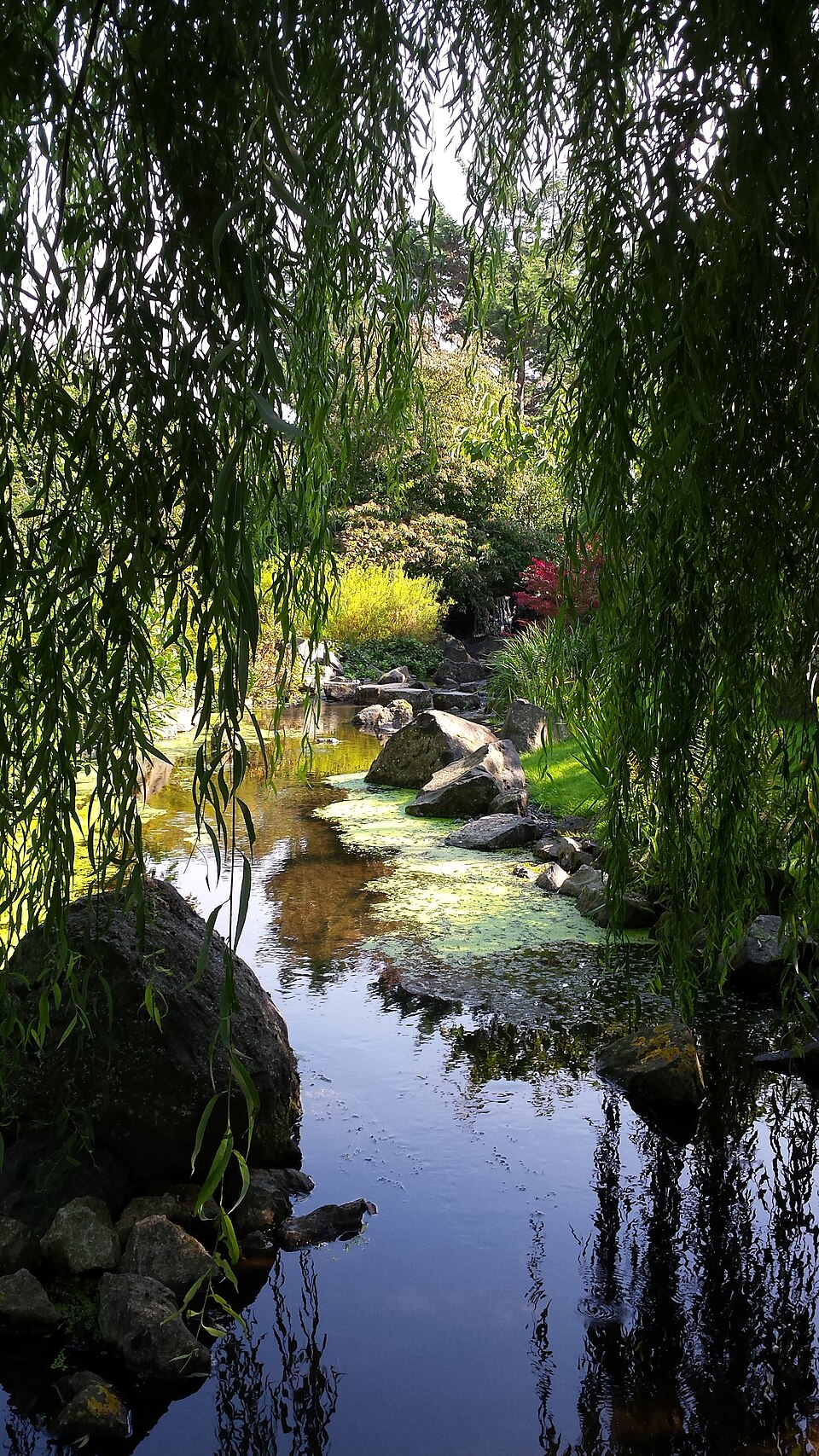
Hortus Overzee
Photo: Lars van der Heide / CC BY-SA 4.0, modified.
Overview
The Japanese Garden at Hortus Overzee in Den Helder is named “Ontmoeting der Stromen” / “Meeting of Streams.” The name refers both to the Marsdiep, where the North Sea and Wadden Sea meet, and to the symbolic meeting of Eastern and Western cultures. Hortus Overzee describes it as the largest Japanese garden with flowing water in the Netherlands.
History
The wider Hortus Overzee site originated as Den Helder’s former municipal nursery. The municipality established a new nursery on Soembastraat in 1939, including the historic palm greenhouse, and the foundation Oranjerie De Groene Parel was created on 9 March 1993. Between 1995 and 2000, the complex was extensively restored and renewed, later receiving the official name Hortus Overzee on 22 April 2017.
The Japanese garden was designed and laid out under the direction of Prof. Wybe Kuitert, with Japanese garden experts / professors Nakamura and Amasaki from Kyoto. Hortus Overzee states that the design has an authentic relationship with the famous Murin-an garden in Kyoto. In 2025, the Japanese garden marked its 30th anniversary, which supports 1995 as the practical establishment year, while Nodaigarden records the garden as Oranjerie Japanese Garden “Meeting of Streams” with a date opened of 2000.
The garden continues to function as Hortus Overzee’s main attraction, combining Japanese garden design with Den Helder’s maritime and botanical identity. Hortus Overzee’s own visitor material describes the garden as part of a public botanical complex with cultural, educational and event functions.
Design features
The garden is a Japanese landscape garden with flowing water, a waterfall, large pond, natural-stone bridges, koi carp, turtles, rocks and an island. Planting includes camellias, bamboo, Japanese flowering cherries, rhododendrons, willows and Dutch dyke stones, combining Japanese and Dutch materials and references. Because the garden is organised around water, walking, views and planted landscape rather than tea or dry-garden practice, it is best classified as a strolling garden.
Garden elements
Bridges
Enclosures
Waters and islands
Stones
Other elements
Current status
Extant Japanese landscape garden within Hortus Overzee. The garden is currently listed by Hortus Overzee as closed for visitors until March 2026, with normal seasonal opening hours and ticketed access otherwise.