
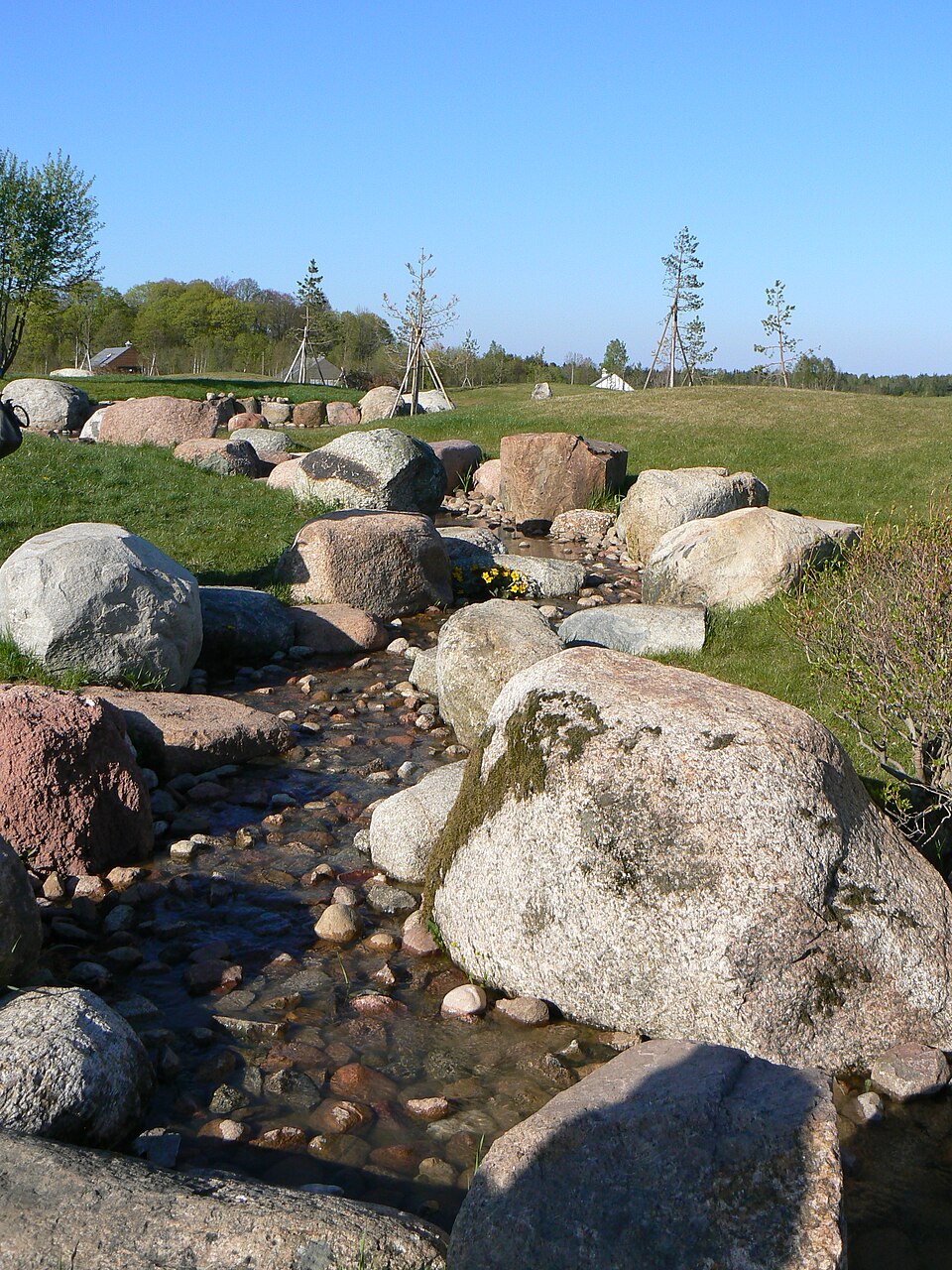
Samogitia Japanese Garden
Photo: Kusurija / CC BY-SA 3.0. modified.
Overview
The Samogitia Japanese Garden, also known as the Japanese Garden of Mažučiai, is a large privately created Japanese landscape garden near Darbėnai in Lithuania’s Kretinga District. Begun in 2007, the garden extends across approximately 16 hectares of formerly open agricultural land. Its ponds, streams, stone landscapes, shaped pines, flowering cherries, bonsai collections and winding paths form an extensive walk-through composition developed through cooperation between Japanese garden master Hajime Watanabe and Lithuanian physician Šarūnas Kasmauskas.
History
The idea for the garden originated with Šarūnas Kasmauskas, who invited Japanese garden specialist Hajime Watanabe, president of the Japanese horticultural company Angyo Ueki, to participate in the project. Initial discussions and planning began before construction, and the transformation of the Mažučiai site started in 2007.
The garden was created on an exposed, largely treeless hill rather than within an inherited park. Watanabe and Japanese assistants directed the principal landscape work, while Kasmauskas initiated and continued the long-term development of the property. The project has consequently evolved over many years rather than being completed in a single construction campaign.
Large quantities of locally sourced stone were introduced, while established Lithuanian trees were transplanted and combined with thousands of Japanese and East Asian plants. Some imported specimens struggled with frost, drought and the exposed Baltic climate, requiring continued adaptation of the planting and maintenance programme.
Design features
The garden is organised as an extensive strolling landscape, with paths leading through a sequence of ponds, streams, planted hills, stone formations and open views. The changing terrain and deliberately arranged viewpoints allow visitors to experience the composition gradually rather than from one fixed position.
Water is one of the principal structuring elements. Large ponds, narrow channels, rocky streams and cascades are bordered by substantial boulders, lawns and sculpturally trained pines. Dry stone and gravel compositions provide a contrasting karesansui element within the broader water landscape.
The planting includes Japanese flowering cherries, maples, azaleas, bamboo and shaped conifers, together with Lithuanian birches and other locally adapted trees. A substantial bonsai collection forms one of the garden’s principal attractions, while stone lanterns, bamboo fences, bridges and Japanese-style pavilions reinforce its cultural character.
The garden also includes a tea house and areas intended for contemplation and cultural activities. Its design brings together Japanese garden traditions with the open terrain, vegetation and climate of western Lithuania rather than reproducing a single historical Japanese prototype.
Garden elements
Buildings
Enclosures
Waters and islands
Stones
Other elements
Current status
The garden remains under continuing development and is operated as a seasonal public visitor attraction. It includes garden walks, bonsai displays, tea facilities and cultural events, and is currently advertised as open daily during the visitor season.