
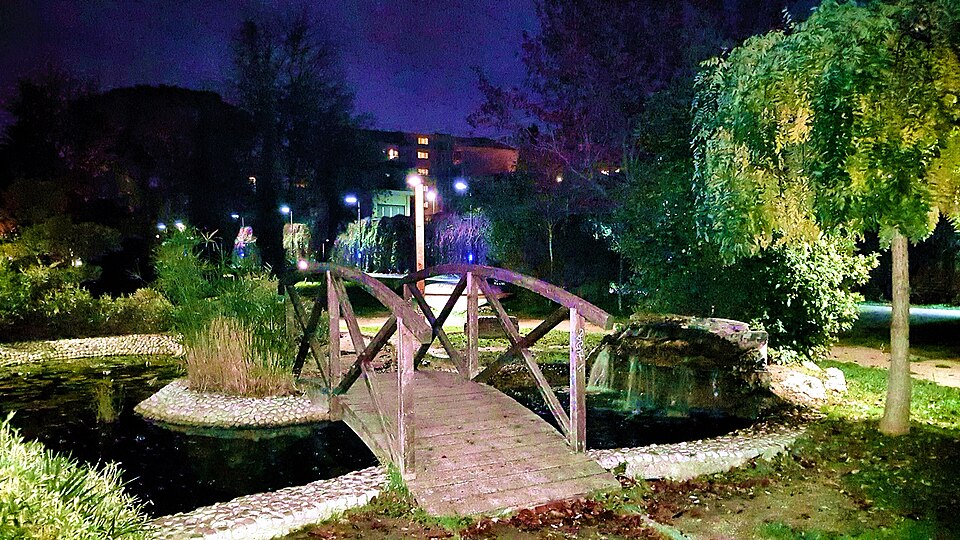
Giardino Olindo Pasqualetti
Photo: Luigi936 / CC BY-SA 4.0. modified.
Overview
The Japanese Garden at Giardino Olindo Pasqualetti is a compact public landscape garden in San Benedetto del Tronto, close to Viale Bruno Buozzi and the Palazzina Azzurra. Created during the comprehensive redevelopment of the historic central gardens in 2009–2010, the approximately 150-square-metre circular composition contains a pond, small waterfall, rocks, modelled ground and Japanese-associated planting. It was conceived primarily as a place for contemplation and reflection on nature within a larger urban park.
History
The Japanese Garden was created as part of the redevelopment of Viale Padre Olindo Pasqualetti and its adjoining pine grove. The wider public gardens originated in the nineteenth century, but by the early twenty-first century the area required substantial renewal. Construction began in October 2009, and the restored gardens were officially inaugurated on 30 July 2010.
The redevelopment was designed by municipal architect Farnush Davarpanah, then head of the City of San Benedetto del Tronto’s planning and public-works department. The project included new planting, irrigation, paving, lighting, a cycle route, facilities for visually impaired visitors, playgrounds, the restoration of an existing fountain and the creation of the Japanese Garden.
The name “Pinetto Buozzi Park” appears to be a mistaken or approximate reference to the surrounding central green spaces. The Japanese Garden is more precisely located within Giardino Olindo Pasqualetti, beside but distinct from Pineta Buozzi. Humanity has once again demonstrated that two adjacent parks are more than enough to defeat consistent naming.
Design features
The garden has a circular plan and is positioned near the centre of the larger landscaped area. Its principal feature is a small pond with goldfish and aquatic plants, fed by a short artificial waterfall. Rocks and modelled ground represent mountains, creating a miniature idealised landscape rather than an extensive naturalistic park.
The planting includes maples, azaleas and Zoysia japonica, supplemented by aquatic vegetation around the pond. The combination of water, rock, low planting and shaped terrain was intended to evoke contrasts within nature while maintaining an overall sense of harmony.
The Japanese composition is visually and functionally connected with the restored anfora fountain, converted into an illuminated and musical “dancing fountain.” A pedestrian route links the two water features and provides places for stopping and observation.
The garden is not organised around a long sequential route, nor is it a dry garden or tea garden. Its emphasis on a small pond landscape viewed from the surrounding path makes Landscape garden the most suitable controlled classification.
Garden elements
Bridges
Waters and islands
Stones
Current status
The Japanese Garden remains part of the municipal green space at Giardino Olindo Pasqualetti and is freely accessible with the surrounding pedestrian gardens. Its pond, waterfall, planting and rock landscape continue to form one of the central features of the park.