
Overview
The Lafcadio Hearn Japanese Gardens are a 2.5-acre biographical strolling garden in Tramore, County Waterford, Ireland. Opened in 2015, the garden commemorates the Greek-Irish writer Patrick Lafcadio Hearn, later known in Japan as Koizumi Yakumo. Eleven interconnected garden areas trace his journey from Ireland through the United States and Greece to Japan, using landscape, architecture, planting and folklore as narrative elements.
History
The garden occupies the former grounds of Tramore House, a nineteenth-century villa whose neglected walled garden stood on a sloping site overlooking Tramore Bay. The project originated after Bon Koizumi, Hearn’s great-grandson, and his wife Shoko Koizumi visited Tramore in 2012. Local historian Agnes Aylward proposed transforming the site into a permanent memorial to Hearn, who had spent part of his childhood in the seaside town.
Aylward developed the conceptual framework with the support of Tramore Development Trust, Waterford City and County Council, the Koizumi family and local volunteers. Funding came from municipal sources, the Japanese JEC Fund, and Irish and Japanese commercial supporters. Construction began in June 2014, and the gardens officially opened on 27 June 2015.
The overall landscape design and construction management were undertaken by Martin Curran, an Irish landscape gardener who had gained experience in Japanese garden design in Shikoku. Laura Cassin designed the Victorian and American sections, Kazuki Kusumi created the Tea House Garden, and Mike Roberts designed the ornamental wooden structures. The garden was constructed largely by members of the Tramore Community Employment Scheme. Further Japanese structures and garden areas were added between 2017 and 2019.
Design features
The garden is organised as a chronological journey through eleven distinct landscape areas. Visitors progress from the Victorian Garden through the Transition, American and Greek gardens before entering the Japanese sequence, which includes the Arrival in Japan Garden, Tea House and Tea Garden, Stream Garden, woodland landscape, Gardens of Peace and Harmony, Mountain Path and Journey’s End Garden.
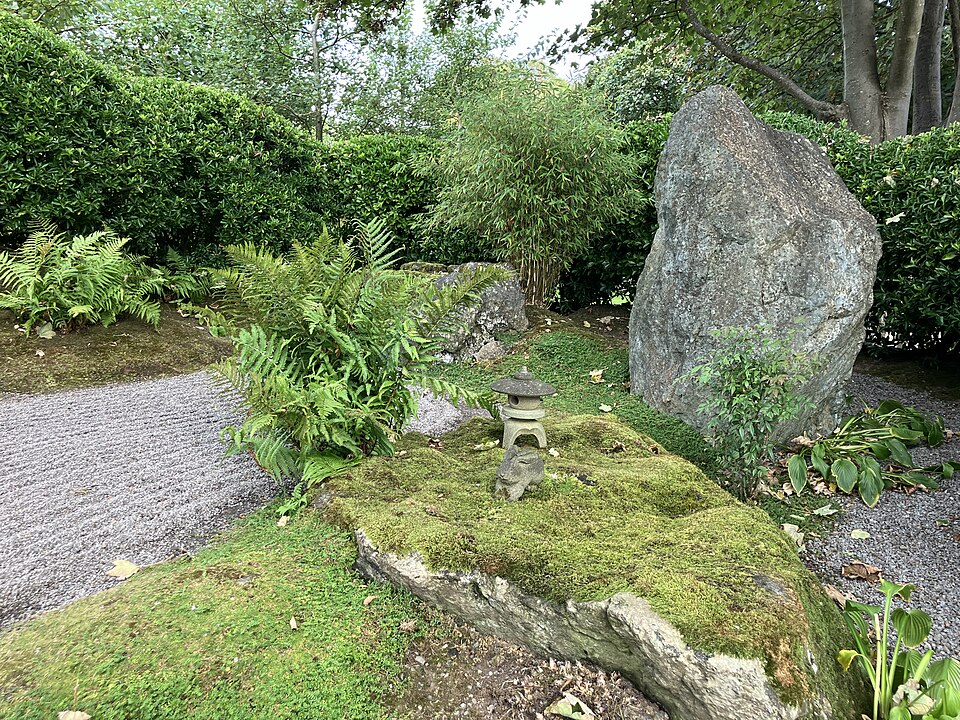
The Japanese sections use ponds, streams, a waterfall, rock arrangements, moss, gravel, bridges, bamboo fences and winding paths. A natural spring supplies three ponds and is incorporated symbolically into the narrative of Hearn’s life. An authentic-style ochaya tea house, a tea garden, a fujidana wisteria frame and an azumaya overlooking the lily pond provide architectural focal points. The Tea House Garden was created by Kyoto gardener Kazuki Kusumi.
The composition draws primarily on the tradition of the Japanese strolling garden, while also using the surrounding woodland and views across Tramore Bay as shakkei, or borrowed scenery. Evergreen trees, bamboo, ferns, camellias, magnolias, azaleas and flowering cherries provide structure and seasonal change.
The garden’s narrative incorporates themes from Hearn’s writings and Japanese folklore, including the legends of Urashima Tarō and the Cave of the Children’s Ghosts. Hearn’s 1892 essay “In a Japanese Garden”, which described his home garden in Matsue and explored Japanese attitudes towards nature, was a major source of inspiration.
Garden elements
Bridges
Buildings
Enclosures
Waters and islands
Stones
Other elements
Current status
The gardens are operated as a not-for-profit social enterprise by Lafcadio Hearn Japanese Gardens CLG, with support from public programmes and local volunteers. They remain open to paying visitors throughout the year, subject to seasonal hours and occasional weather-related closures.