
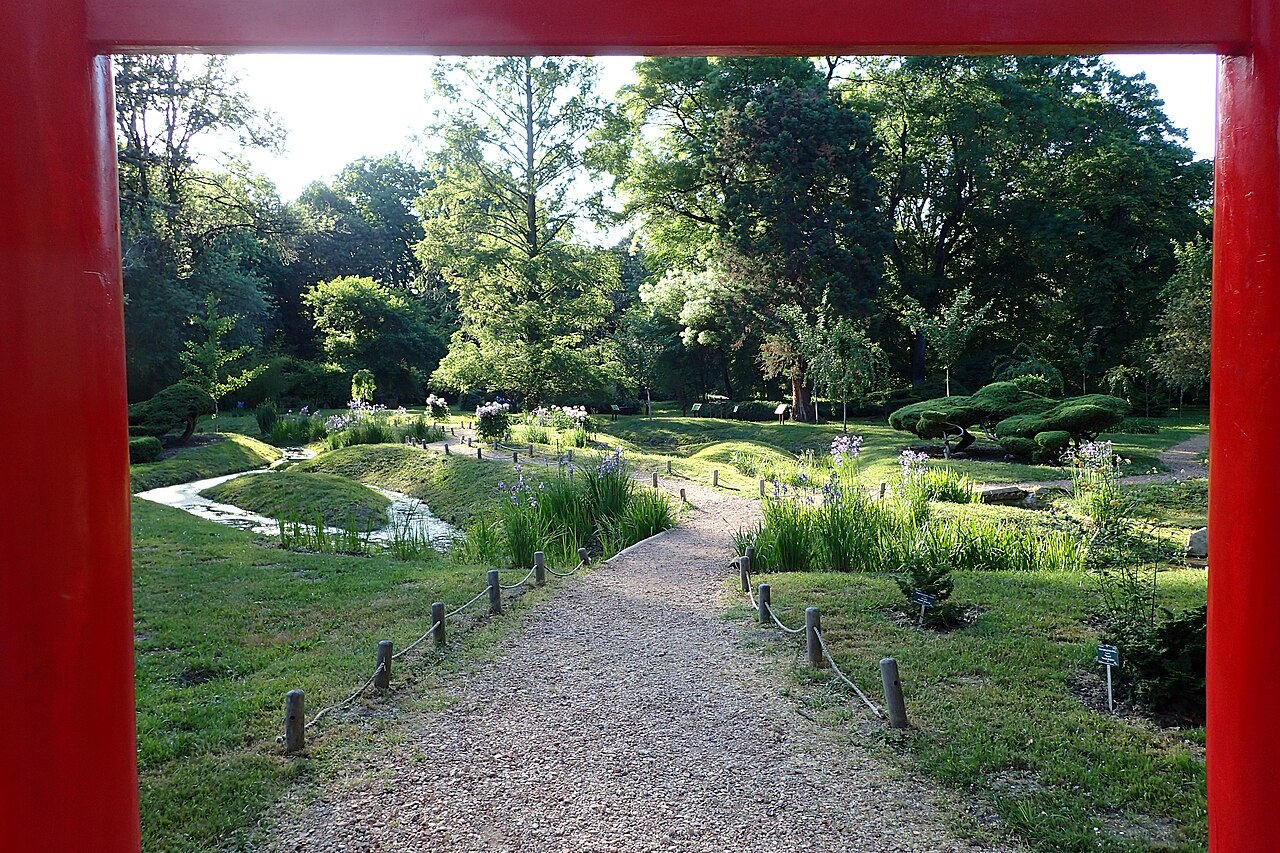
University of Szeged Botanical Garden
Photo: Krzysztof Ziarnek, Kenraiz / CC BY-SA 4.0, modified.
Overview
The Japanese Garden of the University of Szeged Botanical Garden is an extensive strolling landscape developed around the garden’s historic lotus pond. Created from 2014, it combines a lowland stream garden with a more elevated mountain and tea-garden landscape on the pond’s islands. Winding paths, wooden bridges, streams, a waterfall, symbolic islands, stone lanterns and a broad collection of East Asian plants create a sequence of changing scenes intended to be experienced on foot.
History
The large pond at the centre of the present composition was excavated in 1931 and planted with Indian lotus in the following year. It became one of the oldest and most recognisable areas of the botanical garden, but was not originally conceived as a Japanese garden.
Development of the Japanese Garden began in 2014, when the existing lotus pond was incorporated into a new Japanese landscape and its largest island was opened to visitors. The garden was designed and laid out by Hungarian Japanese-garden specialist Zoltán Dani, who had studied traditional garden construction in Kyoto.
Work continued during 2015, with the addition of bamboo, camellias, rhododendrons, flowering cherries, irises and other Asian plants. A red torii gate was installed at the entrance to the strolling section, while streams, paths and specialist garden structures continued to be developed.
Design features
The garden is divided into two principal landscape zones. The lower section is a gently sloping strolling garden modelled on natural river valleys. Small streams divide the ground into islands, while paths and Japanese-style wooden earth bridges lead visitors through the composition. The watercourses include references to nosuji, streams running between hills, and yarimizu, winding streams historically associated with aristocratic gardens.
The second section incorporates the historic lotus pond and its islands, which are interpreted through the symbolism of Buddhist Pure Land gardens. The Turtle Island and Crane Island represent longevity and the legendary Isles of the Immortals, while the larger Waterfall Island forms a more elevated mountain landscape.
The Waterfall Island also contains elements associated with a tea garden, including a tsukubai water basin and a shaded approach through rhododendrons, azaleas and Japanese maples. At its highest point, a vine-covered fuji-dana, or wisteria shelter, provides a resting place and a view across the lotus pond.
The planting includes Japanese flowering cherries, Japanese apricot, Japanese maples, bamboo, camellias, rhododendrons, azaleas, irises, Japanese cedar, Japanese black pine and sacred bamboo. A collection of nearly forty bamboo taxa forms one of the garden’s principal botanical features. Stone lanterns and trained evergreen trees accompany the walking route.
Garden elements
Bridges
Waters and islands
Stones
Shinto elements
Other elements
Current status
The garden remains maintained as one of the principal themed collections of the University of Szeged Botanical Garden. It is used for guided garden walks and seasonal cultural programmes, particularly the spring Hanami and autumn Momiji events.