
Mogyoróssy János City Library
Photo: Globetrotter19 / CC BY-SA 3.0, modified.
Overview
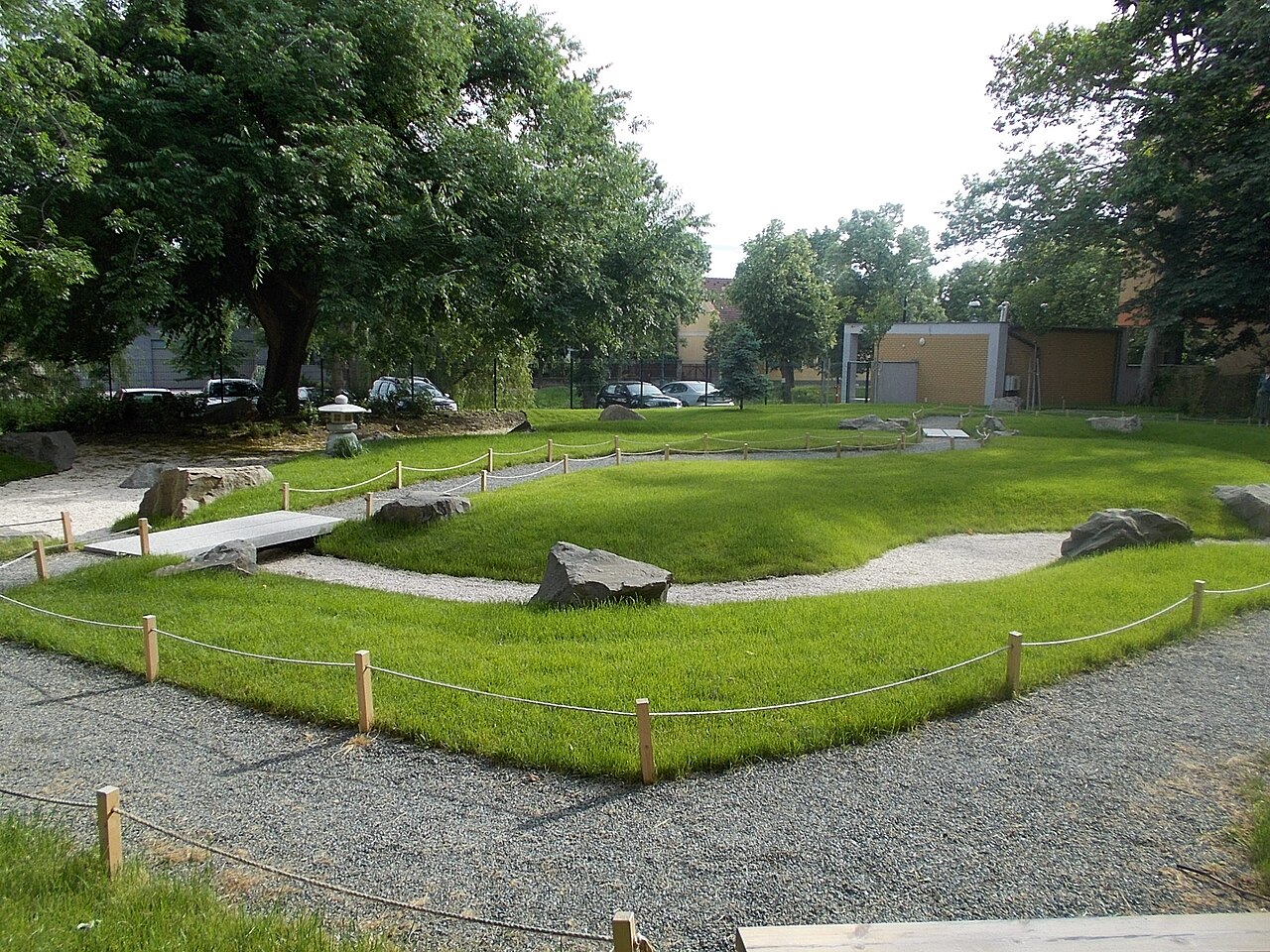
The Japanese Garden of Gyula is a compact public garden in the courtyard of the Mogyoróssy János City Library. Opened in 2021, it was designed by Hungarian Japanese-garden specialist Zoltán Dani as a community and recreational space. A circular gravel path leads through a composition of rocks, a water feature continuing as a dry stream, small bridges, stone lanterns, benches and Japanese-associated planting.
History
The project was initiated by the Japánkert Barátok Köre Egyesület, a local association founded to promote Japanese garden culture. The organisation had considered creating a Japanese garden in Gyula for several years and had already proposed a tea garden for the library courtyard in 2013, but the scheme remained unrealised until funding became available through a TOP-CLLD community-development programme.
Planning began after the association received nearly HUF 20 million in European Union funding. The unused rear courtyard of the library was selected as the site, and Zoltán Dani, president of the Japanese Garden Hungary Association, prepared the design. Construction began in May 2021, including the delivery of approximately 26 tonnes of rocks, stone and gravel.
The completed garden was formally inaugurated on 22 September 2021 in the presence of Masato Otaka, Japan’s ambassador to Hungary. The garden was presented as both a local community space and a symbol of cultural friendship between Hungary and Japan.
Design features
Visitors enter through a torii gate and follow a grey-gravel path that circulates around the garden. The route crosses the symbolic watercourse on small bridges and is accompanied by stone lanterns, stone benches and carefully arranged rocks, allowing the composition to be experienced from a sequence of viewpoints.
In one corner, a small water feature represents the source of a stream. The actual water then gives way to a dry stream composed of white gravel, combining a living water element with an abstract karesansui-inspired representation. The dry stream forms the central organising feature around which the walking route and seating areas are arranged.
The existing mature vegetation was largely retained and supplemented with Japanese maples, ornamental flowering cherries and bamboo. Bamboo planting also screens the boundary facing the Élővíz Canal, helping to enclose the library courtyard and separate the garden from its urban surroundings.
Garden elements
Bridges
Enclosures
Waters and islands
Stones
Other elements
Current status
The garden remains maintained as a visitor and community space connected to the Mogyoróssy János City Library. It is free to enter and is currently accessible during the library’s published opening hours. Guided library and garden visits also continue to be offered.