
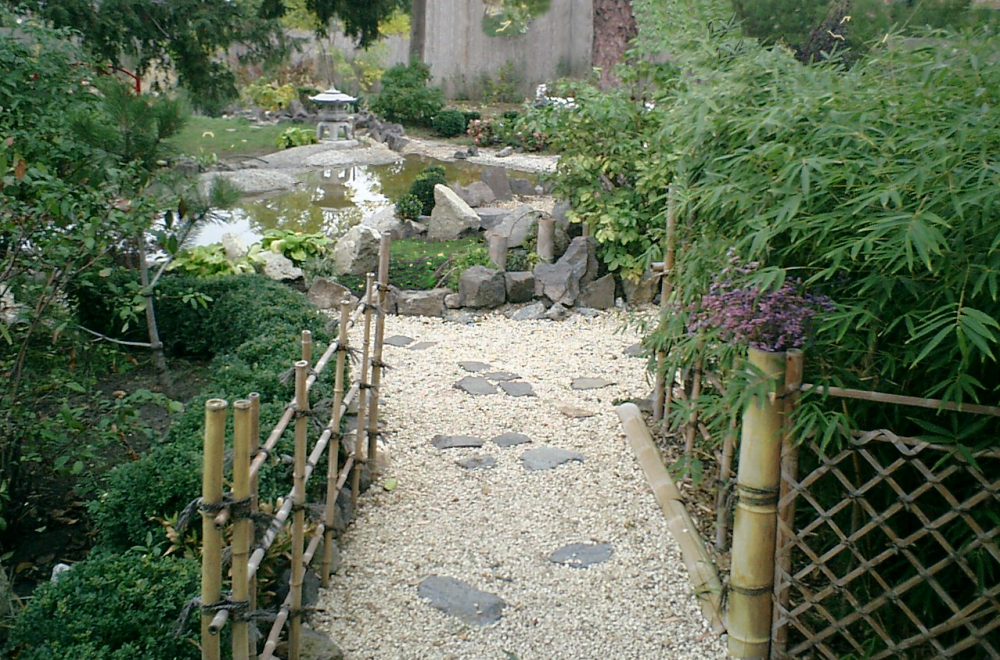
Japanese Museum Garden
Photo: Doma-Mikó István, modified.
Overview
The Japanese Museum Garden was a 1,200-square-metre Japanese landscape garden adjoining the former Japanese Museum in Füzesgyarmat, Hungary. Opened in 2000, the garden was designed by Japanese urban-development specialists Yasuo Sumiyoshi and Akira Kobayashi. Its composition included ponds, a small stream, stepping stones, a drum bridge, a crane island, bamboo water devices, stone lanterns and Japanese ornamental and fruit trees. The garden formed an outdoor extension of the museum and was intended to introduce Japanese culture and garden design to Hungarian visitors.
History
The Japanese Museum was founded in 1980 by the Füzesgyarmat-born painter István Doma-Mikó, who had developed close cultural and professional connections with Japan. After several relocations, the collection was installed in a permanent museum building in Füzesgyarmat. The associated Japanese garden was created beside the museum and opened in the summer of 2000.
The garden was designed by Yasuo Sumiyoshi, then director of the Tokyo Metropolitan Government’s urban-development office, and chief engineer Akira Kobayashi. Both designers also participated personally in its construction. István Doma-Mikó directed the overall museum project and contributed to the establishment and planting of the garden.
The museum and garden served as a venue for concerts, cultural demonstrations and arts education involving invited Japanese artists and teachers. Foundations were also laid for a pagoda-roofed tea house, although the building was never completed. The museum ceased operating in 2006, after which the site was closed to visitors.
Design features
The garden was organised around a sequence of ponds, a small artificial stream and walkable paths formed with stepping stones. A prominent drum bridge, designed according to plans by a Japanese engineer, crossed the stream. Its structural plans were prepared by Hungarian railway engineer Béla Lakatos, who also supervised its construction.
One pond contained a Crane Island, referring to the crane as a traditional Japanese symbol of longevity. Other characteristic elements included a hand-carved stone lantern made by a Japanese craftsman named Suguta, bamboo water devices and musical water spouts.
The planting incorporated Japanese ornamental and fruit trees, flowering plants and bamboo. Particularly notable were ume, or Japanese apricot trees, propagated from material reportedly presented by a descendant of the Tokugawa family. The paths, water features, bridge and island allowed visitors to move through a succession of small garden scenes rather than view the composition from a single fixed position.
Garden elements
Bridges
Enclosures
Waters and islands
Stones
Other elements
Current status
The Japanese Museum closed in 2006, and the building and garden are not open to the public. The former museum property at Kossuth utca 10 remains associated with the Municipality of Füzesgyarmat, but reliable recent documentation of the garden’s physical condition or continued maintenance has not been found. The surviving website functions primarily as a historical record of the former museum and garden.