
Overview
The Japanese Garden of Athens is a 3,500-square-metre public garden created in the former Niriides Park in the Pangrati district. Opened in November 2021 and completed in phases through 2022, it was the first public Japanese garden in Greece. The design combines a circulating path, dry stream, rocks, modelled hills, clipped shrubs and Japanese and Mediterranean planting within a contemporary urban interpretation of a Japanese strolling garden.
History
The project was realised through the Municipality of Athens programme “Adopt Your City”, with financial support from JT International Hellas and under the auspices of the Embassy of Japan in Greece. It transformed the neglected Niriides Park, close to the National Gallery, into a thematic public landscape intended to improve urban biodiversity and provide a quiet recreational space.
The landscape study was completed in June 2021, and the first planting phase followed in November. The garden was inaugurated on 9 November 2021, while additional planting and architectural elements continued afterwards; later accounts identify July 2022 as the completion of the broader project.
The garden was designed and implemented by the Athens landscape architecture practice Ecoscapes, with landscape architect Antonis Skordilis identified in contemporary reporting as the principal designer. Japanese specialists were consulted for later design elements and the garden’s cultural interpretation.
Design features
The garden is organised around a principal circulating route with smaller meandering paths, creating a sequence of changing views. A dry river of gravel and granite rocks crosses the site, with stones representing islands and the raked mineral surface suggesting flowing water. Small planted hills, framed paths and carefully positioned rocks reinforce the impression of a condensed natural landscape.
Planting combines Japanese flowering cherries, Japanese maples and bamboo with Mediterranean species suited to Athens’ hot, dry climate, including myrtle and other evergreen shrubs. Existing mature trees were retained where possible, while shaped shrubs and a carefully pruned entrance pine provide stronger Japanese visual references.
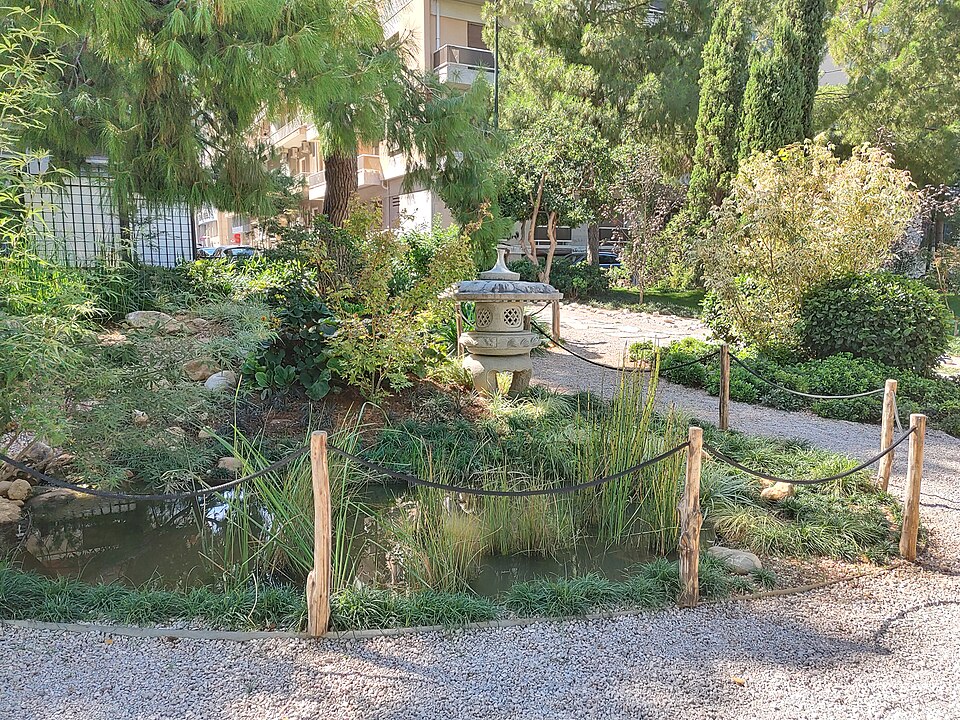
The later composition includes several thematic areas with features such as a koi pond, purification basins, stone lanterns, a tea-house-inspired pergola and a torii entrance. Granite benches and accessible paths allow the garden to function both as a contemplative landscape and as an inclusive neighbourhood park.
Garden elements
Waters and islands
Stones
Shinto elements
Other elements
Current status
The garden remains a maintained municipal park and venue for Japanese cultural activities. It is freely accessible and has five entrances from the surrounding streets.