
Yuko Nihon Teien
Overview
The Japanese Friendship Garden, officially named Yūkō Nihon Teien (“Japanese Garden of Friendship”), is a compact Japanese dry landscape garden at Johannisplatz in Wolfratshausen, Bavaria. Covering approximately 500 square metres, it was presented by the Japanese partner city of Iruma for Wolfratshausen’s millennium celebrations. The garden represents a symbolic Japanese landscape in which stone and gravel evoke rain, streams, waterfalls and the sea, expressing the continuity of friendship between the two cities.
History
Wolfratshausen and Iruma established their formal friendship agreement on 14 October 1987, following cultural contacts that had begun in the early 1980s. The garden was conceived as a gift from Iruma to mark the 1,000th anniversary of Wolfratshausen and to give permanent physical expression to the partnership.
Construction began in 2002 under the direction of Japanese garden specialist Takaaki Yoshikawa, who supervised the work and made a major contribution to its execution. The completed garden was inaugurated on 19 September 2003 during Wolfratshausen’s millennium celebrations.
The Partnerschaftsverein Iruma–Wolfratshausen e.V., founded shortly after the garden opened, subsequently assumed an important role in its care. Local volunteers maintain the planting according to guidance supplied by Japanese specialists, while gardeners from Iruma have periodically visited Wolfratshausen to carry out specialist pruning and maintenance.
Design features
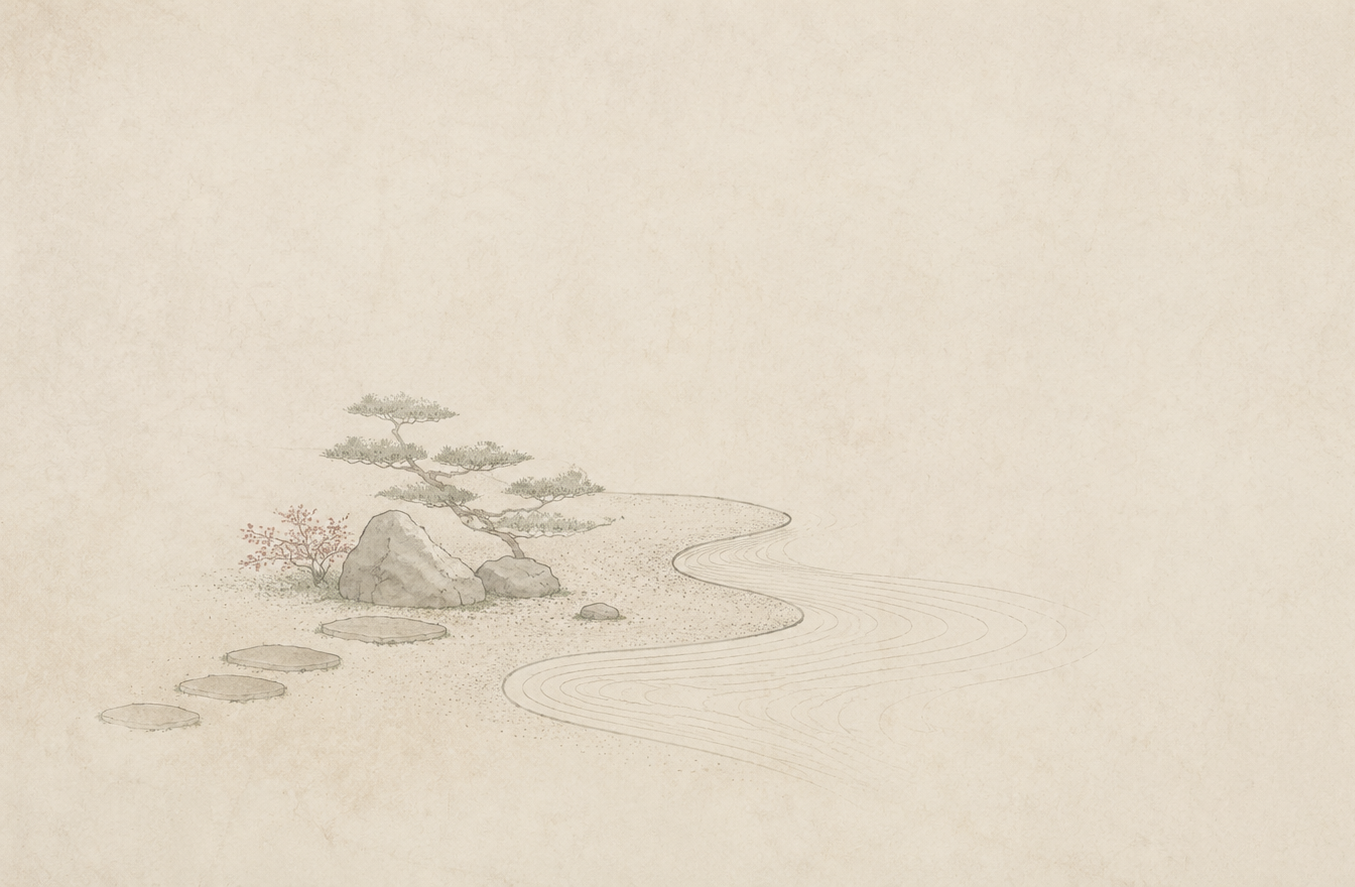
The garden is conceived as a waterless landscape garden in which the natural scenery of Japan is represented in miniature. Gravel and carefully positioned stones trace a symbolic hydrological cycle: rain falls onto rocks, gathers into streams, descends as a waterfall, reaches the sea and eventually returns to the land as rain. This continuous cycle represents the hope that the friendship between Wolfratshausen and Iruma will continue across generations.
The compact composition includes gravel surfaces, rock groupings, stepping stones, shaped shrubs, ground-cover planting and mature ornamental trees. Stones are treated symbolically rather than simply as decorative objects, representing elements such as mountains, animals and flowing water. Trees symbolise life and humanity, while the interplay of open gravel and dense planting creates a balance between movement and stillness.
A small wooden bridge and winding routes allow visitors to experience the garden from several viewpoints. Although the garden can be entered and crossed, its dominant character is not that of an extended strolling garden but of a compact dry landscape composition designed for attentive observation.
Garden elements
Bridges
Waters and islands
Stones
Other elements
Current status
The garden remains maintained by the Partnerschaftsverein Iruma–Wolfratshausen with support from the city and periodic specialist guidance from Iruma. It is freely accessible as a small public garden and continues to serve as a symbol of the active municipal friendship.