
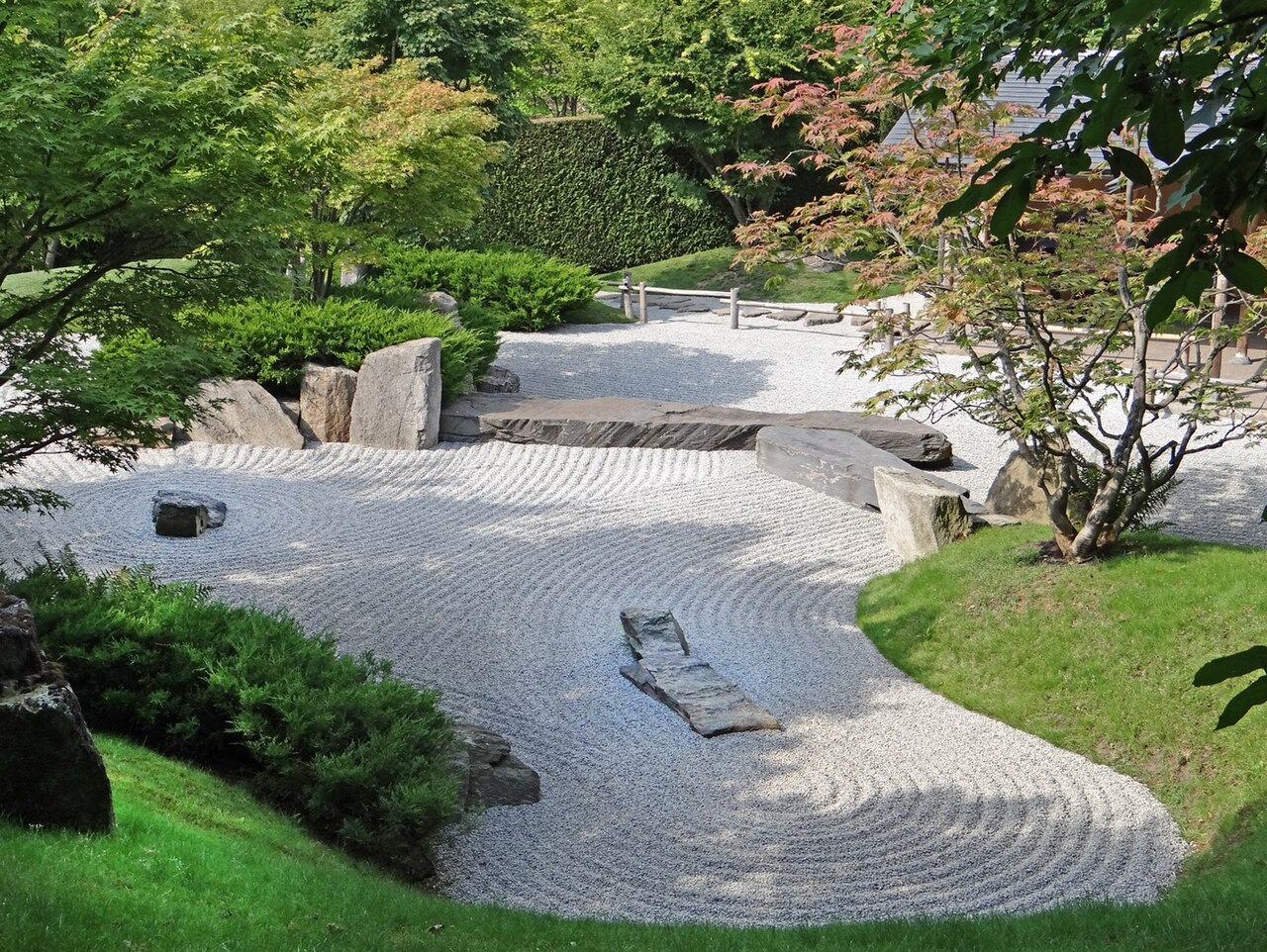
Yū Sui En
Photo: Jean-Pierre Dalbéra / CC BY 2.0, modified.
Overview
The Japanese Garden, formally named Yū Sui En, or the Garden of Flowing Together Water, is a Japanese landscape garden within Gärten der Welt in Berlin-Marzahn. Designed by Japanese landscape architect and Zen priest Shunmyō Masuno, the approximately 2,700-square-metre garden combines a water garden, a Zen-inspired dry garden and a tea-garden section along a prescribed circular route. Its central theme is water as a symbol of time, cultural encounter and the harmonious convergence of different elements.
History
The garden originated through the city partnership between Berlin and Tokyo. Planning began in 2001, when Shunmyō Masuno was commissioned to design both the garden and its central pavilion as a unified composition. The project was intended to provide a permanent expression of cooperation between the two cities while introducing Japanese garden philosophy within Berlin’s developing collection of international gardens.
The completed garden was formally opened on 30 April 2003. It became one of the principal international themed gardens in what was then known as the Erholungspark Marzahn, later renamed Gärten der Welt. Its Japanese name, Yū Sui En, refers to waters flowing together and symbolises both the meeting of cultures and the interdependence of natural elements.
The central pavilion, known as Nyo Sui Tei, was designed as an integral part of the garden rather than as an independent architectural object. In 2006, Masuno received the Order of Merit of the Federal Republic of Germany, partly in recognition of his contribution to the Berlin garden.
Design features
The garden is divided into three interconnected sections representing the past, present and future. Visitors follow a circular route through the northern water garden, the southern Zen garden and the eastern tea garden. The pavilion stands at their meeting point and represents the present, while the sequence of spaces functions as a symbolic journey through time.
Water provides the principal organising theme. A small stream, known as the River of Time, passes through parts of the composition, while gravel and stone represent water where no actual water is present. The transition from flowing water to the dry landscape links tangible natural processes with more abstract ideas of memory, uncertainty and transformation.
The southern main garden is arranged as a Zen-inspired karesansui composition. Raked gravel represents the sea and its currents, while large stones form islands, banks and symbolic landscapes. Approximately 300 ancient augen-gneiss stones were used throughout the garden, giving stone a more prominent visual role than planting.
A symbolic dry waterfall represents the future. Among its stones is a carved or naturally suggestive carp attempting to swim upstream, referring to the East Asian story in which a carp that overcomes a waterfall transforms into a dragon. The dry cascade will never carry water because the future remains uncertain and has not yet been filled by experience.
The planting includes Japanese maples, ornamental cherries, Japanese flowering dogwood, Japanese pieris and carefully shaped evergreen trees. The composition uses relatively restrained colour and relies strongly on stone, texture, seasonal change and silence. A carefully framed view beyond the garden employs shakkei, or borrowed scenery, incorporating distant buildings and artworks into the visual composition.
Garden elements
Bridges
Buildings
Waters and islands
Stones
Other elements
Current status
The garden remains maintained as one of the principal themed gardens within Gärten der Welt. Visitors experience it along an eleven-station circular route, and the dry landscape is regularly raked and carefully maintained.