
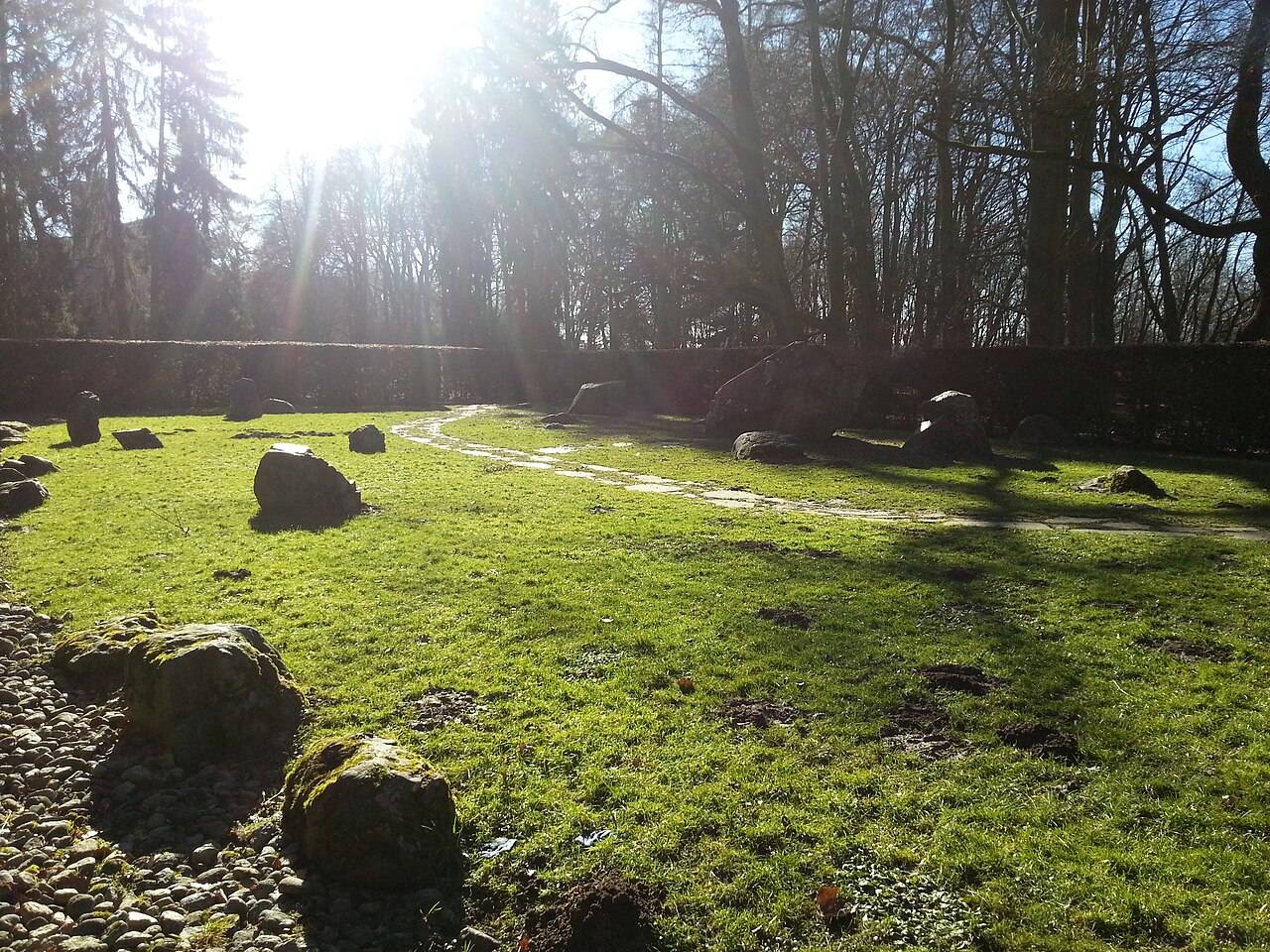
Wittelsbach Park
Photo: LarsEvers / CC BY-SA 3.0, modified.
Overview
The Dry Garden in Wittelsbach Park is the Rudolf-Diesel-Gedächtnishain, a Japanese dry landscape garden and memorial grove in Augsburg. It honours Rudolf Diesel, who studied in Augsburg and invented the diesel engine. The City of Augsburg identifies it as a Japanese stone garden created in 1957 within Wittelsbacher Park, while the city’s Botanical Garden chronology describes it specifically as a japanischer Trockenlandschaftsgarten.
History
During a visit to Augsburg in 1953, Japanese industrialist Magokichi Yamaoka looked for a memorial to Rudolf Diesel and, finding none, decided to donate one. The garden was intended to mark Diesel’s centenary and the 60th anniversary of the diesel engine, and also to express friendship between Japan and Germany. The design was commissioned from architect Junzō Sakakura. The garden was first built and inaugurated in Japan on 10 December 1956, then transported to Augsburg and formally handed over on 5–6 October 1957.
Design features
The garden is a Japanese stone / dry landscape memorial garden of about 1,000 m², enclosed by hedges. Its composition centres on a large main stone bearing a relief portrait of Rudolf Diesel, surrounded by 56 stones of different sizes. A path of stone slabs leads through the arrangement. Wikimedia Commons documentation notes that some of the large stones, up to around two metres high, were transported from the Inagawa River area in Japan to Augsburg.
Garden elements
Stones
Other elements
Current status
Extant public Japanese dry landscape garden / stone memorial grove in the south-western part of Wittelsbacher Park. The garden was donated by Magokichi Yamaoka, founder of Yanmar Diesel, in memory of Rudolf Diesel and as a symbol of German-Japanese friendship. It was first assembled in Japan in 1956, then dismantled, transported to Augsburg and reconstructed in the same arrangement in Wittelsbacher Park, where it was officially handed over in October 1957. Augsburg’s official park information still lists it as a Japanese stone garden within the public Wittelsbacher Park.