
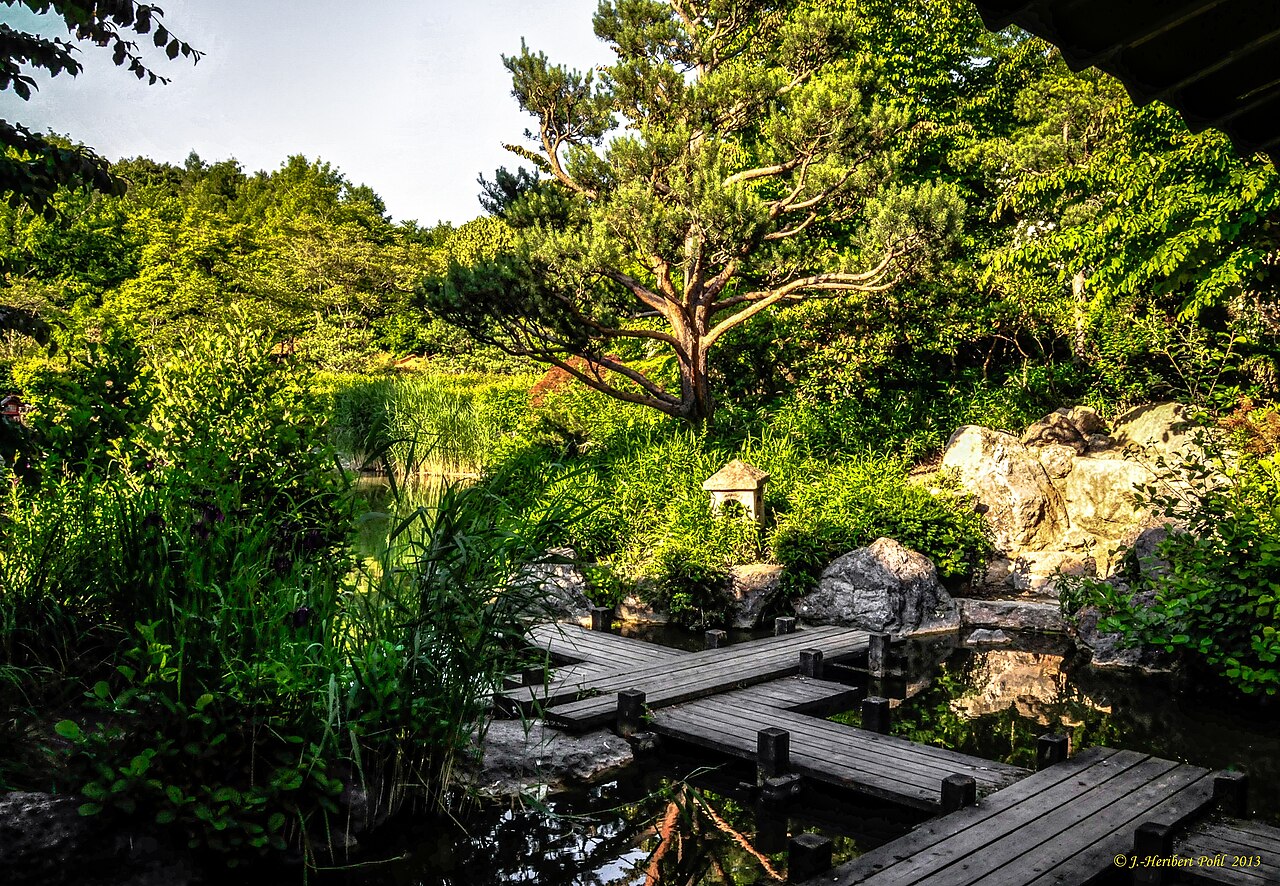
Westpark
Photo: Heribert Pohl / CC BY-SA 2.0, modified.
Overview
The Japanese Garden in Munich’s Westpark was created for the International Garden Exhibition 1983 and contributed by Munich’s partner city Sapporo. It forms part of the park’s East Asia ensemble, together with the Chinese Garden, Thai Sala and Nepalese Pagoda. The wider Westpark was designed by landscape architect Peter Kluska and opened in 1983.
History
Westpark was built for the Internationale Gartenbauausstellung 1983 and later retained as a public park. The Japanese Garden was one of the national / cultural garden contributions preserved after the exhibition. Munich’s official tourism material identifies it as a traditional Japanese garden contributed by Sapporo, while German summaries describe it as created in cooperation with the partner city for the 1983 exhibition.
Design features
The garden combines several Japanese garden references rather than reproducing one single historical type. Descriptions mention a shallow pond, terrace, footbridge / viewing platform, stylised tea pavilion, stones arranged as a rugged landscape, Japanese-style planting, stone lanterns and a waterfall. Sources also describe it as combining pond-island, meditation and tea-garden elements.
Garden elements
Bridges
Buildings
Waters and islands
Stones
Other elements
Current status
Extant public Japanese garden within Munich’s Westpark. It remains freely accessible as part of the East Asia ensemble preserved from the 1983 International Garden Exhibition.