
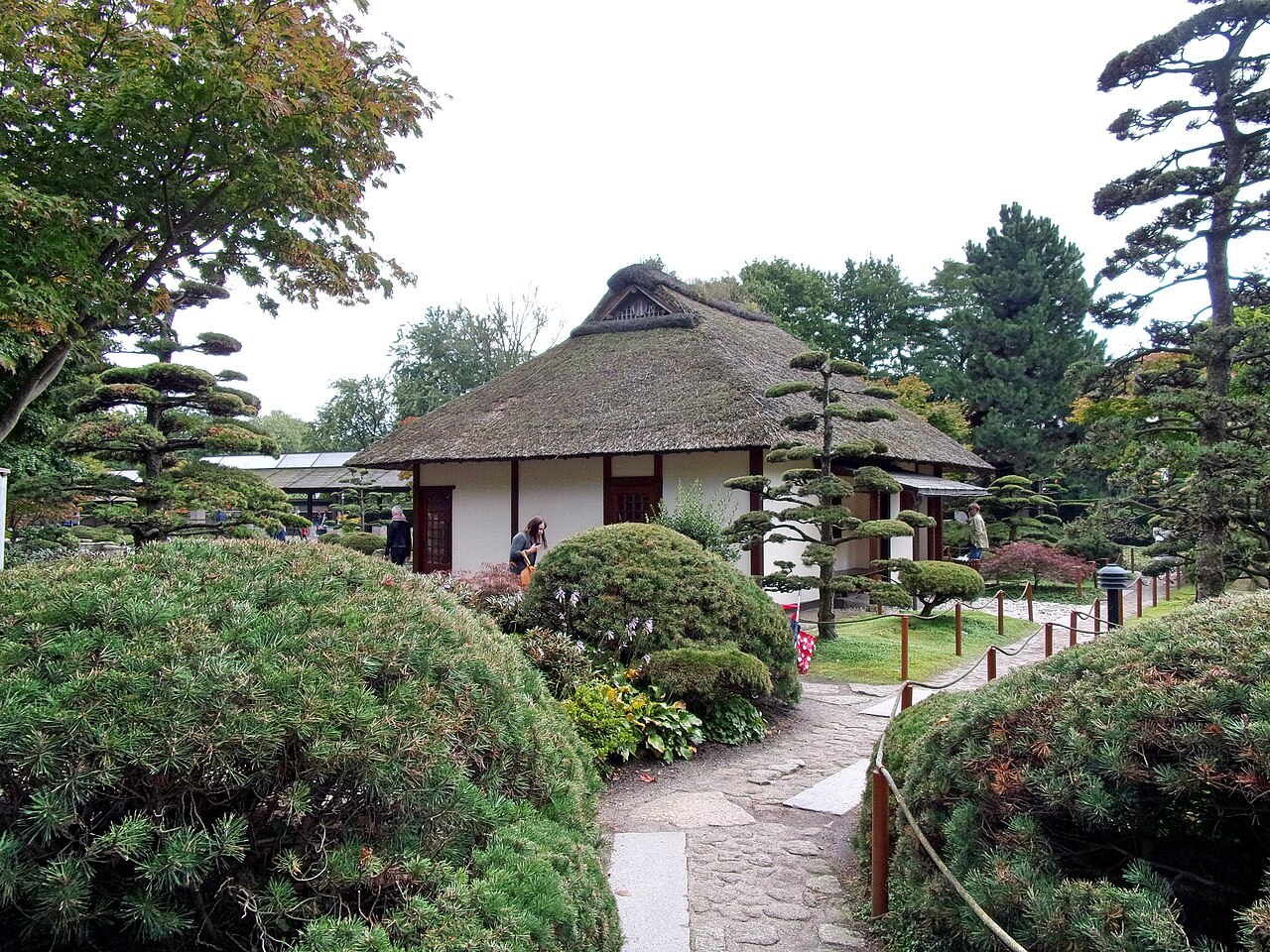
Planten un Blomen Park
Photo: Pauli-Pirat / CC BY-SA 4.0, modified.
Overview
The Japanese Garden in Planten un Blomen is one of Hamburg’s best-known Japanese gardens and is officially presented as the largest garden of its kind in Europe. It lies between the CCH and the Hamburg trade-fair grounds, centred on a small lake and a rustic Japanese teahouse. Hamburg’s official park site states that the garden was created in 1990 after a concept by Japanese landscape architect Yoshikuni Araki.
History
Planten un Blomen had already been shaped by several major garden exhibitions in the twentieth century, including the IGAs of 1953, 1963 and 1973. In the 1980s, the park underwent a new ecological and landscape-oriented redesign, with contributions by designers including Yoshikuni Araki. Araki first created the nearby Japanese Landscape Garden in 1988, on the other side of Marseiller Straße.
The later and better-known Japanese Garden with Teahouse was created around 1990 according to Araki’s concept. Some sources give 1991 for the garden and teahouse, while Hamburg’s official Planten un Blomen page gives 1990. For database purposes, it is safest to record 1990 / 1991, unless you want a single value, in which case 1990 is the better official-site date. The garden is linked to Hamburg’s relationship with Japan, especially the city partnership with Osaka, which is also Araki’s home city.
This entry should be kept separate from the 1963 IGA Kleines Teehaus and from the 1988 Japanese Landscape Garden in Planten un Blomen. Naturally, Hamburg contains multiple Japanese garden layers in the same park system, because one clean database row would have been too merciful.
Design features
The garden is organised around a small lake, with a Japanese teahouse opening onto the water by a terrace. A wooden gate marks the entrance into the more intimate garden area. The wider composition includes water, rocks, paths, planting, carefully framed views and cultural programming around tea ceremony, calligraphy, taiko and other Japanese arts.
Garden elements
Buildings
Enclosures
Waters and islands
Stones
Other elements
Current status
Extant public Japanese garden within Planten un Blomen. It remains freely accessible as one of the park’s major themed gardens, with tea ceremonies and Japanese cultural events held in the teahouse during the main season.