
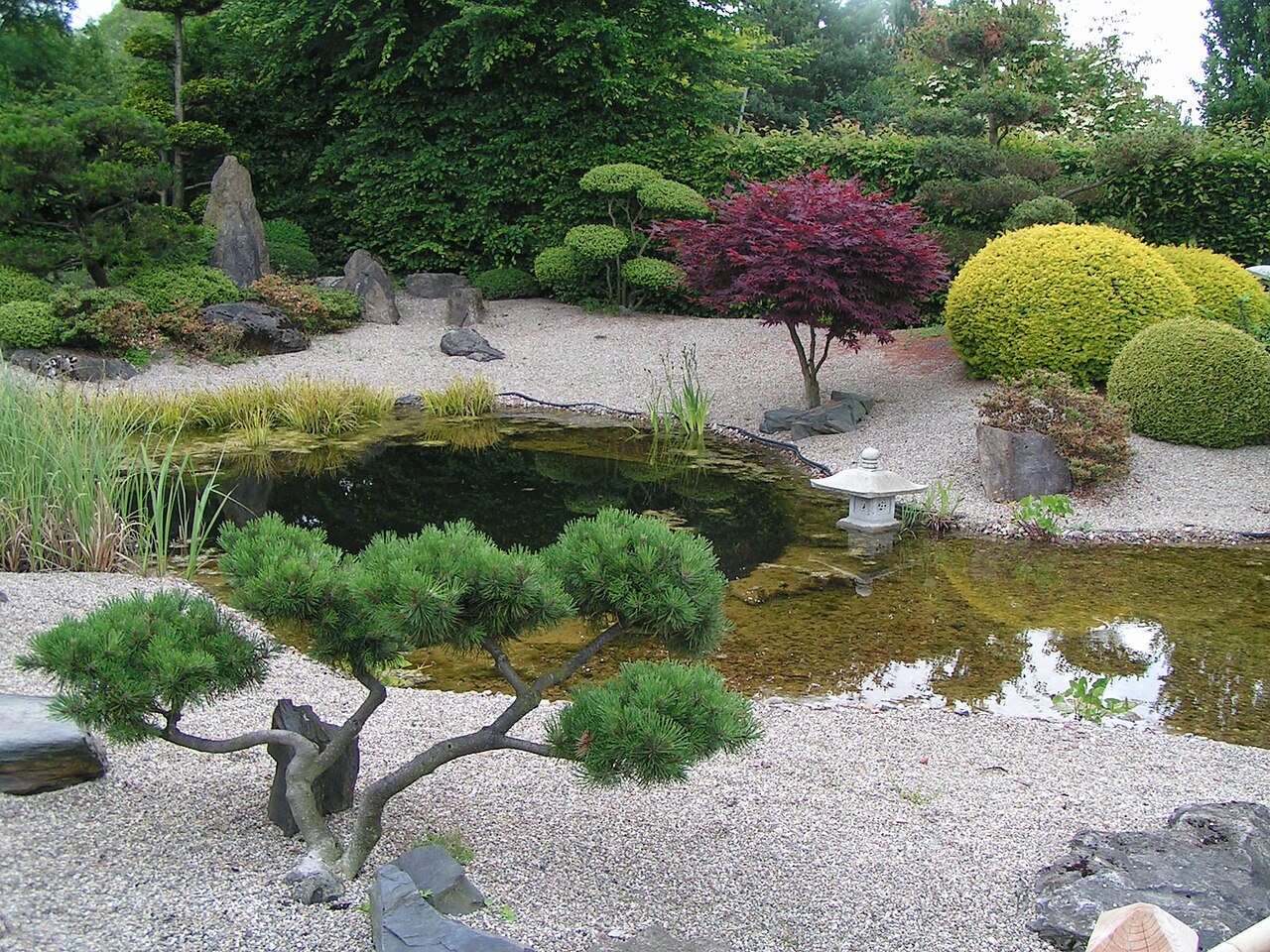
Park der Gärten
Photo: Corradox / CC BY-SA 3.0, modified.
Overview
The Japanese Garden is a compact landscape garden within Park der Gärten in Bad Zwischenahn. It represents a stylised mountain landscape in which a river descends between rocks and gradually becomes calm water. Rather than using an actual stream, the watercourse is expressed through gravel in the manner of a dry garden. Mature clipped conifers, rhododendrons, bamboo, stonework and a small thatched pavilion create an enclosed composition intended to convey age, tranquillity and balance.
History
The original garden was planned and constructed in 2000 by Hans Jürgen Höpken, formerly of Baumschule Höpken in Bad Zwischenahn, together with Gerd Alves. It was created before the Lower Saxony State Garden Show held on the wider site in 2002 and subsequently became Mustergarten 10 within Park der Gärten.
In 2020 and 2021, the garden underwent a major redesign and extension. The project was undertaken by Park der Gärten in cooperation with landscape designer Olof Schlittenhardt of Gartenräume. The previously enclosed rear portion was opened and incorporated into the visitor route, while new ground modelling, planting and stonework expanded the composition. A curving natural-stone path was introduced across the dry stream, and a raised pavilion measuring approximately 20 square metres was added. These changes transformed the garden from a predominantly static viewing garden into a small walk-through landscape offering several viewpoints.
Design features
The central dry stream winds between large boulders and areas of carefully modelled ground. Tall false cypresses clipped into tiered, pagoda-like forms create a rising background described as a symbolic stairway to heaven. Large mountain pines are trained as sculptural specimens, while lower clipped pines form rounded “living stones.”
One of the principal features is an approximately sixty-year-old mountain pine trained by Hans Jürgen Höpken as a large garden bonsai. The surrounding planting includes mature rhododendrons, Japanese azaleas, Rhododendron yakushimanum, Japanese holly, yew, Japanese maples, bamboo, Japanese forest grass, ferns and low-growing perennials. A stone lantern marks the bamboo grove, while a natural-stone water basin and the thatched larchwood pavilion form focal points in the extended section. Lawn is used in place of moss because it is more reliable under the local climatic conditions.
Current status
The garden remains maintained as Mustergarten 10 within Park der Gärten and forms part of the park’s publicly accessible collection of demonstration gardens. Its mature clipped trees, dry stream, stone path and pavilion remain the principal features.