
Overview
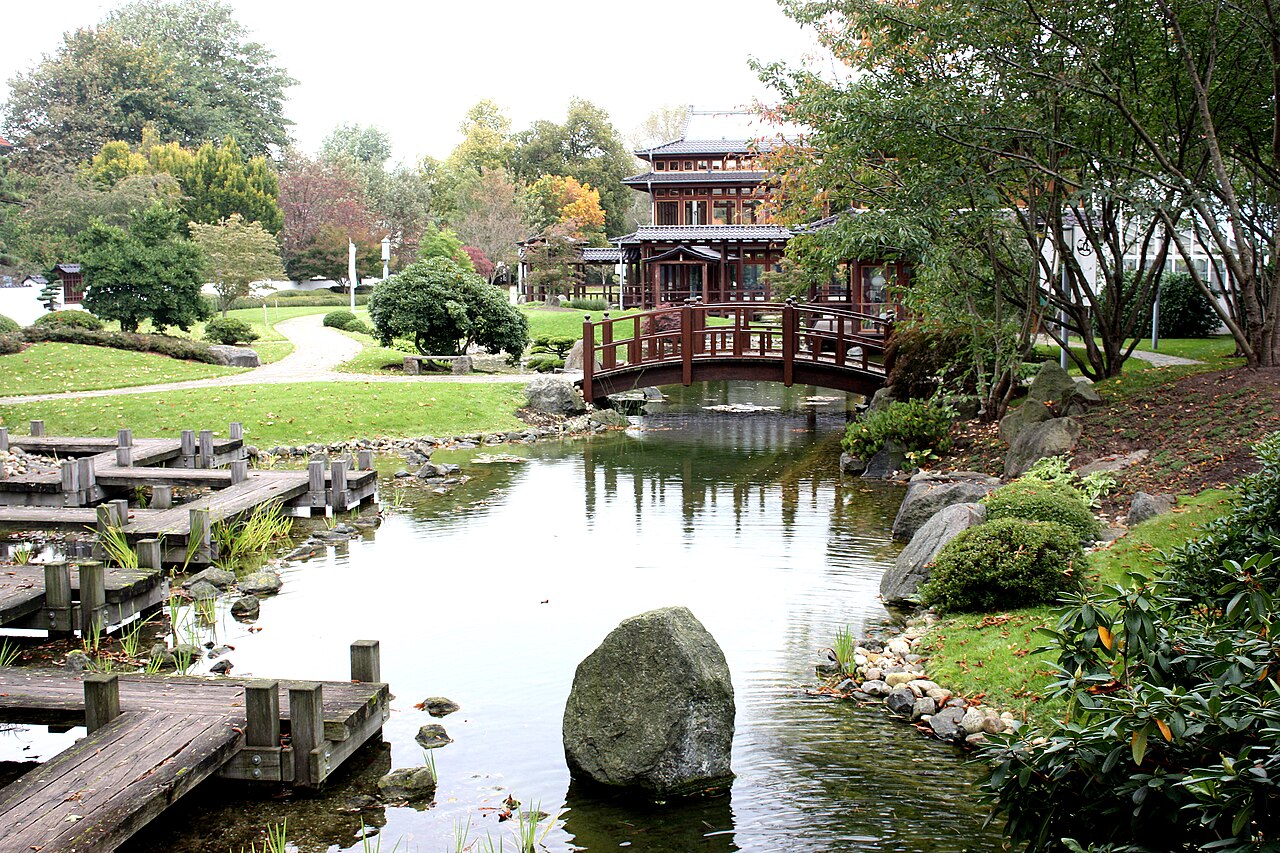
The Japanese Garden of Bad Langensalza, named Kōfuku no Niwa or “Garden of Bliss,” is a modern Japanese strolling garden near the historic centre of the Thuringian spa town. Opened in 2003, it combines a large pond, dry landscape compositions, tea-garden elements, bamboo, flowering cherries, bonsai and Japanese-style pavilions. The garden is designed as a sequence of contrasting scenes representing different stages and qualities of life.
History
The idea of creating a Japanese garden in Bad Langensalza emerged in 1999 as part of the town’s development as a spa and garden destination. Construction of the associated pavilion complex began in 2001, followed by the landscaping of the garden from 2002. The completed garden was formally opened on 16 August 2003.
The garden was planned by landscape architect Silke Hasskerl-Schilling, now known professionally as Silke Schilling. She developed the project from its initial concept through detailed planning and supervised the construction and placement of the garden’s stones. The development was financed through European regional-development funding together with municipal funds from the City of Bad Langensalza.
The garden later became one of the principal themed gardens promoted by the town. It also served as an external venue of the 2021 Federal Garden Show in Erfurt and continues to host events associated with Japanese culture, including Hanami, children’s celebrations, tea ceremonies and the Tanabata festival.
Design features
The garden is laid out as a Japanese strolling garden, allowing visitors to encounter a sequence of different landscapes along its paths. Its conceptual structure includes a Garden of Awakening, associated with the source of life, and a Garden of Reflection, representing maturity and the diversity of life. The changing landscapes and seasonal planting are intended to evoke the varied natural scenery of the Japanese islands.
A large pond occupies much of the southern section. It includes koi, a yukimi-dōrō, or snow-viewing lantern, and a zigzag yatsubashi bridge bordered by irises. The angular form of the bridge creates a changing sequence of views across the water and refers to a traditional Japanese belief that harmful spirits cannot follow sharply turning paths.
The northern section contains a karesansui dry garden formed from pale raked gravel. Within it, two planted stone compositions represent the Crane and Turtle Islands, traditional symbols of longevity and good fortune. A smaller courtyard-style gravel garden with bonsai is positioned near the pavilion complex.
Additional areas include a bamboo grove, cherry garden, azalea garden and displays of mature bonsai. Japanese maples, pines, flowering cherries and carefully shaped shrubs provide strong seasonal and sculptural effects. A stone Buddha, although not a conventional feature of most Japanese landscape gardens, was placed within the azalea garden after being awarded to the town through a municipal competition.
The garden’s buildings include a glazed plant pavilion containing the tea house Sei Sen An, an exhibition area and a separate tea-drinking pavilion connected by a covered passage. The structures support regular tea ceremonies and cultural programmes while also providing sheltered views over the garden.
Garden elements
Bridges
Buildings
Enclosures
Waters and islands
Stones
Shinto elements
Other elements
Current status
The garden remains maintained by the City of Bad Langensalza as a seasonal public attraction and cultural venue. It normally opens from March to October, with additional special events occasionally held outside the regular garden season.