
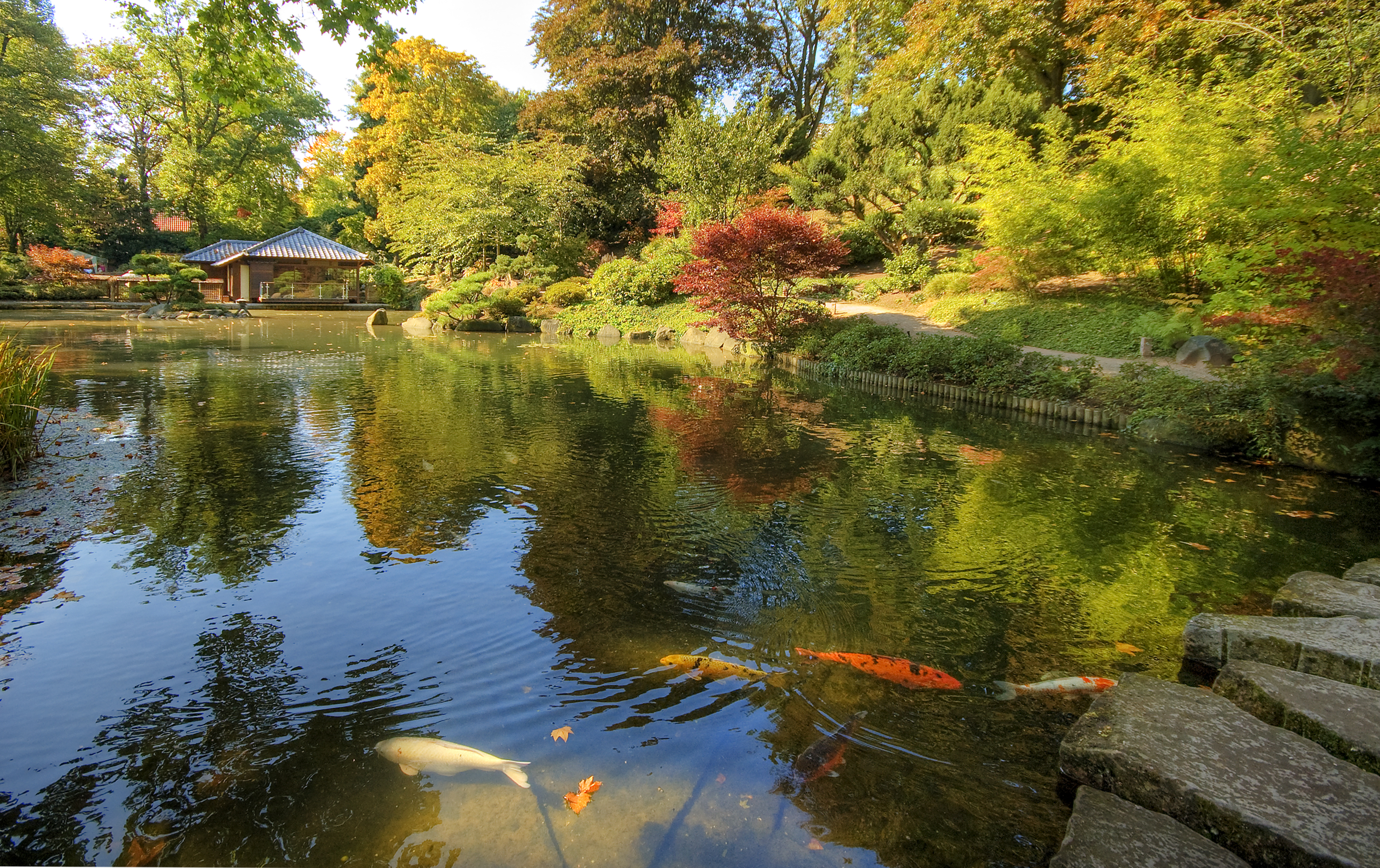
Japanese Garden, Kaiserslautern
Photo: Wolfgang Staudt / CC BY 2.0, modified.
Overview
The Japanese Garden in Kaiserslautern is a large, enclosed landscape garden near the city centre, developed through the partnership between Kaiserslautern and Bunkyō in Tokyo. Covering approximately 13,500 square metres, it combines pond, strolling, dry-landscape and tea-garden traditions within the steeply sloping grounds of a former nineteenth-century landscape park. Two interconnected ponds, waterfalls, winding paths, stone settings, clipped vegetation and an original Japanese tea and guest house form the principal composition.
History
The site was originally used as a sandstone quarry and was transformed from around 1880 into the private villa park known as Am Abendsberg. After 1890, banker Karl Karcher commissioned the Frankfurt landscape architecture firm Siesmayer to create an English-style landscape park. Although the villas were destroyed during the Second World War, several mature trees from this earlier park survived and were later incorporated into the Japanese garden.
The idea for a Japanese garden arose from Kaiserslautern’s relationship with Bunkyō, established as a sister-city partnership in 1988. During the inauguration of Kaiserslauterer Platz in Bunkyō in 1993, Mayor Gerhard Piontek promised that a Japanese garden would be created in Kaiserslautern in return. The former Lautertalpark site was selected in 1996, and the Freunde des Japanischen Gartens Kaiserslautern e.V. was founded in 1997 to realise the project. Construction began in 1998, with planning developed with the assistance of Japanese architect Kunihiko Akamatsu. The first of five planned construction phases opened on 19 April 2000.
Subsequent phases added the stream and waterfall landscape, followed by the stone and moss garden in 2004, the historic Japanese tea and guest house in 2003–2005, and the Tsukiyama mountain garden in 2007. Later work included pond restoration, new bridges and the continuing renovation of major structures such as the entrance torii and red bridge. In 2019, the garden entered into a formal partnership with the Higo-Hosokawa Garden in Bunkyō.
Design features
The garden is arranged across terrain with a height difference of approximately twenty metres. Its lower valley is conceived as a sequence of sea and lake landscapes, while the higher slopes become progressively more mountainous and informal. Curving paths, stone steps, stepping stones, bridges and serpentine routes avoid straight axes and provide a succession of changing views.
Water is the principal unifying element. The upper pond, populated by koi, is bordered by stone settings, reeds and overhanging trees and is visually focused on the historic tea house. Its crane island, planted with three trained pines, symbolises longevity. The lower pond is dominated by a waterfall approximately twelve metres high, with the garden’s streams, cascades and ponds forming a connected water system.
The Tsukiyama garden represents a stylised mountain landscape through rocks, rhododendrons, dwarf bamboo and clipped shrubs. A dry stream composed of slate slabs descends toward an imaginary waterfall. The separate stone and moss garden is based on the dry landscape of Ryōan-ji in Kyoto, using raked gravel to represent water and moss-covered forms to suggest mountainous islands.
Mature beeches, ginkgo, yews, planes, sweetgums and hazels inherited from the earlier landscape park are combined with Japanese and East Asian species, bamboo and trained vegetation. Niwaki, cloud pruning and karikomi are used throughout. Architectural and ornamental features include a five-metre-high red torii, stone lanterns, a red wooden bridge, a zigzag bridge and an original Japanese tea and guest house built in Tokyo around 1900 and installed beside the upper pond in 2003.
Garden elements
Bridges
Buildings
Enclosures
Waters and islands
Stones
Shinto elements
Other elements
Current status
The garden remains maintained and operated by Japanischer Garten Kaiserslautern e.V. as a seasonal public attraction and cultural venue. It continues to host tea ceremonies, Japanese festivals, exhibitions and other events, while restoration and maintenance projects are supported through admissions, memberships, donations and sponsorship.