
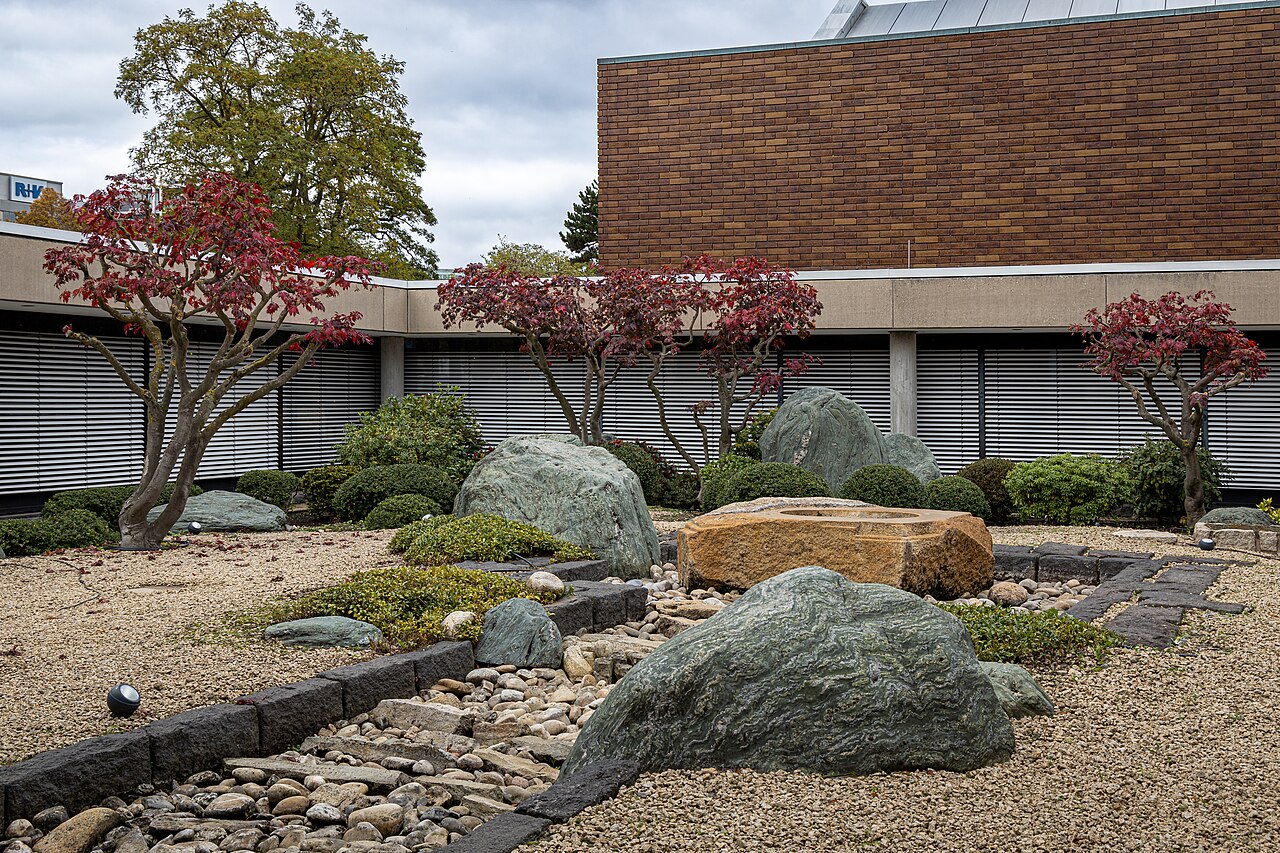
Garden of the Museum of East Asian Art
Photo: Superbass / CC BY-SA 4.0, modified.
Overview
The garden of the Museum für Ostasiatische Kunst in Cologne is a Japanese interior garden integrated into the museum building at the Aachener Weiher. The present museum building was designed by Japanese architect Kunio Maekawa, a pupil of Le Corbusier, and opened in 1977. The museum describes the building as a group of simple cubes arranged around a Japanese interior garden by sculptor Masayuki Nagare.
History
The original Museum für Ostasiatische Kunst opened in Cologne in 1913, but the present building at the Aachener Weiher was opened in 1977. The new museum was designed by Kunio Maekawa, with Cologne architects Berner and Jacobs responsible for implementation. The Japanese interior garden was conceived by Masayuki Nagare as part of the architectural ensemble.
The garden is closely connected with Nagare’s sculptural work at the site, especially the granite sculpture Fahne im Wind / Flag in the Wind, dated 1980, which stands on a small artificial island in the pond in front of the museum. For this reason, 1977 is the better date for the museum garden context, while 1980 should be treated as the date of the associated outdoor sculpture rather than the garden’s opening date.
Although the museum stands beside Hiroshima-Nagasaki-Park, the garden should be understood primarily as part of the Museum für Ostasiatische Kunst, rather than as a separate public park garden. The surrounding park, inaugurated in 2004, is a memorial landscape dedicated to peace and remembrance of the atomic bombings of Hiroshima and Nagasaki; it lies in Cologne’s Inner Green Belt, close to the museum and the Japanese Cultural Institute.
The garden’s significance lies in the way it connects Japanese modern architecture, museum display, and garden aesthetics. With its rocks, water, trees and enclosed spatial setting, it offers visitors an experience of Japanese landscape and spatial sensibility within a modern European museum. As a result, it is best described as an interior Japanese meditation garden integrated into one of Europe’s most important institutions devoted to East Asian art.
Design features
The garden is a modern Japanese interior garden based on the model of Zen Buddhist gardens. The museum describes it as a symbolic miniature landscape representing the macrocosm. It should be treated as a modern Japanese meditation / dry-garden-inspired museum garden, rather than a stroll garden.
Garden elements
Stones
Current status
Extant Japanese interior garden within the Museum für Ostasiatische Kunst in Cologne. It remains part of the museum’s modernist building complex and is experienced as an architectural meditation garden rather than a public outdoor park.