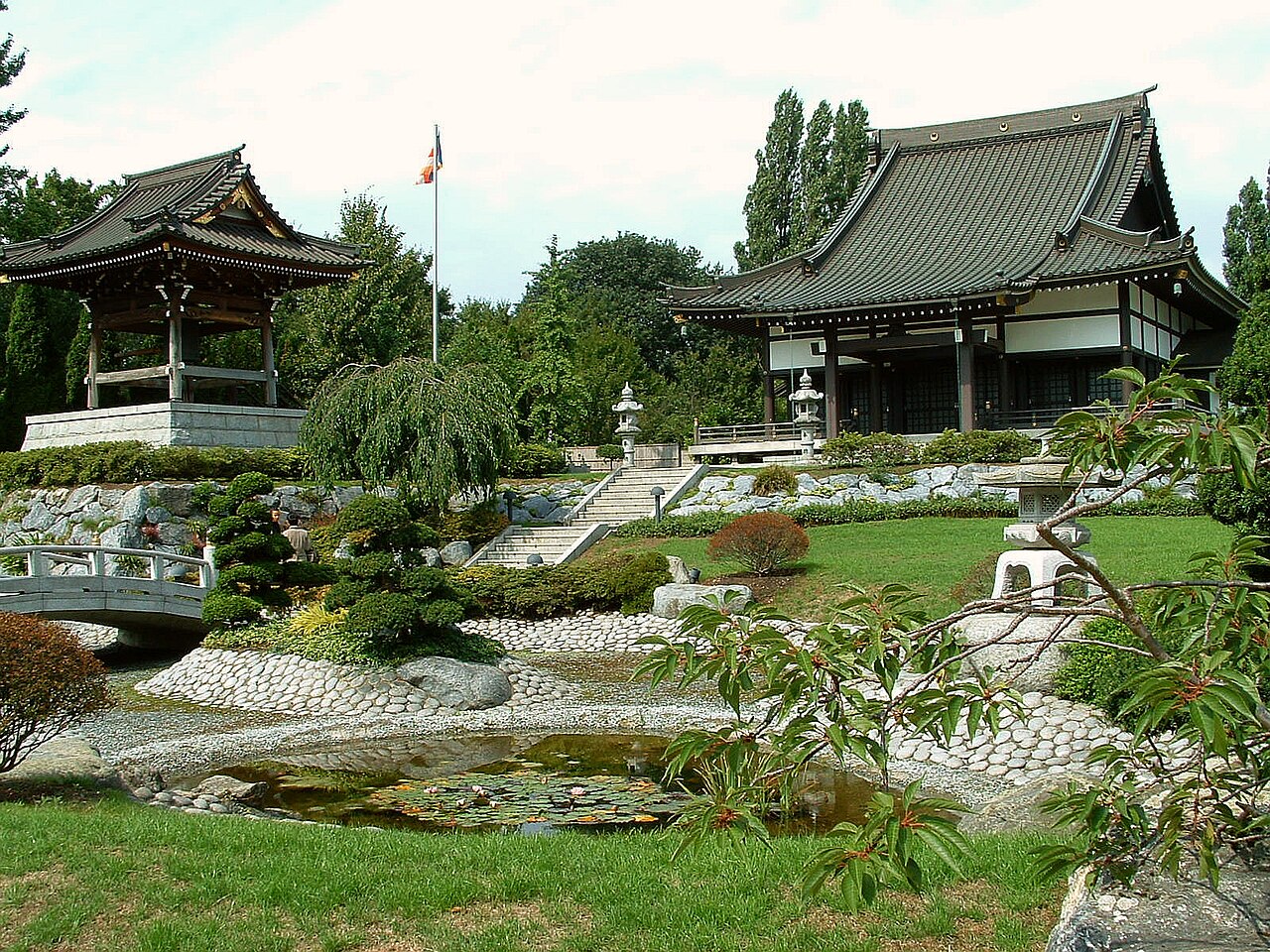
EKO House of Japanese Culture
Photo: Gakuro / CC BY-SA 3.0, modified.
Overview
The EKŌ House of Japanese Culture in Düsseldorf is a Japanese Buddhist and cultural centre containing the EKŌ Temple, a traditional Japanese house with tea room, exhibition and seminar spaces, and Japanese gardens. Nodaigarden lists the site as a Japanese cultural centre with a Buddhist temple, two Japanese gardens and a Japanese house with tea room. The centre opened in 1993 and is one of Düsseldorf’s major Japanese cultural institutions.
History
The EKŌ House project originated with Yehan Numata, founder of Mitutoyo Corporation and the Numata Foundation / BDK. Nodaigarden states that Numata decided in April 1988 to establish the German “EKŌ” Japanese Cultural Centre in Düsseldorf. Garden planning began in 1992. After the Floriade 1992 in the Netherlands, materials from the Japanese garden exhibited there and from a tree garden exhibited by Kawaguchi City were transferred and reused in the construction of the EKŌ House gardens.
The centre opened in 1993 in Düsseldorf-Niederkassel, serving both the Japanese community and wider German-Japanese cultural exchange. It includes a Jōdo Shinshū Buddhist temple, cultural and educational spaces, a traditional Japanese house and gardens. The official EKŌ House site describes the temple, Japanese house and gardens as an integrated architectural and garden ensemble, while visitor information confirms present access arrangements for the front Temple Garden and interior areas.
The front Temple Garden is described by EKŌ House as a Pure Land type garden and a ritual place. It is entered through the Mountain Gate / Triple Gate, donated in 1995, and the path leads past a purification basin toward the temple. A later sculptural addition is the statue of Prince Shōtoku, donated in 2002 by sculptor Nagaoka Wakei.
Design features
The main Temple Garden is a dry Pure Land garden. EKŌ House describes the waterfall, stream course, pool and stream banks as represented entirely by stones, although the “water” area can be flooded for special occasions. The garden path, purification basin, Mountain Gate, temple axis and memorial features connect the garden directly with the Buddhist ritual and architectural programme of the centre.
Garden elements
Bridges
Buildings
Enclosures
Waters and islands
Stones
Other elements
Current status
Extant temple and cultural-centre gardens at the EKŌ House in Düsseldorf. The front Temple Garden is freely accessible during stated opening hours; interior rooms and guided visits require admission or advance arrangement.