
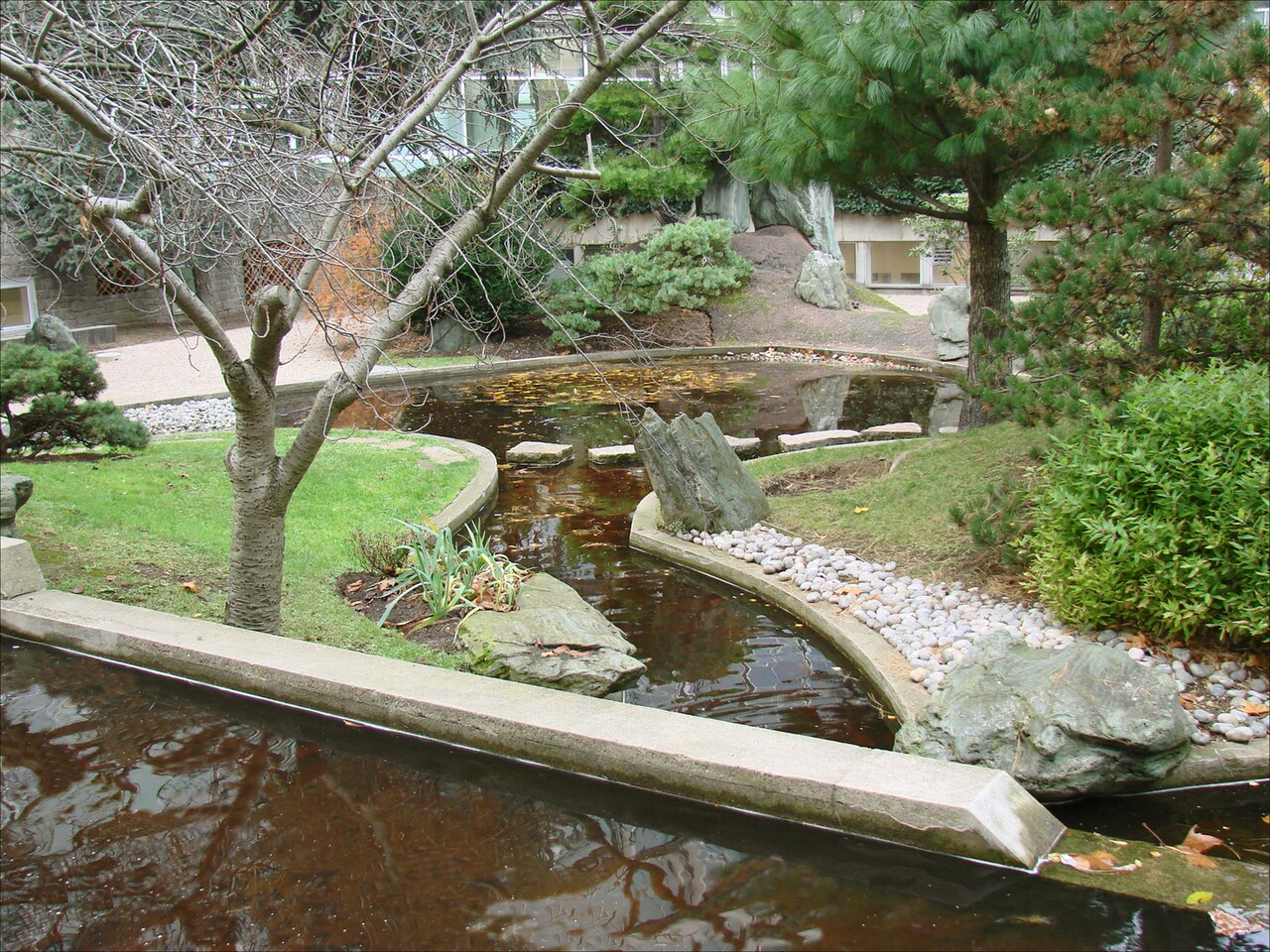
Garden of Peace, Unesco HQ
Photo: Jean-Pierre Dalbéra / CC BY 2.0, modified.
Overview
The Japanese Peace Garden, also known as the Garden of Peace, is a Japanese garden at UNESCO Headquarters in Paris. It was designed by Isamu Noguchi, one of the most important Japanese-American sculptors of the twentieth century. UNESCO describes the garden as created in 1957, while UNESCO historical material and Noguchi-related documentation also connect it with completion and presentation in 1958.
History
The garden was donated by the Government of Japan to UNESCO as a symbolic peace garden in the post-war period. It was designed by Noguchi in a modern Japanese idiom rather than as a purely traditional garden. The garden was installed with the help of Japanese gardener Toemon Sano, and it became one of Noguchi’s first major public landscape works. UNESCO reported in 2025 that restoration work had been underway since 2024 to bring the garden back toward its original condition.
Design features
The garden combines Japanese garden elements with Noguchi’s sculptural modernism. It includes organic paths, ponds, arched bridges, rock compositions, stepping stones and a dry-garden / kare-sansui corner. UNESCO’s digitised “Garden of Peace” material records the Japanese inscription for “Peace,” while later descriptions emphasise the garden’s gentle slopes, ponds and bridges.
Garden elements
Bridges
Waters and islands
Stones
Current status
Extant modern Japanese garden / peace garden within the UNESCO Headquarters complex in Paris. The garden was created by Japanese-American sculptor Isamu Noguchi in 1957–1958 as a gift from the Government of Japan to UNESCO. It has been undergoing a major restoration since 2024, with Japanese gardening experts working to restore the planting and landscape while respecting Noguchi’s original design. A restoration milestone and ceremony were reported in September 2025. The garden remains part of UNESCO’s headquarters landscape and is accessible through UNESCO visitor access / guided visit context rather than as a normal public park.