
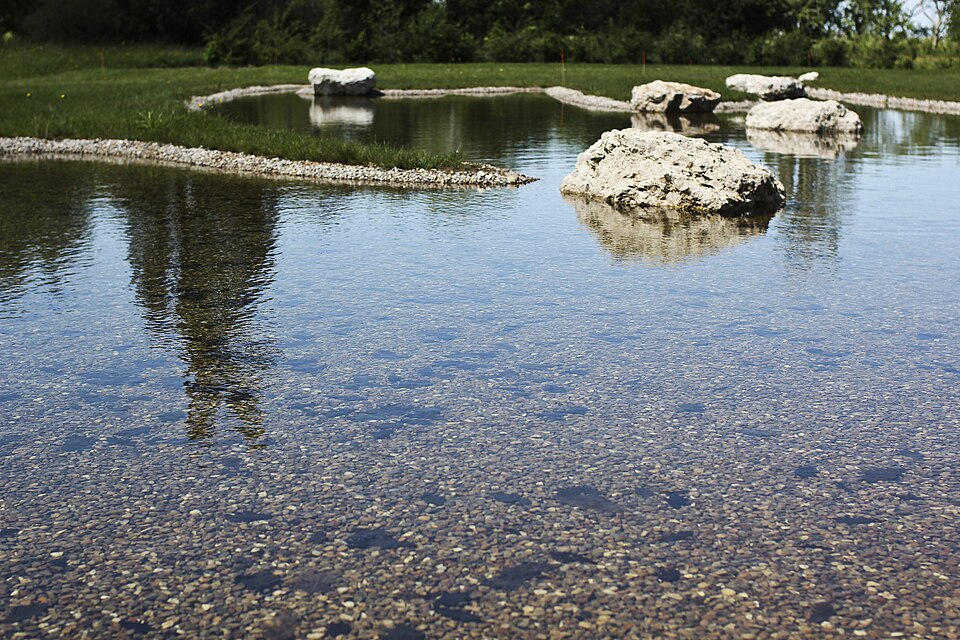
Domaine de Chaumont-sur-Loire
Photo: Sarah Wattouat / CC BY 3.0. modified.
Overview
The Japanese Gardens are a group of permanent contemporary gardens in the Prés du Goualoup at the Domaine de Chaumont-sur-Loire. Centred on L’Archipel, a work by Japanese landscape architect Shodo Suzuki, the composition uses reflective pools, polished black stones, planted banks and circular paths to evoke the islands of Japan. The original concept was expanded by Fumiaki Takano and completed by Hiroshi Naruse, creating a unified water landscape intended for quiet observation and gradual exploration.
History
The origins of the garden lie in L’Archipel, which Shodo Suzuki originally designed for the 1993 International Garden Festival of Chaumont-sur-Loire. The work represented the Japanese archipelago through fragmented groups of dark stone and was subsequently selected for permanent reinterpretation in the newly developed Prés du Goualoup, an area created from 2012 to accommodate lasting gardens associated with major international garden cultures.
The permanent version of L’Archipel was created in 2013. It is regarded by the Domaine as Shodo Suzuki’s only garden realised outside Japan. In the reconstructed composition, polished black stones representing the islands of Japan were placed directly in water, fulfilling an element of Suzuki’s original concept that could not be fully realised in the temporary festival garden.
Japanese landscape architect Fumiaki Takano subsequently designed a larger circular landscape around Suzuki’s central work. His extension enclosed the original archipelago and approximately tripled the area of reflective water. The ensemble was completed in 2015 by architect and landscape designer Hiroshi Naruse. The Domaine therefore presents it not as a single untouched composition, but as a collaboratively developed group of contemporary Japanese gardens.
Design features
At the centre of the garden, groups of smooth black stones rise from shallow water to represent the islands of the Japanese archipelago. Some stones appear split into several sections, introducing ideas of separation, fragility and renewal. Their dark surfaces contrast with the sky reflected in the surrounding pools, shifting attention between solid material and changing light.
The circular form surrounding the stone islands refers to satori, the Buddhist idea of awakening, and also expresses a wish for peace. Water replaces the raked gravel traditionally associated with a dry Zen composition, transforming the abstract stone landscape into a reflective water garden. The pools mirror clouds and vegetation, making atmospheric change an active part of the design.
Fumiaki Takano’s surrounding design expands the landscape through additional water surfaces, planted edges and a circular visitor route. The original work remains the contemplative centre, while the later composition allows visitors to experience it from several angles and distances. Restrained planting softens the water margins without competing with the stones and reflections.
The garden is deliberately contemporary rather than a reconstruction of a historic temple, tea or strolling garden. Its design interprets Japanese ideas of islands, water, emptiness, transience and meditation through abstract land art and modern landscape architecture.
Garden elements
Stones
Current status
The Japanese Gardens remain maintained as permanent landscapes within the Prés du Goualoup and are included in visits to the Domaine de Chaumont-sur-Loire. The gardens continue to mature and change with the seasons, as intended by their designers.