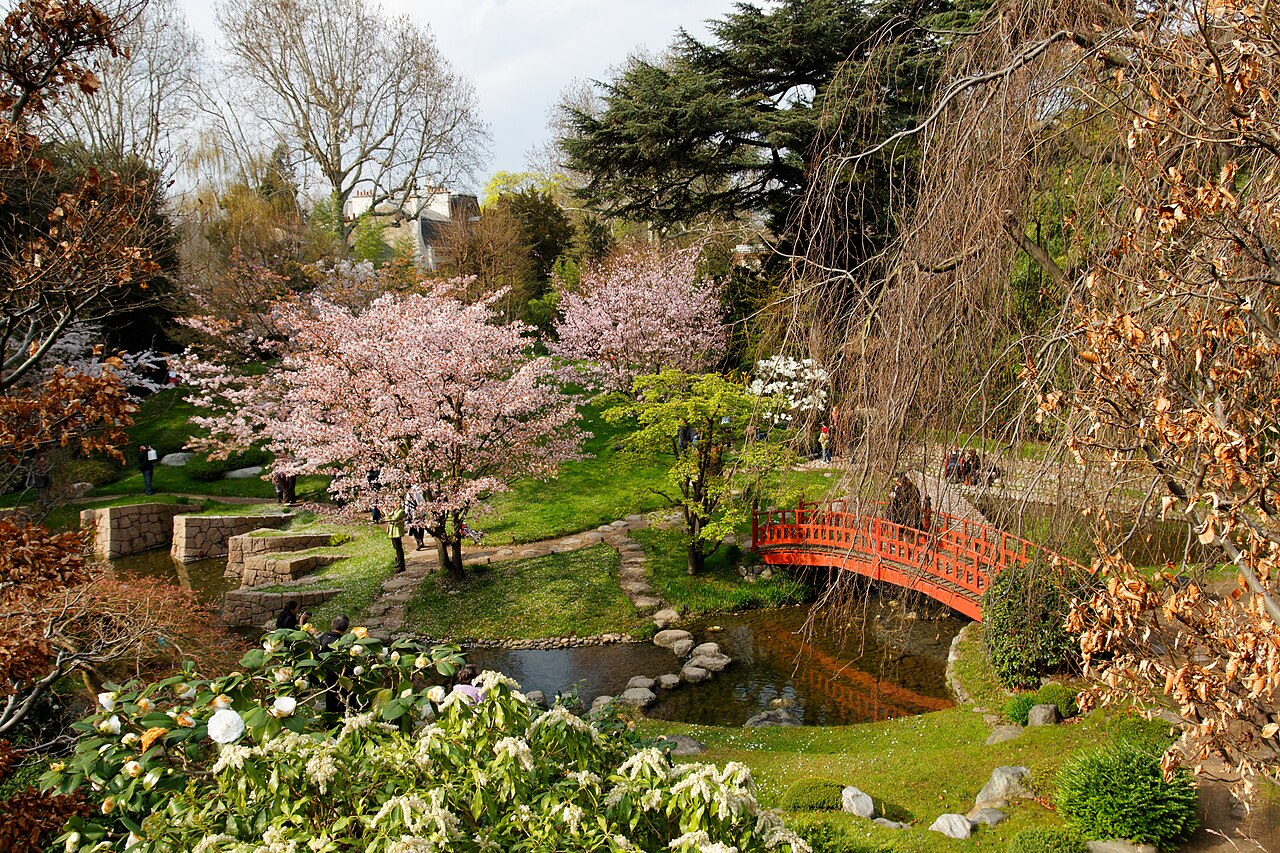
Albert Kahn Japanese Garden
Photo: Apostoly / CC BY-SA 3.0, modified.
Overview
The Albert Kahn Japanese Garden is part of the gardens of the Musée départemental Albert-Kahn in Boulogne-Billancourt, near Paris, France. The site contains both a traditional Japanese village and garden area (1897) linked to Albert Kahn’s original early twentieth-century landscape, and a contemporary Japanese garden created in 1990 by Japanese landscape designer Fumiaki Takano. Together they form one of the most important Japanese garden ensembles in France, within Kahn’s broader “garden of scenes” representing different landscape traditions.
History
The original Japanese garden developed in two main phases. After travelling to Japan, Kahn created a Japanese village from 1897, with buildings constructed by Japanese carpenters brought to France for the project. A second Japanese-inspired section, often described as a sanctuary, was added in 1908–1909. These elements combined architecture, water, planting and symbolic landscape references, creating not a simple decorative garden, but an immersive evocation of Japan within a Parisian suburban setting.
Much of the original Japanese composition was later altered or lost, but the Japanese identity of the site remained central. Between 1988 and 1990, a new contemporary Japanese garden was created by the Japanese landscape designer Fumiaki Takano. This garden reinterprets Kahn’s life and ideals through water, bridges, stones and planting, rather than attempting a straightforward historical reconstruction. It should therefore be understood as a layered site: part surviving historic Japanese village, part lost early twentieth-century garden, and part late twentieth-century contemporary Japanese garden.
Design features
The Japanese ensemble includes a traditional Japanese village area and a contemporary Japanese strolling garden. The contemporary garden by Fumiaki Takano reuses and reinterprets elements from Kahn’s earlier Japanese garden, including bridges, a weeping beech and a Himalayan cedar. It is designed as a symbolic landscape evoking the life and work of Albert Kahn, with water movement through the garden representing his life journey. Current visitor descriptions also identify the Japanese garden as the highlight of the route through the wider garden, combining traditional and contemporary Japanese references.
Garden elements
Bridges
Buildings
Enclosures
Waters and islands
Stones
Other elements
Current status
The Japanese Garden remains part of the Musée départemental Albert-Kahn and is open to visitors as part of the museum gardens. The wider site includes around four hectares of gardens and a museum building redesigned by Kengo Kuma, whose architecture also reflects Kahn’s connection with Japan. The gardens are managed as a departmental museum site in Hauts-de-Seine. (2026)