
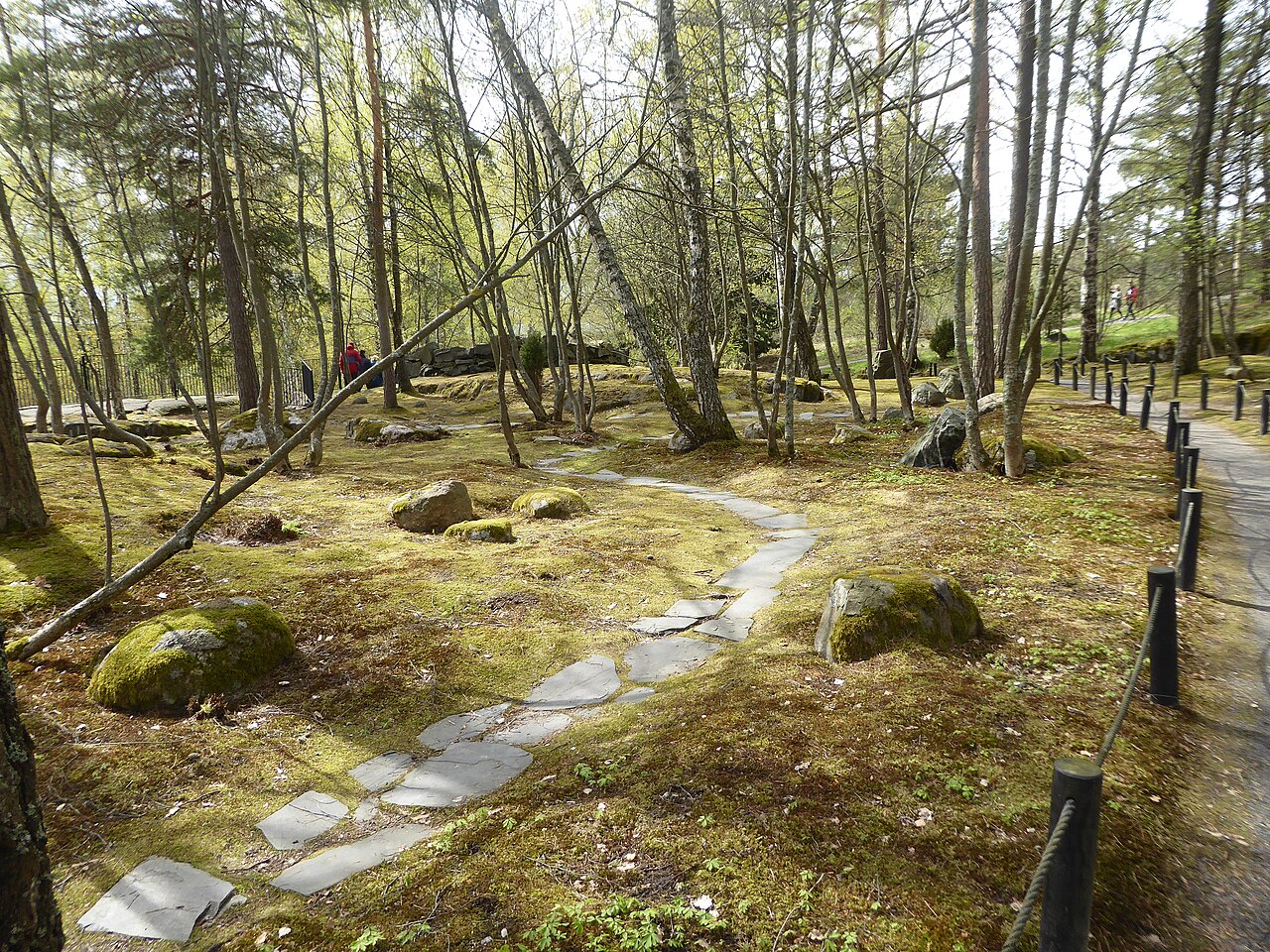
Japan-Inspired Garden in Roihuvuori
Photo: Nemo bis / CC BY-SA 3.0, modified.
Overview
The Japan-Inspired Garden in Roihuvuori is a public Japanese-influenced garden in eastern Helsinki, located on a terraced slope between apartment blocks at Roihuvuorentie 12–16. MyHelsinki describes it as a nearly one-hectare oriental garden created mostly by hand on the site of a former slate quarry, with a moon gate, bamboo fences, shingle shelters, stone arrangements, sand waves and a rocky stream symbolising the “sea of life.”
History
The garden was designed and built between 1992 and 1998, largely through volunteer work, and received Finland’s Vuoden ympäristörakenne 1998 / Environmental Structure of the Year award when completed. Wikimedia Commons gives the construction period as 1992–1998 and notes that the garden was built mostly by volunteers; the Finnish Wikipedia infobox gives 1998 as the establishment date and names Kaisu Ilonen, Jukka Toivonen and Virve Veisterä as designers.
The Roihuvuori garden should be kept separate from the nearby Roihuvuori Cherry Park / Kirsikkapuisto, which began later, when the first 52 cherry trees were planted in 2007 and expanded into a larger sakura / hanami landscape. Helsinki’s own park information treats the Cherry Park and the Japan-inspired garden as two neighbouring but distinct sites, both important to Roihuvuori’s “Little Japan” identity.
Local Roihuvuori material explains that the project was first referred to as a Japanese park, but the name was later changed to Japan-inspired garden to make clear that it was not intended as an exact traditional Japanese garden. The garden is organised into four symbolic sections: Pienen sinisen lohikäärmeen puutarha / Little Blue Dragon Garden, Punaisen fenixlinnun puutarha / Red Phoenix Garden, Valkoisen tiikerin puutarha / White Tiger Garden, and Mustan kilpikonnan puistometsä / Black Turtle park woodland.
Design features
The garden uses a terraced former quarry slope to create a symbolic Japanese-inspired landscape. Its main elements include a moon gate, bamboo fences, shingle-roofed shelters, stone compositions, sand-wave patterns, a rocky stream, cherry trees and symbolic animal-themed sections based on East Asian directional mythology. Because the garden explicitly presents itself as Japan-inspired rather than as a strict traditional Japanese garden, it is best classified as a modern hybrid public garden rather than a formal stroll garden or dry garden.
Garden elements
Bridges
Buildings
Enclosures
Waters and islands
Stones
Current status
Extant public Japan-inspired garden in Roihuvuori, close to the Roihuvuori Cherry Park. It remains freely accessible and is maintained as one of Helsinki’s recognised Japanese-inspired public landscapes.