
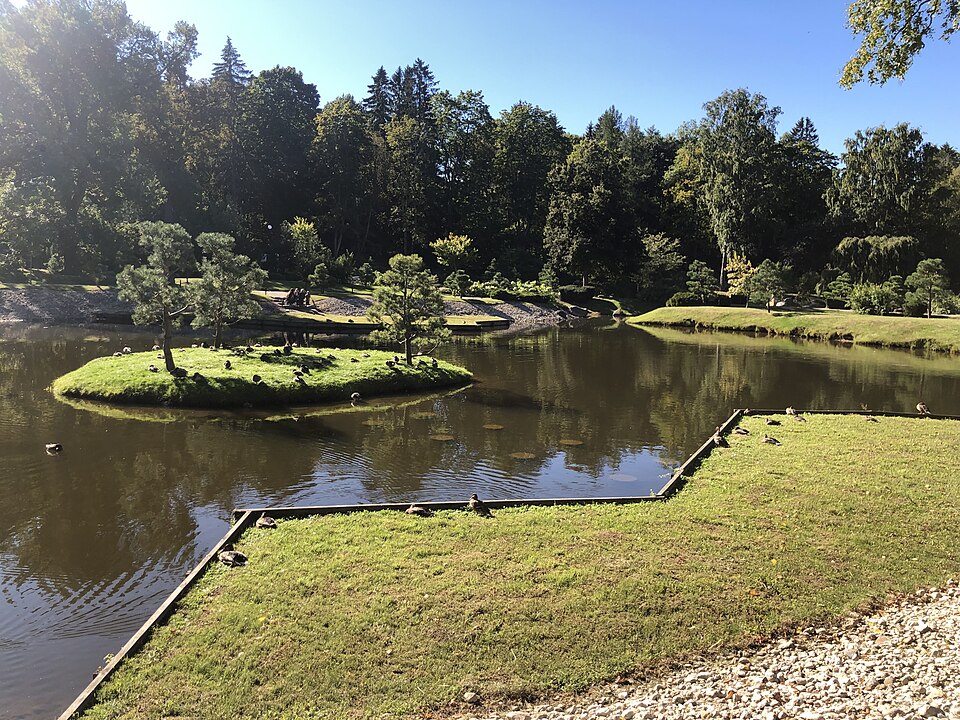
Kadriorg Park
Photo: HartOve / CC BY-SA 4.0. modified.
Overview
The Japanese Garden in Kadriorg Park is a large pond-centred landscape garden in Tallinn, Estonia. Designed by Japanese landscape architect Masao Sone, it opened in 2011 around the park’s north-eastern pond, known as Kirdetiik. The garden combines ponds, a waterfall, stone bridges, paths, carefully positioned boulders and seasonal planting within a route conceived as a slow journey through changing landscape scenes.
History
Preparatory work for the garden began in 2009, followed by the main construction phase in 2010–2011. The project formed part of the long-term restoration and development of Kadriorg Park under the municipal park authority. The first phase of the garden was formally opened on 31 July 2011.
The design was prepared by Masao Sone, a Kyoto-based Japanese landscape architect and garden specialist. Sone and his Japanese team also participated in the construction, including the difficult placement of stones and the assembly of bridges manufactured in Japan.
The garden was conceived as an evolving landscape rather than a composition completed permanently at its opening. Later plans included additional gates, bridges, a pavilion and a tea-ceremony room, although not all proposed elements had been realised by 2019.
Design features
The garden uses the existing pond, limestone slope, mature trees, boulders and waterfall as the basis of its composition. Visitors follow curving paths across stone bridges and around the water, encountering a sequence of changing views. This deliberate progression through the landscape gives the garden the structure of a strolling garden.
Stone and water are treated as equally important to planting. Sone arranged upright stones to recall the church towers of Tallinn’s Old Town, while flatter stones evoke its pitched and gabled rooftops. The stone bridges were produced in Japan and reassembled on site.
The planting was originally intended to consist entirely of Japanese species, but Tallinn’s cold winters required some sensitive plants to be replaced with more resilient alternatives. Seasonal features include flowering cherries in spring, rhododendrons in early summer, irises in midsummer and colourful maples in autumn. Municipal records document the planting of 868 rhododendrons and azaleas and approximately 5,000 irises around the pond.
The garden’s underlying theme is the cycle of life and the expressiveness of nature. It was designed as a quiet environment for slow walking, contemplation and observing seasonal change rather than for sport or active recreation.
Garden elements
Bridges
Waters and islands
Stones
Other elements
Current status
The garden remains maintained as a specialised landscape within Kadriorg Park and is freely accessible during its opening periods. Cycling, sports and walking dogs are prohibited within the Japanese Garden, and access may be restricted during winter.