
Overview
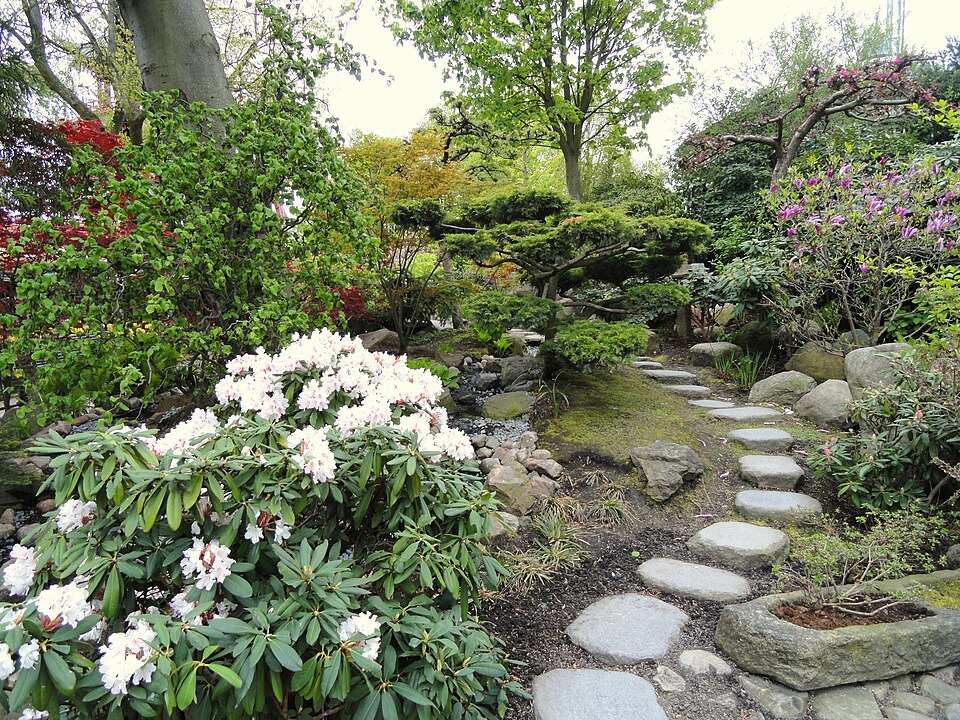
The Japanese Garden is a compact landscaped section within Tivoli Gardens in central Copenhagen. Created in 2010, it was designed by Danish Japanese-garden specialist Peter Dalsgaard together with Jagro. The garden combines a circulating path, stone steps, clipped shrubs, sculpturally trained trees and seasonal planting within the dense ornamental landscape of the historic amusement park. Its route-based composition and succession of changing views give it the character of a small strolling garden.
History
Tivoli Gardens opened in 1843 and has long combined amusement facilities with ornamental gardens, exotic architecture and theatrical interpretations of distant cultures. Japanese and broader East Asian imagery had already appeared in Tivoli before the present garden, most notably in the illuminated pagoda designed by Knud Arne Petersen in 1900, whose architecture blends Japanese and Chinese references.
The present Japanese Garden was completed in 2010. According to the Nodaigarden database, it was designed by Peter Dalsgaard and Jagro as one of the numerous small gardens distributed throughout Tivoli. Dalsgaard is a Danish landscape gardener and garden designer specialising in historical Japanese gardens, with professional study and practical experience in Japan.
Published documentation does not identify a separate ceremonial opening, construction team or detailed development programme. The garden appears to have been created as part of Tivoli’s continuing renewal of its planted landscapes rather than as an independent diplomatic or exhibition project.
Design features
The garden is organised around a walkable route with stone steps, allowing visitors to pass through the planting rather than view it solely from a fixed position. Clipped shrubs and stylised trees provide its principal sculptural forms, adapting Japanese pruning aesthetics to the limited space and intensive visitor environment of Tivoli.
Flowering cherry trees provide a strong seasonal feature during spring, while the surrounding water, paths and ornamental planting connect the garden visually with Tivoli’s wider lakeside landscape. The composition is relatively small and forms one garden episode within the amusement park rather than an enclosed, self-contained Japanese landscape.
The garden’s design is best understood as a compact contemporary strolling garden adapted to a commercial entertainment setting. Its Japanese character is conveyed primarily through spatial sequencing, trained vegetation, stonework and seasonal effects rather than through a complete reconstruction of a temple, tea or dry garden.
Garden elements
Buildings
Waters and islands
Stones
Other elements
Current status
The garden remains part of Tivoli Gardens and is accessible during the amusement park’s seasonal opening periods. Entry is included with admission to Tivoli.