
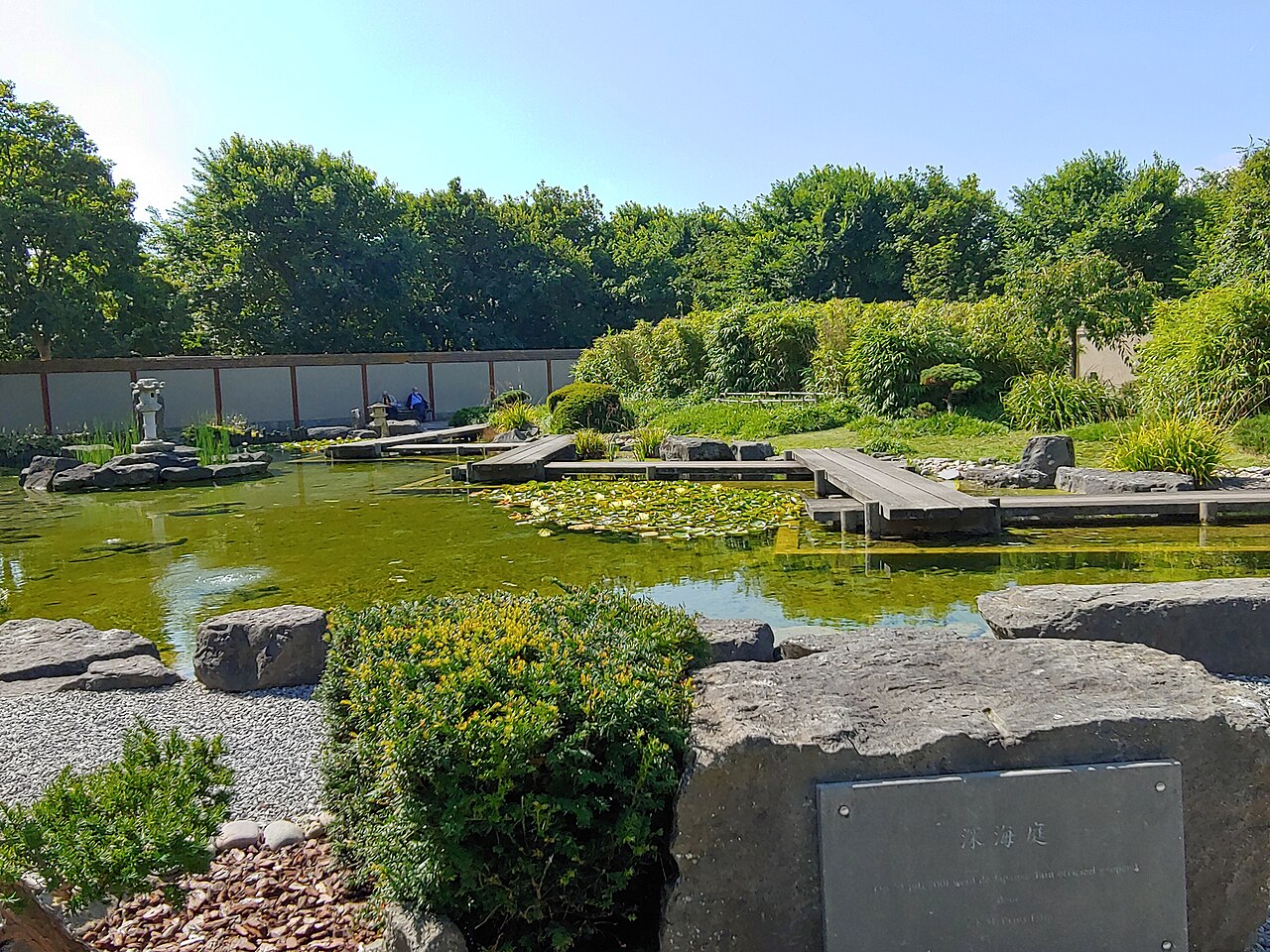
Shin Kai Tei
Photo: Jaronax (Jari Asselman) / CC BY-SA 4.0, modified.
Overview
Shin Kai Tei is a Japanese strolling garden in the Koningspark in Ostend, Belgium, designed by Japanese architect Takashi Sawano and opened in 2001. Created through cooperation between the City of Ostend and Daikin Europe, the approximately 2,500 m² garden symbolises the long-standing relationship between the Belgian coastal city and Japan. Its name, Shin Kai Tei, may be translated as “Deep Sea Garden”, referring both to the historical depth of the site and to the maritime character shared by Japan and Ostend.
History
The garden occupies part of the former grounds of the Royal Villa. The surrounding Koningspark originated as the private garden of the Belgian royal residence and was transformed into a public park in 1974. Shin Kai Tei was formally opened on 20 July 2001 in the presence of Prince Philippe of Belgium, later King Philippe. The inauguration included a Shinto ceremony. The project was developed in cooperation between the City of Ostend and Daikin Europe and was intended to express the close relationship between the city and the Japanese company, whose European presence in Ostend dates from the early 1970s.
Design features
The garden is conceived as a kaiyū-shiki, or strolling garden, in which changing views are revealed as the visitor moves through the landscape. A dry garden of rocks and stones precedes the main enclosure, marking the transition into the garden. At its centre lies a turtle-shaped pond, the turtle symbolising longevity and durability. Water flows symbolically from east to west, while rocks emerging from the pond represent obstacles encountered along the path of life. Paths and stepping stones lead through a sequence of miniature landscapes including hills, a bamboo grove and an azumaya summer pavilion. Other Japanese elements include wisteria, stone lanterns, a stone pagoda and a Buddha figure.
The design combines Japanese strolling-garden principles with a deliberately symbolic interpretation of the site. The garden’s reference to the sea links Japan as an island nation with Ostend as a North Sea city, while its position within the former royal grounds connects the new Japanese landscape with the historical layers of the site.
Garden elements
Bridges
Buildings
Enclosures
Waters and islands
Stones
Other elements
Current status
Maintained and open to the public.