
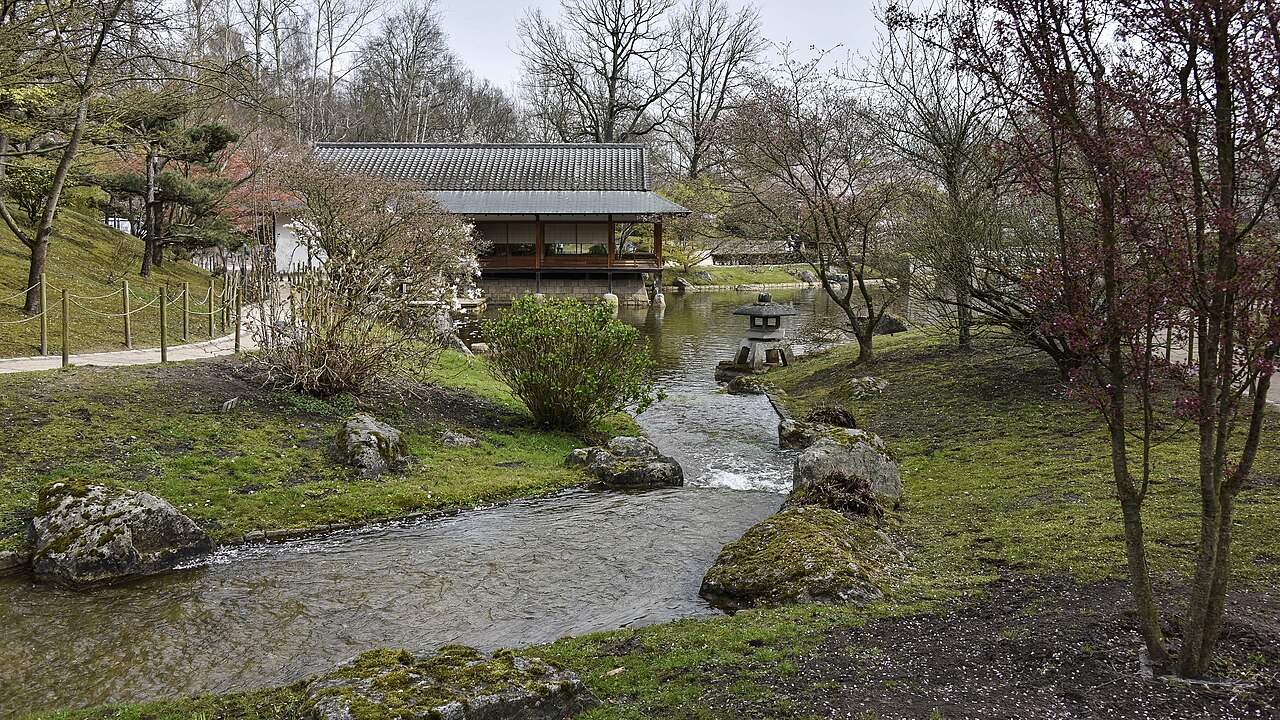
Japanese Garden, Hasselt
Photo: Paul Hermans / CC BY-SA 4.0, modified.
Overview
The Japanese Garden in Hasselt is a large Japanese garden created as a symbol of friendship between Hasselt and its Japanese sister city Itami. The Embassy of Japan in Belgium states that the garden was constructed in 1992 with the technical cooperation of Itami, and describes it as one of the largest Japanese gardens in Europe and a symbol of sister-city exchange. Nodaigarden records the site as Japanese Garden in Hasselt, gives the area as 25,490 m², and identifies it as a full-scale Japanese garden in Belgium.
History
Hasselt and Itami established their sister-city relationship in 1985. As part of the exchange, Hasselt gave Itami a carillon tower, while Itami offered to create a Japanese garden in Hasselt. The garden was built in the early 1990s and opened to the public on 20 November 1992. Belgian government cultural material published for the garden’s 25th anniversary records the opening date and describes the project as a major symbol of the Hasselt–Itami relationship.
The garden was realised with strong Japanese technical involvement. Nodaigarden notes that most of the construction work was carried out by people from Hasselt, while the stone arrangements were installed by Inoue Takuyuki and members of the Itami Garden Association. The Embassy of Japan in Belgium also emphasises Itami’s technical cooperation and later recognised the garden’s role in promoting Japanese culture in Belgium with the Foreign Minister’s Commendation in 2017, during the garden’s 25th anniversary ceremony.
The garden continues to function both as a public visitor garden and as a Japanese cultural venue. It hosts seasonal events such as cherry-blossom viewing, Children’s Day and Tanabata, and Visit Limburg describes it as a place for walking, contemplation, koi viewing and Japanese cultural experience.
Design features
The garden is a large pond-strolling composition with waterfalls, streams, koi ponds, bridges, stepping stones, stone lanterns, a tea house and ceremonial buildings. Nodaigarden specifically notes the importance of the stone arrangements by Inoue Takuyuki and the Itami Garden Association. Other descriptions record its 17th-century Japanese garden inspiration, cherry trees, waterfalls, koi and ceremonial / tea-house architecture.
Garden elements
Bridges
Buildings
Enclosures
Waters and islands
Stones
Shinto elements
Other elements
Current status
Extant public Japanese garden in Hasselt. It remains one of the largest Japanese gardens in Europe and is open seasonally as a ticketed visitor garden.