
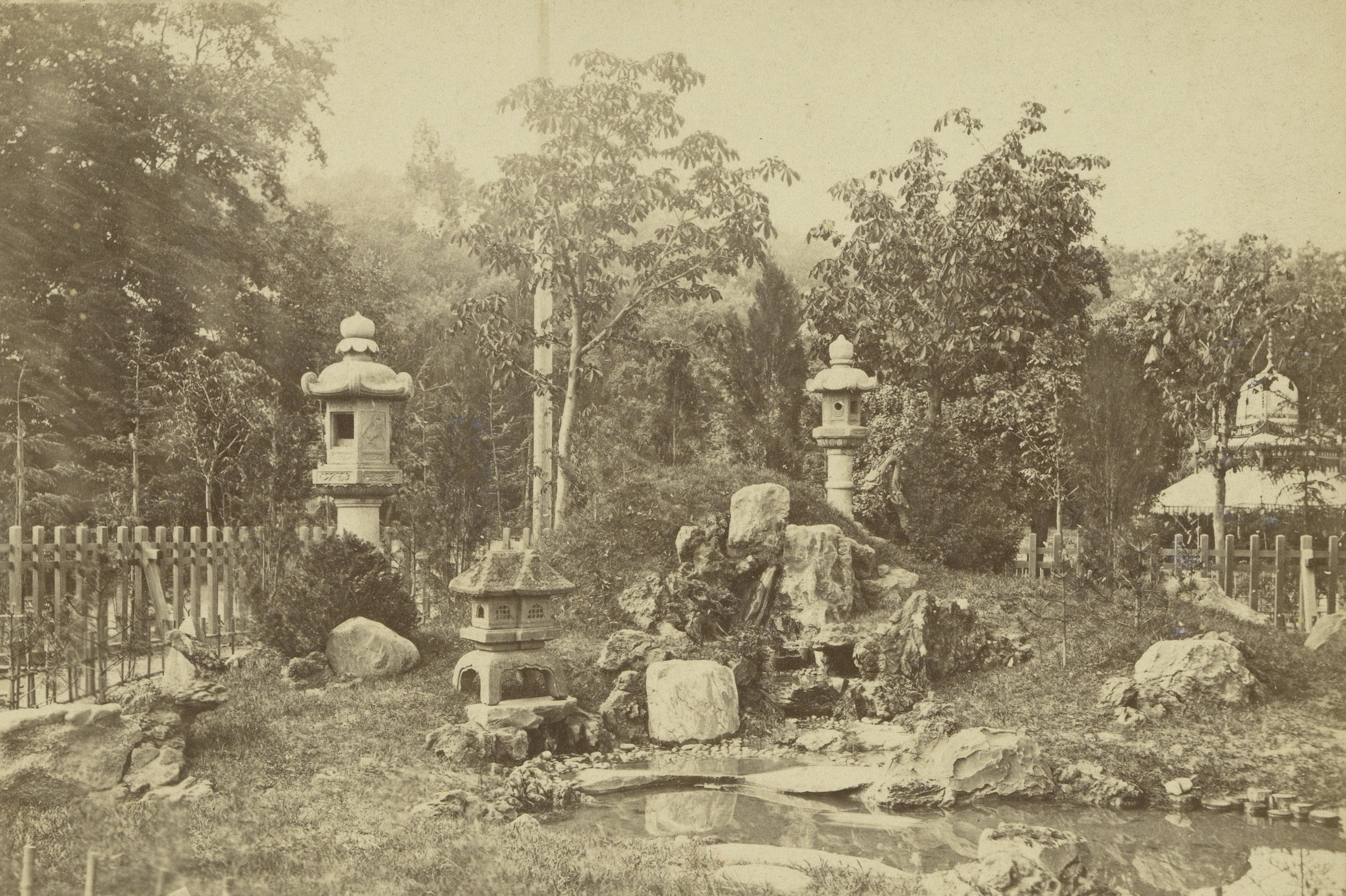
World Exhibition 1873
Photo: Oscar Kramer / Wien Museum Online Collection / CC0, modified.
Overview
The Japanese Garden at the Vienna World Exhibition of 1873 was a temporary exhibition garden built for Japan’s official participation in the Vienna International Exposition, held in the Prater, Vienna, Austria. It was one of the earliest documented Japanese gardens constructed outside Japan and played an important role in introducing Japanese garden aesthetics to a European public. The Japanese government built a large display area of about 1,300 tsubo, including a Shinto shrine, a white wooden gate and a Japanese garden.
History
The Vienna International Exposition of 1873 was the first international exposition in which the modern Meiji Japanese government officially participated. Japan used the exhibition to present itself internationally through art, craft, architecture and garden culture. The Japanese display included a recreated Japanese garden with a shrine, and the garden was visited by the Emperor and Empress of Austria. After the exhibition, the Japanese buildings, trees and stones were reportedly purchased by the Alexandra Park Company and transferred to Alexandra Palace in London, where they became part of one of the first Japanese-designed garden displays seen in Britain.
Design features
The garden formed part of the Japanese exhibition area and included a white wooden entrance gate, a Shinto shrine, a traditional music and dance hall and an arched bridge. Contemporary photographic records identify it as the “Japanese Garden” or “Garten der Japanesen” at the Vienna World’s Fair. The garden was designed as an exhibition landscape rather than a permanent public garden, combining garden, architecture and cultural display to represent Japan abroad.
Garden elements
Bridges
Enclosures
Waters and islands
Stones
Shinto elements
Other elements
Current status
The original garden no longer exists at the Vienna exhibition site. The 1873 World Exhibition itself was temporary, and the Japanese garden was an exhibition installation. Some garden materials and buildings were reportedly moved to Alexandra Palace after the fair, but the Vienna garden should be recorded as a former temporary exhibition garden, not as a surviving garden in Vienna.