
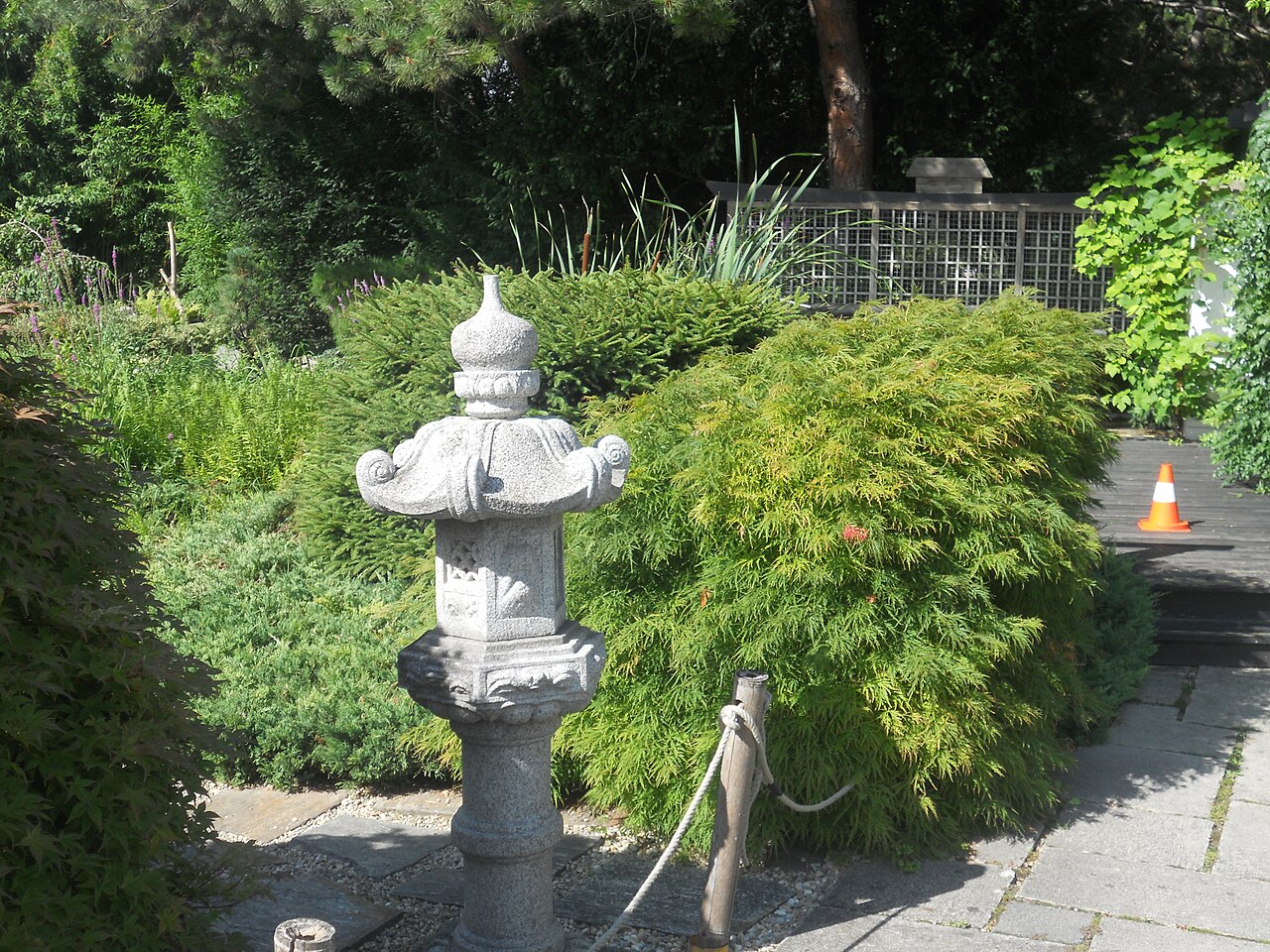
The Franz-Karl-Effenberg Garden of Asia
Photo: Clemens Mosch / CC BY-SA 4.0, modified.
Overview
The Franz-Karl-Effenberg Garden of Asia is an East Asian-inspired teaching garden within the Kagran School Gardens in Vienna. Established in 2000, it introduces students and visitors to plants and design elements associated with East Asian garden culture. The composition combines a viewing garden with a pond garden, incorporating water, stone, clipped trees and architectural features within a compact educational setting.
History
The garden was created in 2000 as one of the thematic gardens of the Schulgarten Kagran, which serves as the practical training ground of Vienna’s vocational school for horticulture and floristry. Its purpose is primarily educational, allowing trainee gardeners to study both the characteristic planting and selected design principles of East Asian gardens.
The garden is named after Franz-Karl Effenberg, a Viennese politician and district mayor of Donaustadt from 1998 until 2005. Effenberg was active in environmental and horticultural matters, including the protection of the Danube wetlands and the interests of Vienna’s allotment gardeners. The available official garden documentation does not identify an individual designer.
Design features
The garden is divided into two principal sections: a viewing garden and a pond garden. The viewing garden is not intended to be entered; it is designed for meditation and the contemplation of nature and garden art. The adjoining pond garden contains a waterfall, bubbling source stone, stream, pond and stone lantern. Both sections are viewed from a wooden platform sheltered by a pergola.
The planting represents the temperate flora of East Asia and includes Japanese maples, bamboo, flowering cherry trees and ferns. Pines and junipers are trained into large bonsai-like or niwaki-style forms, giving the garden a more mature and sculptural appearance. Additional features include a traditional-style bamboo deer scarer, stone arrangements and planted pond margins.
Garden elements
Enclosures
Waters and islands
Stones
Shinto elements
Other elements
Current status
The garden remains maintained as a thematic and educational garden within the Schulgarten Kagran. Public access is restricted to designated open days between April and October, while organised group visits may be arranged separately.